

For system integrators, electrical engineers, and procurement teams in the power monitoring and energy metering industry, the current sense transformer is not a commodity—it is the component that determines measurement accuracy, power quality analysis capability, and regulatory compliance. A transformer with poor phase linearity or inconsistent ratio error can render an entire energy meter non-compliant with IEC 61869 standards, delaying product certification and market entry.
TPS Elektronik’s custom transformer winding service for miniature current sense transformers was engaged by an anonymous power monitoring equipment manufacturer to develop high accuracy transformers with excellent phase linearity for a next-generation energy meter platform—from prototype validation to volume production.
1. The Challenge: High Accuracy and Phase Linearity in Miniature Current Sense Transformers
The customer—a European power monitoring equipment manufacturer developing a next-generation revenue-grade energy meter—faced a critical component challenge. Their existing current sense transformers could not meet the combined requirements of high accuracy, excellent phase linearity, and the miniature form factor demanded by the new meter design.
Key requirements included:
- High accuracy: Class 0.1 or better per IEC 61869-2, with ratio error within ±0.1% across the measurement range
- Excellent phase linearity: Phase displacement within ±5 minutes over the rated current range, essential for accurate power factor and reactive energy measurement
- Miniature form factor: PCB-mountable design fitting within the meter’s compact enclosure
- Wide current range: Accurate measurement from 5% to 120% of rated current
- Temperature stability: Consistent accuracy across -40°C to +85°C operating temperature range
Phase linearity in current transformers is particularly challenging to achieve. Phase error arises from the transformer’s magnetizing current and the phase shift between primary and secondary currents. In miniature transformers with small core cross-sections, the magnetizing current as a percentage of rated current is larger than in full-size transformers, making phase error control difficult. For measurement grade current transformer applications, non-linear magnetization of the core material introduces additional phase errors that vary with primary current.
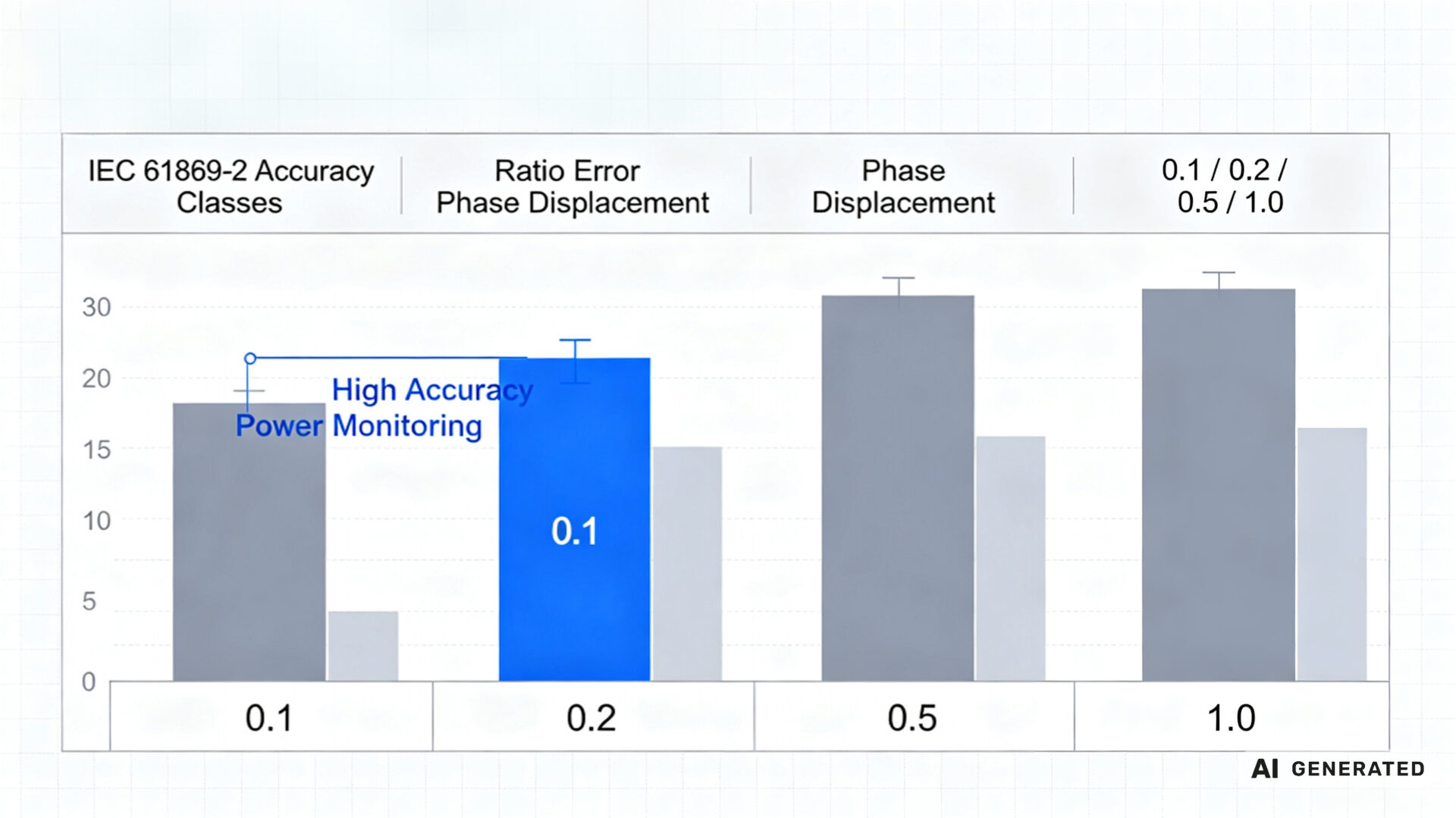
While accuracy classes from 0.1 to 1.0 are defined for standard power-frequency applications, miniature designs with small core cross-sections make phase error control particularly challenging. The customer had previously sourced transformers from two suppliers—neither could consistently achieve the required phase linearity across the full operating range, and one supplier’s components exhibited unacceptable batch-to-batch variation in ratio error.
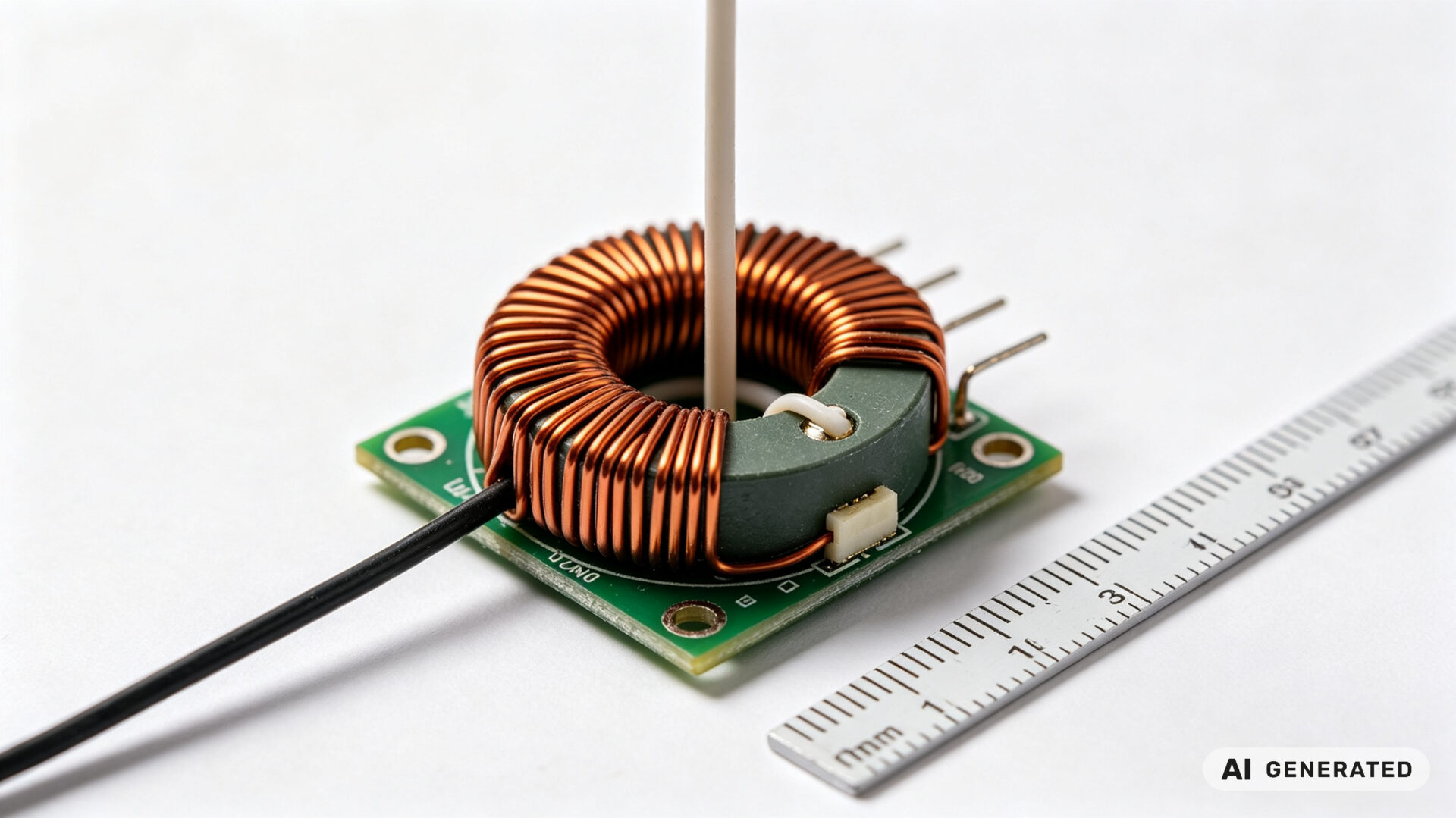
TPS Elektronik was engaged to develop a custom toroidal current transformer winding solution that would deliver Class 0.1 accuracy with excellent phase linearity in a miniature form factor.
2. The TPS Solution: Custom Toroidal Winding for Precision Current Sensing
TPS Elektronik’s approach combined precision toroidal winding with meticulous material selection and process control to deliver current sense transformers that met all customer requirements.
Core Material Selection:
The magnetic core material is the foundation of current transformer accuracy. TPS evaluated multiple core materials to achieve the required combination of high permeability, low coercivity, and linear B-H characteristics:
- Permalloy (80% Ni-Fe): High initial permeability and excellent linearity, achieving Class 0.1 accuracy
- Nanocrystalline material: High permeability with low losses, suitable for wideband applications
- Microcrystalline iron cores: Cost-effective alternative for applications with less demanding accuracy requirements
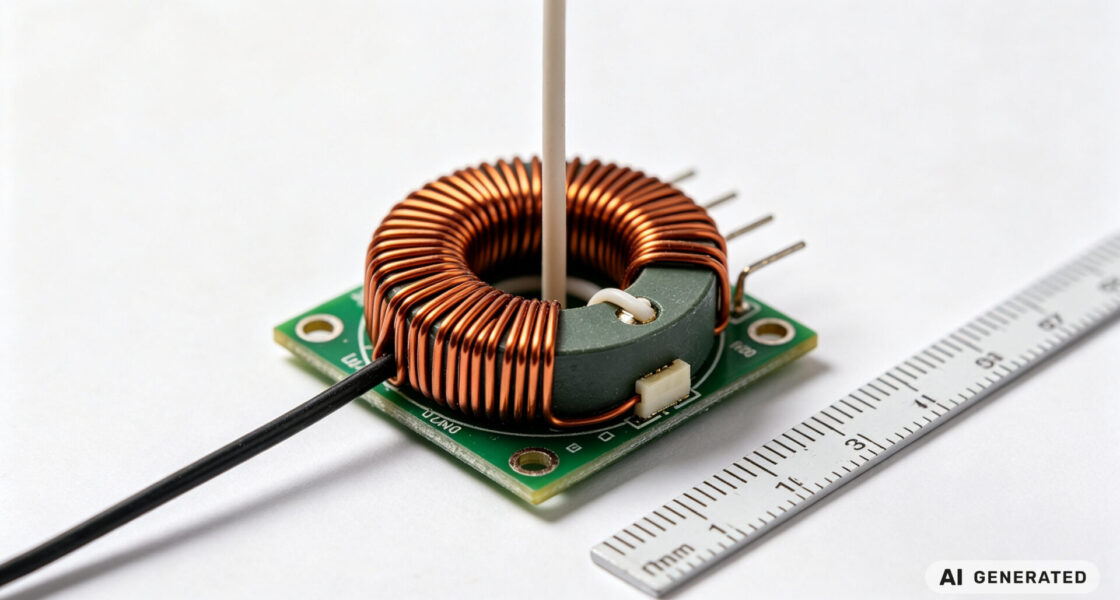
For this customer, permalloy cores were selected for their superior linearity and ability to achieve Class 0.1 accuracy in a miniature form factor. The core geometry was optimized to maximize the cross-sectional area within the PCB footprint constraints, reducing magnetizing current and improving phase error.
Winding Design:
- Secondary winding with precision turn count to achieve the required turns ratio
- Uniform winding distribution around the toroidal core to minimize leakage flux and improve linearity
- Insulated primary conductor passed through the core center for single-turn primary configuration
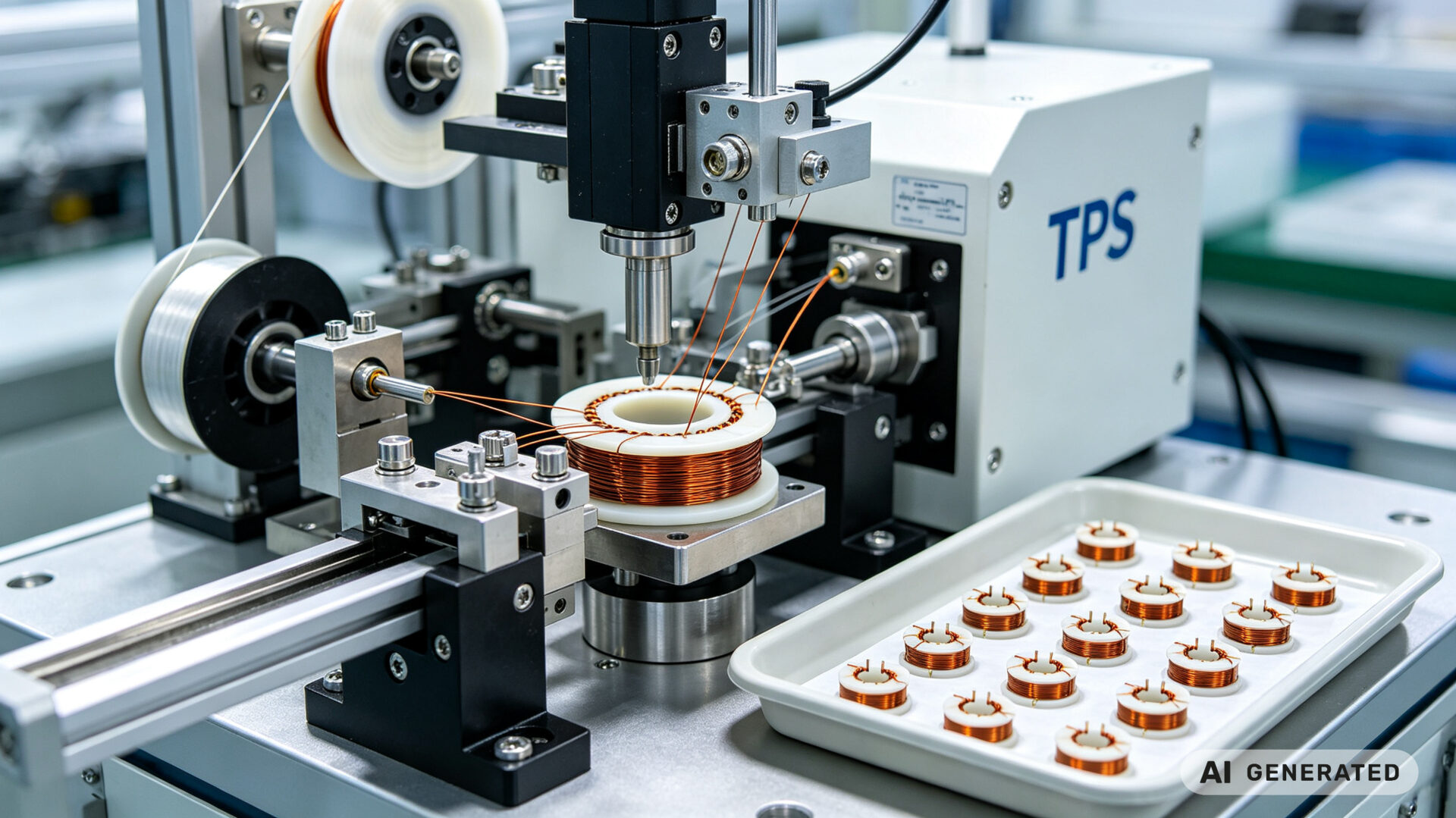
For miniature toroidal current transformer applications, the winding distribution around the core is critical. Uneven winding distribution creates non-uniform flux distribution in the core, leading to localized saturation and non-linear behavior. TPS’s automated winding machines ensure consistent, uniform winding distribution across every transformer.
3. Manufacturing Approach: Precision Toroidal Winding Process
TPS Elektronik’s custom transformer winding manufacturing process was designed to deliver consistent quality across prototype and production volumes, with full traceability and documentation.
Core Preparation:
- Permalloy cores are precision-ground to maintain consistent magnetic properties and dimensions
- Cores undergo stress-relief annealing to eliminate residual stresses that could affect permeability
- Core dimensions verified before winding to ensure consistent magnetic path length
Automated Toroidal Winding:
- Multi-axis CNC winding machines capable of handling fine magnet wire down to AWG 40
- Precision tension control to prevent wire stretch or insulation damage during winding
- Uniform layer distribution to minimize leakage flux and phase error
- Automated turn counting with precision of ±1 turn
For miniature current transformer custom applications, the ability to handle fine magnet wire with precise tension control is essential. The small core sizes used in miniature transformers require fine wire gauges, and even small variations in tension can affect the winding’s electrical characteristics.
Secondary Operations:
- Termination of winding ends to pins or leads
- Insulation of primary conductor with appropriate voltage rating
- Final assembly and encapsulation as required
Toroidal windings generally exhibit lower stray fields and good efficiency. For power monitoring current transformer applications, the toroidal geometry minimizes external magnetic field interference and provides excellent shielding of the secondary winding from external fields.
4. Quality Assurance: Accuracy Testing Per IEC 61869
For revenue-grade energy metering applications, transformer accuracy must be verified against the requirements of IEC 61869-2, the international standard for current transformers. The standard defines accuracy classes from 0.1 to 1.0, with associated limits on ratio error and phase displacement.
TPS Elektronik’s quality assurance for current sense transformer winding includes comprehensive accuracy testing:
Ratio Error Measurement:
- Measurement of ratio error at multiple primary current levels (5%, 20%, 50%, 100%, and 120% of rated current)
- Verification that ratio error remains within the limits specified for the target accuracy class
- Documentation of ratio error values for traceability
Phase Displacement Measurement:
- Measurement of phase displacement in minutes at multiple current levels
- Verification that phase displacement remains within class limits across the operating range
- Linearity assessment across the measurement range
Temperature Testing:
- Verification of accuracy performance across the -40°C to +85°C operating temperature range
- Documentation of temperature coefficient for compensation if required
All test results are documented in inspection reports provided with each production batch. For energy meter transformer winding applications, this documentation supports regulatory compliance and quality records.
5. Outcomes: 0.1% Accuracy and Excellent Phase Linearity
The custom miniature current sense transformers delivered by TPS Elektronik exceeded the customer’s performance targets while meeting all form factor and cost requirements.
Key Outcomes:
- Accuracy: Achieved Class 0.1 accuracy per IEC 61869-2, with ratio error within ±0.08% across the measurement range
- Phase linearity: Phase displacement within ±3 minutes from 10% to 120% of rated current, significantly better than the customer’s requirement
- Miniature form factor: PCB footprint of 18×12mm, fitting within the meter’s compact enclosure
- Consistency: Batch-to-batch variation in ratio error of less than ±0.02%, ensuring consistent meter performance across production
- Temperature stability: Accuracy variation of less than 0.05% across the -40°C to +85°C range
Operational Benefits:
- Improved meter accuracy: The transformer’s excellent phase linearity enabled the customer to achieve the overall meter accuracy required for revenue-grade energy metering certification
- Reduced calibration effort: Consistent transformer performance reduced the per-unit calibration time in production
- Single-source supply: TPS provided design, manufacturing, and testing from a single source, reducing supply chain complexity
This case study demonstrates how TPS Elektronik combines expertise in custom transformer winding, precision toroidal manufacturing, and quality assurance to deliver high accuracy current sense transformers for demanding power monitoring applications.
6. TPS Custom Transformer Winding Capabilities
TPS Elektronik’s custom transformer winding service for current sense transformers combines precision manufacturing, engineering support, and comprehensive quality assurance in a single integrated workflow.
Manufacturing Capabilities:
- Toroidal winding: Automated winding on ferrite, permalloy, nanocrystalline, and iron powder cores
- Fine wire handling: AWG 40 and finer for miniature transformer applications
- Multiple core geometries: Toroidal, EI, UI, and custom shapes
- Wire types: Copper and aluminum windings, plain enamel, triple-insulated wire (TIW), and Litz wire
- Impregnation and encapsulation: For environmental protection and mechanical stability
Engineering Support:
- DFM feedback: Design optimization for manufacturability and reliability
- Core material selection: Guidance based on accuracy requirements, frequency range, and environmental conditions
- Winding design: Turn count, wire gauge, and layer configuration optimization
- Prototype development: Rapid turnaround for design validation
Quality and Testing:
- Ratio error and phase displacement testing: Per IEC 61869-2 requirements
- Insulation resistance and dielectric withstand testing: Per applicable safety standards
- Inductance and Q factor measurement: At operating frequency
- First Article Inspection (FAI): Comprehensive dimensional and electrical reports
- Documentation: Material certificates, test reports, and traceability documentation
TPS Elektronik’s custom transformer winding service is part of a broader EMS workflow, integrating magnetic component manufacturing with PCB assembly and system integration—reducing supply chain complexity for system integrators and procurement teams.
Request your custom transformer winding RFQ in 24–48 hours →