

In December 2025, NXP Semiconductors confirmed it would close its ECHO wafer fab in Chandler, Arizona. A facility opened in 2020 specifically to manufacture GaN-based power amplifiers for 5G base stations. The company’s RF power business “no longer aligns with its long-term strategy,” and NXP expects to complete final GaN wafer runs in the first quarter of 2027. Industry analysts warned that “anyone reading this article that has an NXP RF device designed into their system should start looking for another replacement part, and quickly”.
This is not a hypothetical supply chain risk. It is a real event that has forced system integrators, panel builders, and procurement teams across the US and Germany to urgently re-evaluate their RF transistor sourcing strategies for 5G base station infrastructure (including electronic component supply).
Discuss your RF transistor multi-sourcing strategy with TPS →
1. The Customer Challenge: When a Primary RF Transistor Supplier Exits the Market
A European-based system integrator—a key supplier of 5G macro base station radio units to Tier-1 telecom infrastructure providers—faced a critical supply chain disruption in early 2026. The company had designed its 5G massive MIMO power amplifier modules around a specific family of high-frequency LDMOS and GaN-on-SiC RF power transistors from a single semiconductor manufacturer. These devices were central to the Doherty amplifier architectures used in the company’s 3.5 GHz and 2.6 GHz band radio units.
The integrator’s procurement team learned through industry channels that their primary supplier was exiting the 5G RF power amplifier market. The supplier’s GaN wafer fab—the sole source for the specific transistor models used in the integrator’s designs. Which scheduled for shutdown. The supplier had committed to maintaining supply through a transition period, but the timeline was uncertain. For a company shipping thousands of radio units annually to telecom operators across Europe and North America, this created an unacceptable level of supply risk.
The challenge was compounded by several factors. First, the RF power transistor market for 5G infrastructure is concentrated among a limited number of suppliers. Second, the specific transistor models used in the integrator’s designs had no publicly documented drop-in replacements. Third, the integrator’s engineering team lacked the bandwidth to independently qualify alternative devices while maintaining ongoing product development. Fourth, any alternative device would need to meet the stringent performance requirements of 5G massive MIMO systems. Which including Doherty amplifier efficiency, linearity, and thermal performance—without requiring significant PCB redesign.
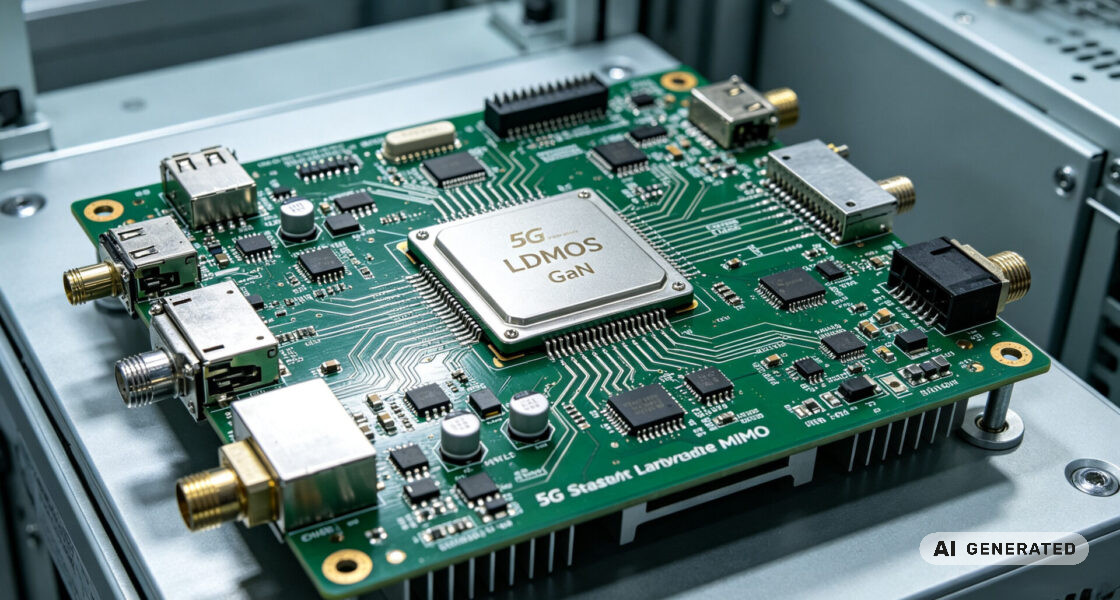
Image Generation Prompt: “5G base station massive MIMO radio unit PCB showing RF power amplifier section with LDMOS and GaN transistors, professional telecom infrastructure environment, photorealistic, close-up technical shot” — Alt: 5G base station RF power amplifier PCB with LDMOS and GaN transistors
2. The TPS Response: Multi-Source RF Transistor Sourcing and Pin-to-Pin Alternative Identification
TPS Elektronik’s Global Sales Partner for Electronics service engaged to address the integrator’s supply chain vulnerability. Our approach combined deep supplier relationships, technical expertise in RF power semiconductors, electronic component supply and a structured qualification process designed to minimize engineering overhead for the customer.
2.1 Supplier Mapping and Alternative Device Qualification
The first phase involved comprehensive supplier mapping across the RF power transistor ecosystem. TPS leveraged relationships with multiple semiconductor manufacturers. Which including Ampleon, Qorvo, MACOM, and Wolfspeed—to identify potential alternative devices. Each supplier’s portfolio was evaluated against the integrator’s performance requirements: frequency range (3.4–4.0 GHz and 2.5–2.7 GHz), output power (40–80 W per device), drain efficiency (>50% for Doherty operation), and package compatibility.
Ampleon, a Netherlands-based RF power specialist with nearly 60 years of RF power leadership, emerged as a key alternative supplier. Ampleon’s portfolio spans both LDMOS and GaN technologies, offering flexibility for scaling design and production. The company’s C4H27F700AV—a 700 W GaN-on-SiC HEMT packaged asymmetric Doherty power transistor for 2.5–2.7 GHz applications. Who provided a direct performance alternative for the integrator’s 2.6 GHz band designs. For the 3.5 GHz band, Ampleon’s C5H3440N70D—a 70 W GaN Doherty transistor engineered for massive MIMO base stations—offered a solution.
Qorvo also offered relevant alternatives, including the QPD0030—a 45 W unmatched discrete GaN-on-SiC HEMT operating from DC to 5 GHz on a 48 V supply rail, suitable for base station applications. MACOM’s MAGb power transistor series provided additional options with demonstrated MTTF exceeding 10⁵ hours at real-world base station operating temperatures.
2.2 Pin-to-Pin Validation and Performance Testing
With potential alternatives identified, TPS conducted a structured qualification process. This included:
- Electrical parameter comparison: Mapping key specifications—gain, efficiency, output capacitance, breakdown voltage—between the original devices and alternatives.
- Package and footprint analysis: Verifying mechanical compatibility, including pin assignments, package dimensions, and thermal pad placement.
- Load-pull performance testing: Characterizing each alternative device under operating conditions matching the integrator’s Doherty amplifier design.
- Thermal and reliability assessment: Evaluating junction temperature, thermal resistance, and long-term reliability metrics.
For devices that were not exact pin-to-pin matches, TPS worked with the integrator’s engineering team to identify minimal PCB modifications that would enable alternative device adoption without a full board respin. In cases where minor layout changes were required, TPS provided updated reference designs and supported the engineering team through the modification process.
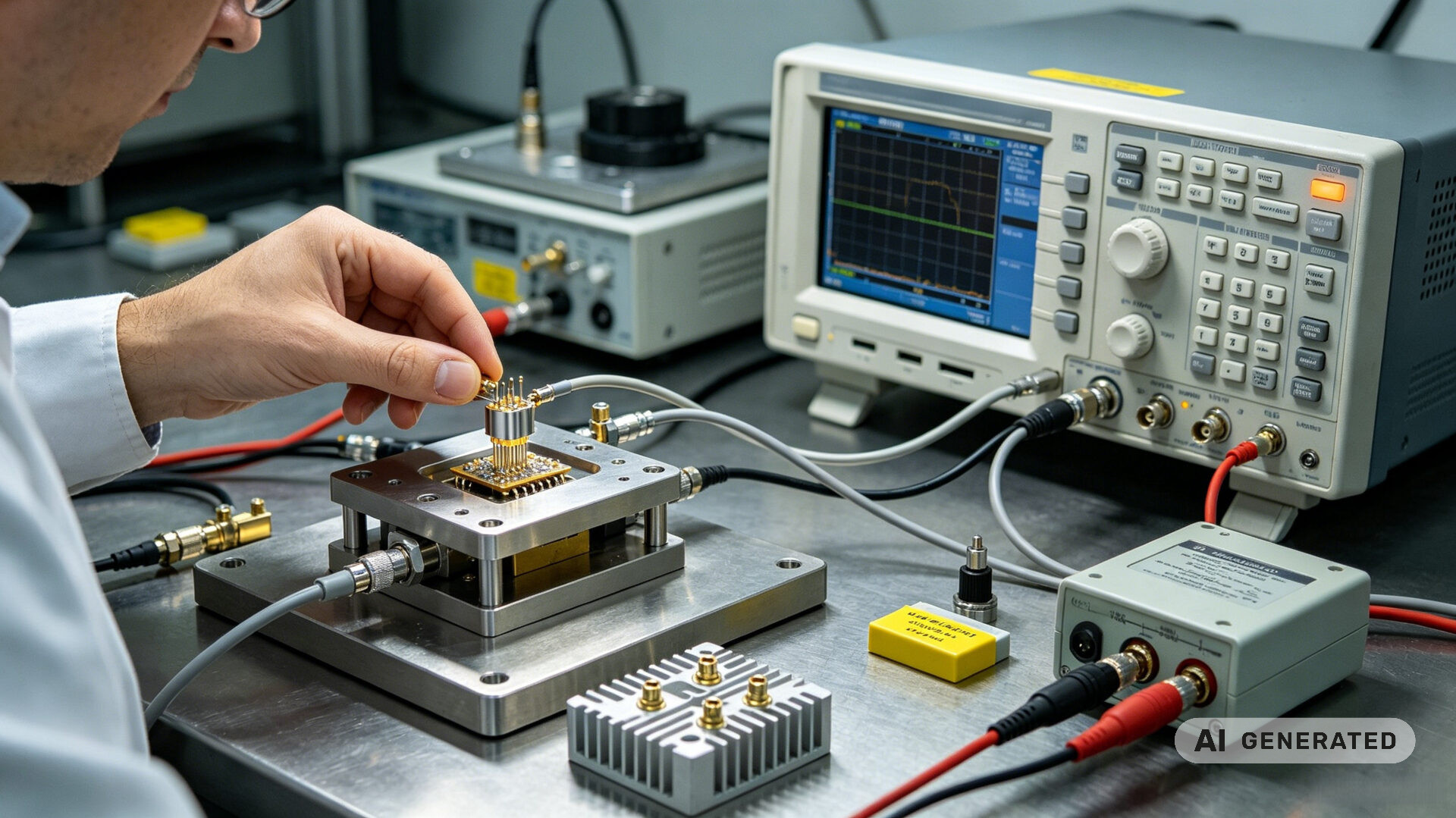
Image Generation Prompt: “RF power transistor test fixture with spectrum analyzer and load-pull measurement system, technician performing pin-to-pin alternative validation, professional test laboratory environment, photorealistic” — Alt: RF power transistor pin-to-pin alternative validation testing
For related technical expertise, see our resources on element material technology and element testing laboratories.
3. Results: Secured Production Continuity and Reduced Supply Chain Risk
Within 12 weeks of engagement, TPS delivered a comprehensive multi-sourcing strategy for the integrator’s RF transistor supply. The results included:
- Three qualified alternative sources for each critical RF transistor model used in the integrator’s 5G radio units.
- Two pin-to-pin compatible alternatives requiring zero PCB modifications for immediate deployment.
- One additional alternative requiring minor PCB changes, qualified and documented for future design iterations.
- Full test documentation for each alternative device, including load-pull performance data, thermal characterization, and reliability assessment.
- Established supply relationships with alternative suppliers, enabling volume procurement without lead-time delays.
The integrator was able to maintain production continuity throughout the transition period. By the time the original supplier completed its final GaN wafer runs, the integrator had already qualified and transitioned to alternative devices for its key product lines. The multi-sourcing strategy not only addressed the immediate supply risk but also provided long-term supply chain resilience—the integrator now maintains relationships with multiple RF transistor suppliers. Which reducing vulnerability to future supplier exits or capacity constraints.
For the integrator’s procurement team, the outcome was clear: predictable supply, stable pricing, and reduced negotiation leverage for any single supplier. For the engineering team, the outcome was equally valuable: qualified alternatives that could be deployed without extensive redesign effort.
Image Generation Prompt: “Supply chain diversification diagram showing multiple RF transistor suppliers (Ampleon, Qorvo, MACOM, Wolfspeed) feeding into 5G base station production, professional business environment, infographic style” — Alt: RF transistor multi-sourcing supply chain diagram
For more case studies, see our quality assurance customer case and global sales partner case study.
4. Why RF Transistor Supply Diversification Matters for 5G Infrastructure
The integrator’s experience is not an isolated case. The RF power semiconductor market for 5G infrastructure is undergoing structural change. The GaN RF semiconductor devices market reached USD 1.60 billion in 2025 and projected to reach USD 2.54 billion by 2030. At the same time, the supplier landscape is shifting. NXP’s exit from the 5G RF power market creates a clear opening for other RF PA manufacturers with proven track records with global base station equipment manufacturers.
For system integrators and panel builders, the implications are clear. Relying on a single RF transistor supplier exposes the entire 5G base station production line to supply chain risk. The consequences of a supply disruption extend beyond procurement—they affect engineering schedules, production planning, customer delivery commitments, and ultimately, market share.
A structured multi-sourcing strategy for RF transistors offers several benefits:
- Supply continuity: Alternative sources ensure production can continue if a primary supplier exits a market or faces capacity constraints.
- Competitive pricing: Multiple qualified sources create negotiating leverage and prevent supplier lock-in.
- Technology optionality: Access to multiple suppliers’ technology roadmaps enables faster adoption of next-generation devices.
- Geopolitical resilience: Diversified sourcing across regions reduces exposure to trade restrictions or regional supply disruptions.
TPS Elektronik’s Global Sales Partner for Electronics service is designed to help system integrators, panel builders, and procurement teams build exactly this kind of resilient supply chain—with a focus on technical qualification, supplier relationships, and documented performance validation.
For additional insights, see our supply chain optimization guide and sales playbook for electronics sourcing.