

Understanding portable oscilloscopes starts with the basics. An oscilloscope captures and analyses electrical signals over time. The same core principle defines what an oscillograph delivers. Teams use it for circuit debugging, product validation, and field maintenance. Oscillography remains a foundational practice. It spans automotive, industrial automation, renewable energy, and embedded systems. Anyone asking what an oscilloscope does for modern work quickly learns: basic waveform capture is only the starting point. For European small and medium businesses, the real cost extends far beyond the initial price. Add-ons like an oscilloscope current probe, a high voltage probe, or test probe accessories bring extra fees. Paid software unlocks also increase the total.
An all-in-one platform combines a Built in Battery Oscilloscope design, full Serial Bus Decoding, SCPI Programming Support, and advanced analysis tools. This delivers a dramatically lower total cost of ownership. It supports both laboratory precision and Portable Oscilloscope Field Use. This guide breaks down the hidden costs of traditional base-model oscilloscopes. It explains how a fully standardised feature set impacts long-term budgets. It outlines why this approach best fits the practical needs of European SMB engineering teams.
The Hidden Cost Structure of Traditional Oscilloscope Purchasing
Most mainstream test instrument vendors build pricing around a low-entry base unit. Core engineering functions stay locked behind paid upgrade licenses. For European SMBs with fixed annual budgets, this model creates predictable overruns. Teams purchase a base oscilloscope to meet initial price targets. Then they discover that essential daily features require separate purchases. Over a typical 7–10 year equipment lifespan, add-on costs can push total spending 30–60% above the initial purchase price. This also creates administrative friction for procurement teams and workflow delays for engineers.
Serial Bus Decoding Licenses: The Most Overlooked Recurring Cost
The Cost of Per-Protocol Licensing
Serial protocol analysis is non-negotiable for nearly every European electronics team. Yet it is also the most commonly upsold feature on mid-range oscilloscopes. Vendors split decoding capabilities into separate paid packages. They force teams to buy individual licenses for each protocol they use. For teams working across multiple industries, these costs accumulate rapidly. They often exceed the price of the base oscilloscope itself.
All Decoders Included as Standard
Our self-developed oscilloscope platform takes the opposite approach. It includes every protocol decoder as standard. There are no per-unit activation fees or recurring license charges. Teams get full RS232 Decode, RS422 Decode, RS485 Decode, and UART Decode out of the box. This covers common industrial fieldbus and embedded serial interfaces used across European manufacturing. Automotive electronics teams receive standard CAN Decode, CAN FD Decode, and LIN Decode. These support modern vehicle network testing without extra charges. Embedded development work benefits from standard SPI Decode and I2C Decode. They cover chip-level communication debugging.
What truly sets the platform apart is included avionics protocol support. ARINC429 Decode and MIL STD 1553B Decode come pre-installed at no additional cost. This feature typically costs thousands of euros as a premium add-on from competing brands. For European SMBs in aerospace, defence, and avionics maintenance, this single inclusion delivers an immediate and substantial reduction in upfront equipment costs.
Friction-Free Field and R&D Work
Standardised decoding removes operational friction. Field service engineers arrive with every protocol already available. No license status checks or temporary unlocks are needed. R&D teams can switch between project types without budget approval for new decoder packages. A single feature set across every unit simplifies calibration and maintenance cycles.
Advanced Analysis & Trigger Functions: Paid Upgrades for Daily Engineering Tools
Basic waveform viewing is enough only for the simplest troubleshooting. Real engineering work demands signal analysis, fault isolation, and performance characterisation. Many vendors treat these essential functions as premium upgrades. Teams that purchase a base-model oscilloscope often cannot complete routine work. They must pay extra for math functions, spectrum analysis, and advanced triggering.
Our platform includes every analysis and trigger feature as standard. No paid unlocks are required. Advanced Math Functions support addition, subtraction, multiplication, division, integration, differentiation, and custom formula editing. Engineers can perform complex signal calculations directly on the instrument. An FFT Oscilloscope mode offers selectable window functions. Options include Rectangular, Hamming, Blackman, and Hanning. This enables real-time frequency domain analysis for harmonic testing and EMI pre-compliance work. It eliminates the need for a separate basic spectrum analyser. Statistics Measurement calculates average, maximum, minimum, and RMS values simultaneously. It handles up to 10 measurement items with a maximum count of 10,000 waveforms. This ensures reliable statistical analysis. Hardware Digital Filtering provides high-pass and low-pass options. Users can clean up noisy signals directly in hardware without post-processing delay.
The trigger system is equally comprehensive. Every common capture type is included as standard. Edge Trigger, Pulse Width Trigger, Runt Trigger, Slope Trigger, and Video Trigger cover routine scenarios. Full serial bus triggering enables precise event capture on every supported protocol. An innovative Time Base Matrix design allows one-click access to any time base setting. This replaces slow sequential stepping and cuts debugging time significantly. For European SMBs, having all functions included means engineers have the tools they need from day one. There are no surprise upgrade costs months into a project.
Connectivity & Automation Tools: Hidden Fees for Modern Workflows
Modern engineering teams rely on connectivity, data sharing, and automation. These streamline workflows across distributed European locations. Remote access, programmable control, and flexible data export are now standard requirements. They support collaborative R&D, automated production testing, and remote field support. Yet many oscilloscope vendors charge extra for remote control software. They also charge for programming command support and basic data export options. This turns essential workflow tools into additional revenue streams.
Our platform is built for modern engineering workflows from the ground up. Every connectivity feature comes as standard. Full Remote Control Oscilloscope functionality works across PC, Android, and iOS devices. Engineers can control the instrument, view waveforms, and export data from anywhere. This works both in the lab and at remote sites. Native SCPI Programming Support enables seamless integration into automated test systems. No extra programming license is required. Physical connectivity includes a USB 3.0 Interface, a USB Type C Port, and an HDMI Output. These provide fast data transfer, peripheral connection, and external display projection. No additional adapter purchases are needed.
For data export and documentation, the platform supports multiple standard file formats. There are no paid export unlocks. It includes CSV File Export and BIN File Export. These serve post-processing in Matlab, Excel, or other analysis tools. Uniquely, the platform also supports WAV File Format export. This lets you save and analyse audio and vibration signals directly in audio editing software. For European SMBs building automated test setups, standard connectivity eliminates an entire category of hidden software costs.
How an All-Inclusive Platform Reduces Total Cost of Ownership
A fully standardised oscilloscope design reduces long-term TCO through three core pathways. The total number of instruments a team must purchase drops significantly. Accessory and consumable costs also fall. Flexible, future-proof design extends the useful equipment lifespan. For European SMBs on tight capital budgets, these advantages add up to substantial savings over the full service life.
Built-In Battery Design: Consolidating Lab and Field Equipment
One large hidden cost is duplicate instrument purchasing. A benchtop oscilloscope delivers lab-grade performance but cannot handle field work. A handheld field oscilloscope lacks the bandwidth, channel count, and analysis features for R&D. The result is two separate purchases, two calibration cycles, and two training programs. This effectively doubles the total cost of ownership for oscilloscope equipment.
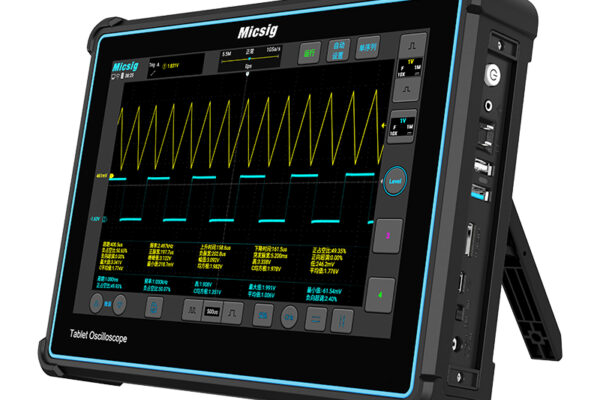
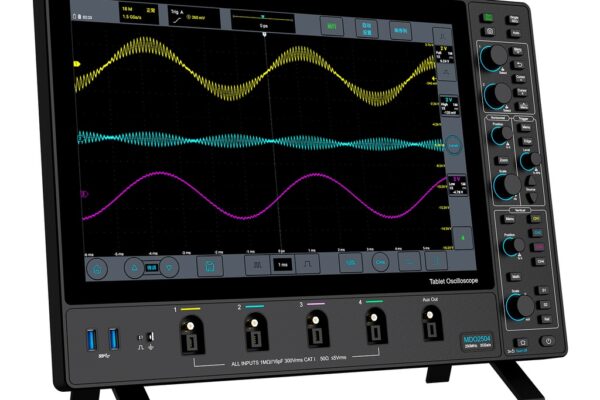
Our Built in Battery Oscilloscope platform solves this problem. It delivers lab-grade performance in a portable form factor suitable for field use. The instrument features a high-capacity 13500mAh lithium-ion battery and a special power lock design. This prevents accidental startup. At just 3.6kg, the platform enables true Portable Oscilloscope Field Use without compromise. Engineers get up to 500MHz bandwidth, 4 analog channels, and 3GSa/s sampling rate. The full suite of analysis features is available everywhere. Work at a lab bench, on a factory production line, at a renewable energy site, or in a vehicle workshop. The 14-inch anti-glare full touch screen has 1920×1200 resolution. It delivers a comfortable viewing experience in both office lighting and bright outdoor conditions. This makes it ideal for long R&D sessions and quick field debugging.
A single instrument can replace both a benchtop lab oscilloscope and a field service unit. Capital expenditure is cut roughly in half. Teams manage calibration, maintenance, and training for only one instrument platform. VESA Mount Compatible design uses a standard 75mm×75mm interface. This adds flexibility for lab bench mounting, production line integration, or custom test station setups. It further extends the equipment’s utility across different work environments.
Segmented Storage Acquisition: Eliminating the Need for Extra Recording Tools
Intermittent faults are among the most frustrating problems for engineering teams. Traditional single-segment acquisition wastes memory space. It also makes it nearly impossible to capture and compare rare events over long periods. Many vendors sell advanced memory functions as paid upgrades. Teams that cannot unlock these features often purchase separate data loggers or signal recorders.
Our platform includes Segmented Storage Acquisition as a standard feature. It supports up to 10,000 independent capture segments. Instead of recording continuous dead time, the instrument captures only the target waveforms. Each is stored as a separate, time-stamped segment. This dramatically improves memory efficiency. It enables reliable Intermittent Signal Capture over extended periods. This is ideal for debugging laser pulses, serial bus glitches, and power supply transients. Users can play back captured events sequentially and compare waveforms across segments. They identify root causes far faster than with traditional methods. Paired with a maximum 360Mpts memory depth, the function eliminates the need for separate data recording tools. Full performance is maintained even with two channels active.
European industrial maintenance teams and power electronics R&D labs benefit directly. They have one less piece of equipment to purchase, calibrate, and maintain. Faster fault resolution is another gain. Engineers capture and analyse intermittent events on one instrument instead of exporting data across multiple tools. For renewable energy, factory automation, and automotive electronics teams, this capability reduces both equipment costs and troubleshooting time.
Open Probe Compatibility: Avoiding Proprietary Accessory Lock-In
Probes and accessories are an ongoing consumable cost. Many teams overlook this when calculating oscilloscope TCO. A standard test probe can wear out, break, or get lost. Many vendors lock their oscilloscopes to proprietary probe systems. These cost two to three times more than generic BNC probes. Over an oscilloscope’s lifespan, teams can spend hundreds or thousands of euros replacing probes. These probes only work with one brand of instrument. A proprietary current clamp probe can cost far more than an equivalent third-party model.
Our platform features an innovative Mic OPI Probe Interface. It offers the best of both worlds. The native interface supports smart probes with automatic attenuation matching and auto-compensation. This enables fast, error-free setup. An included BNC adapter lets the instrument work with any standard BNC probe. Teams have full flexibility to use their existing probe inventory. They can use their preferred oscilloscope current probe, high voltage probe, or differential probe. They avoid being locked into a single vendor’s accessory ecosystem. The full range of compatible accessories covers every common test scenario. This includes optical-fiber isolated probes, high-voltage differential probes, AC/DC current probes, and Rogowski coils. They work from low-voltage embedded circuits to high-voltage power electronics testing.
For European SMBs, this flexibility delivers immediate and long-term savings. Teams do not need to replace their existing probe inventory when upgrading. Future probe replacements can be sourced from multiple suppliers at competitive prices. This open accessory model also reduces risk. Teams are not dependent on a single vendor for replacement parts and accessories.
Core Standard Features Overview
Our self-developed platform includes every core feature as standard. There are no hidden upgrade fees, paid software licenses, or locked functions. Every capability is available from the moment you power on the instrument. The system runs on an Android Operating System. It provides smooth multi-tasking and intuitive navigation. 32GB Internal Storage handles large waveform datasets with no paid storage upgrades. A standard Three Year Warranty covers parts and labour. European-localised technical support and calibration services are available for all customers.
- Performance: Up to 500MHz bandwidth, 4 analog channels, up to 3GSa/s real-time sampling, 360Mpts max memory, 230,000 wfms/s max capture rate, and noise floor below 90μVrms at full bandwidth
- Serial decoding: Full standard support for RS232 Decode, RS422 Decode, RS485 Decode, UART Decode, CAN Decode, CAN FD Decode, LIN Decode, SPI Decode, I2C Decode, ARINC429 Decode, and MIL STD 1553B Decode, with text mode and CSV export
- Acquisition & triggering: Segmented Storage for up to 10,000 events, full trigger suite (Edge, Pulse Width, Runt, Slope, Video, and serial bus triggering), plus one-click Time Base Matrix selection
- Analysis tools: Advanced Math Functions with custom formula support, FFT with four window options, Statistics Measurement for up to 10 parameters, Hardware Digital Filtering (high-pass/low-pass)
- Connectivity & control: Remote Control Oscilloscope for PC and mobile devices, full SCPI Programming Support, USB 3.0, USB Type C, HDMI Output, and trigger out port
- Data storage & export: 32GB Internal Storage, CSV File Export, BIN File Export, WAV File Format support, screenshot capture, and video recording
- Design & mounting: 14-inch 1920×1200 anti-glare full touch display, VESA Mount Compatible 75mm×75mm interface, built-in side handle, Android Operating System
- Power & portability: Built-in 7.4V/13500mAh lithium-ion battery, power lock design, universal 100–240V AC power adapter
- Warranty & support: Three Year Warranty covering parts and labour, with European-localised technical support and calibration services
Final Performance & Specification Summary
No-Compromise Measurement Performance
The specification summary confirms that an all-inclusive design does not sacrifice performance. The platform delivers lab-grade measurement capabilities. It provides up to 500MHz analog bandwidth across 4 channels. The maximum real-time sampling rate is 3GSa/s. Deep memory reaches up to 360Mpts and maintains full performance with dual channels active. The waveform capture rate is 230,000 wfms/s. The noise floor stays below 90μVrms at full bandwidth. This ensures accurate capture of both large signals and small, sensitive details.
Precision Vertical and Horizontal Systems
The vertical system supports 8-bit resolution. The vertical range goes from 1mV/div to 10V/div at 1MΩ input impedance. DC gain accuracy is ±2.0% across most ranges. The horizontal system covers time bases from 1ns/div to 1ks/div. Roll mode is available from 200ms/div for long-duration monitoring. The trigger system supports all standard capture modes. Adjustable hold-off ranges from 200ns to 10s. The full suite of serial bus decoders operates natively on the instrument without external software.
Portability and Power
Physically, the instrument measures 353×245×56mm and weighs 3.6kg with the battery. This makes it lightweight enough for field carry while keeping a large, easy-to-read display. The built-in 7.4V/13500mAh lithium-ion battery provides extended runtime. The universal power adapter supports all standard European mains voltages. All standard accessories are included in the base purchase. No add-ons are required for full functionality.
The Smarter Financial Choice
For European SMBs looking to maximise test equipment value, the conclusion is clear. The lowest upfront price is rarely the lowest total cost of ownership. An oscilloscope with a fully standardised feature set and flexible design delivers better performance. It also delivers higher productivity and substantially lower costs over the instrument’s full lifespan. Whether your team works in automotive electronics, industrial automation, renewable energy, or embedded systems R&D, an all-inclusive platform is the smarter financial and technical choice for long-term success.