

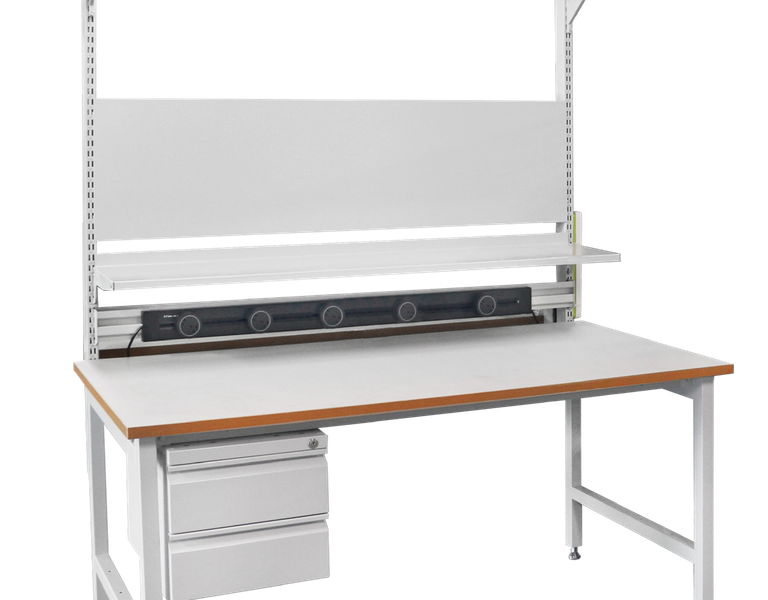
For system integrators, panel builders, and engineering-driven procurement teams, setting up an ESD repair station for smartphone and electronics rework is not only about buying a bench.
It also involves the grounding architecture, the surface resistivity of the worktop, the wrist strap and common ground point, the accessory set that makes the bench usable for board-level rework, and—if the station has to move between service desks, production cells, or customer sites—whether the bench can be relocated without breaking the ESD path.
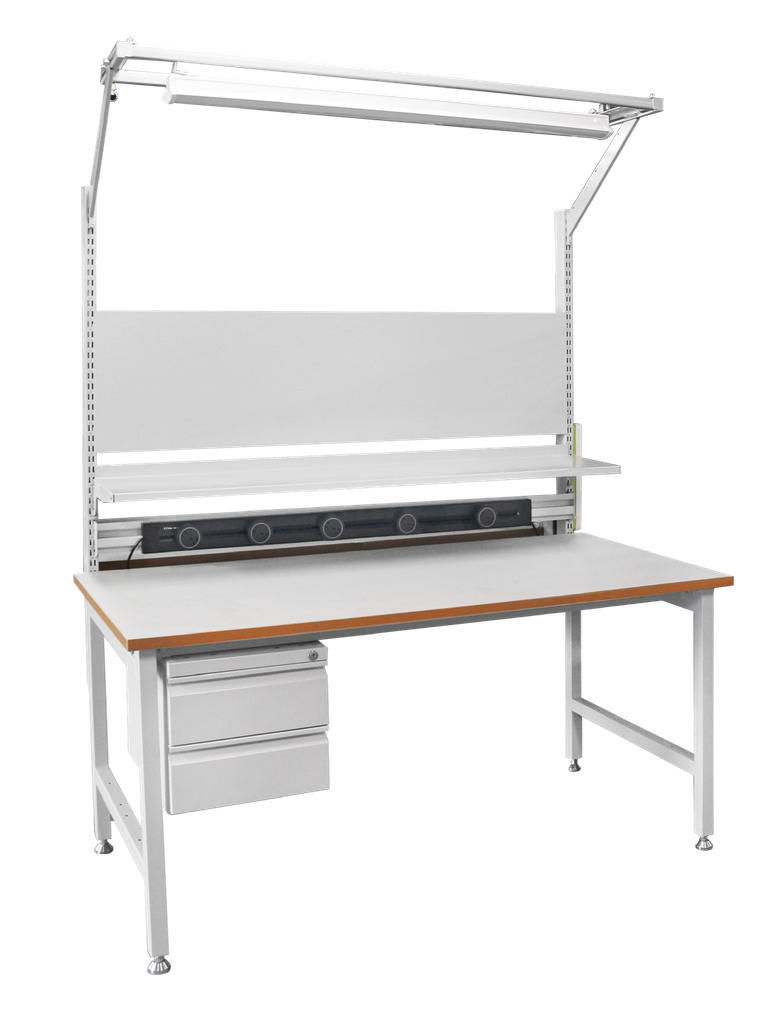
The TPS Fixed-1260 ESD Workstation is a fixed-structure, industrial-grade ESD workbench with a 25 mm ESD (HPL) laminated top, 1220 × 600 × 760 mm dimensions, 500 kg uniform static load capacity, and compliance with IEC 61340-5-1:2016 across 10–60% relative humidity. It does not have castors or a height-adjustment mechanism as standard. This article explains how to use it as the core of a flexible rework station, what has to be added to make it relocatable, and where a different configuration is the correct choice.
1. What a mobile ESD repair station actually requires
A “mobile ESD workstation” is a rework bench that can be moved between locations while maintaining a valid ESD control path. The word “mobile” changes the mechanical requirements; it does not change the electrical ones. The bench must still provide a grounded, static-dissipative work surface, a personnel grounding point, and a common ground reference that remains connected after the move.
1.1 The three ESD control elements
IEC 61340-5-1 defines the ESD control program requirements. At the workstation level, three elements must be in place:
- A static-dissipative work surface connected to a groundable point, so that charges on the worktop and on the parts placed on it drain to earth in a controlled way.
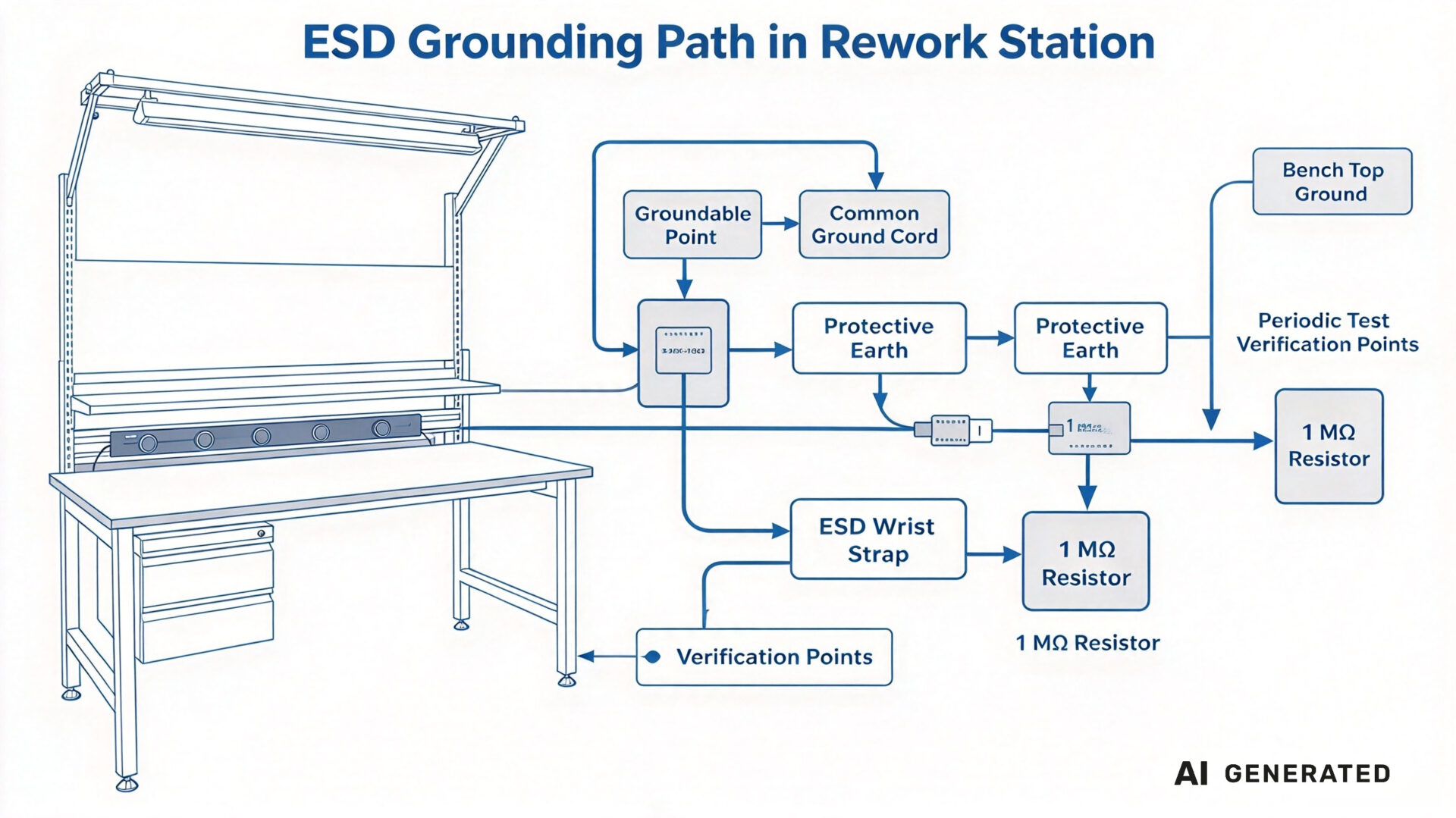
- A personnel grounding path, typically a wrist strap with a 1 MΩ resistor, connected to the same common ground point as the worktop.
- A common ground connection to protective earth, with the ground cords and the earth bond verified at a defined interval.
If any of the three is missing or intermittent, the station is not an ESD station—it is a bench with an antistatic mat on it. The distinction matters for procurement because the audit evidence is the verification record, not the product label.
1.2 Why mobility and ESD control conflict—and how to resolve it
Mobility introduces three risks. First, the ground cord can left disconnected after a move, or the connection can strained by repeated handling. Second, a castor-mounted bench can lose its earth bond if the castors isolate the frame from the floor and the ground cord is the only path—so the cord becomes a single point of failure. Third, vibration and floor unevenness can loosen the groundable point hardware over time.
The resolution is not to avoid mobility, but to design the ground path so that it verified after every move. A common approach is a dedicated ground cord with a visible connection point and a short verification procedure (wrist strap test plus worktop-to-earth resistance check) performed at the start of each shift or after each relocation. This is the same discipline that IEC 61340-5-1 expects for any workstation, mobile or fixed.
2. What the TPS Fixed-1260 provides as the bench platform
The Fixed-1260 designed as a fixed installation for electronics production, laboratory, and industrial workshop use. Its value in a rework context is the combination of a stable, heavy-duty frame, a compliant antistatic worktop, and a modular accessory system that can be configured for board-level repair.
2.1 Dimensions, load, and worktop
The bench measures 1220 mm in length, 600 mm in depth, and 760 mm in fixed height. The 25 mm ESD (HPL) laminated top in RAL 7035 provides a durable, easy-to-clean work surface. The frame rated for a uniform static load of up to 500 kg, which is far above what a rework station typically carries—but it matters when the bench also holds a microscope, a hot-air station, a power supply, and a drawer stack, and when the bench is moved as a complete unit rather than disassembled.
The 760 mm fixed height is a standard industrial work height. For a seated rework operator, that height is generally suitable with an adjustable ESD chair; for a standing operator, it may be too low. This is the point where the “height-adjustable” requirement in many RFQs has to be addressed explicitly: the Fixed-1260 is not height-adjustable, so either the chair provides the adjustment, or a different bench model is required.
2.2 IEC 61340-5-1 compliance and humidity range
The bench specified to meet IEC 61340-5-1:2016 and to maintain stable static control performance across 10–60% relative humidity. The humidity range matters because surface resistivity of dissipative materials changes with moisture; a bench that performs well at 50% RH can drift outside the dissipative range in a very dry room. The stated 10–60% range gives the procurement team a defensible specification for the facility’s environmental envelope.
3. Configuring the bench for smartphone and board-level rework
A smartphone rework station needs more than a flat surface. It needs controlled lighting, a power rail for the hot-air station and the microscope, storage for parts and tools, and a grounding arrangement that keeps the operator and the board at the same potential.
3.1 Grounding and verification points
Connect the worktop groundable point to the common ground cord, and connect the common ground cord to the protective earth of the building installation through a dedicated earth bond. The wrist strap connects to the same common ground point. Provide a clearly labeled verification point for the worktop-to-earth resistance and a second point for the wrist strap test, so that the daily check can be performed in under a minute without disassembling anything.
The verification itself is a resistance measurement: worktop to earth, and wrist strap to earth, compared against the limits defined in the facility’s ESD control plan. The measurement instrument and the limits should recorded in the station documentation, not left to operator memory.
3.2 Accessory set for rework
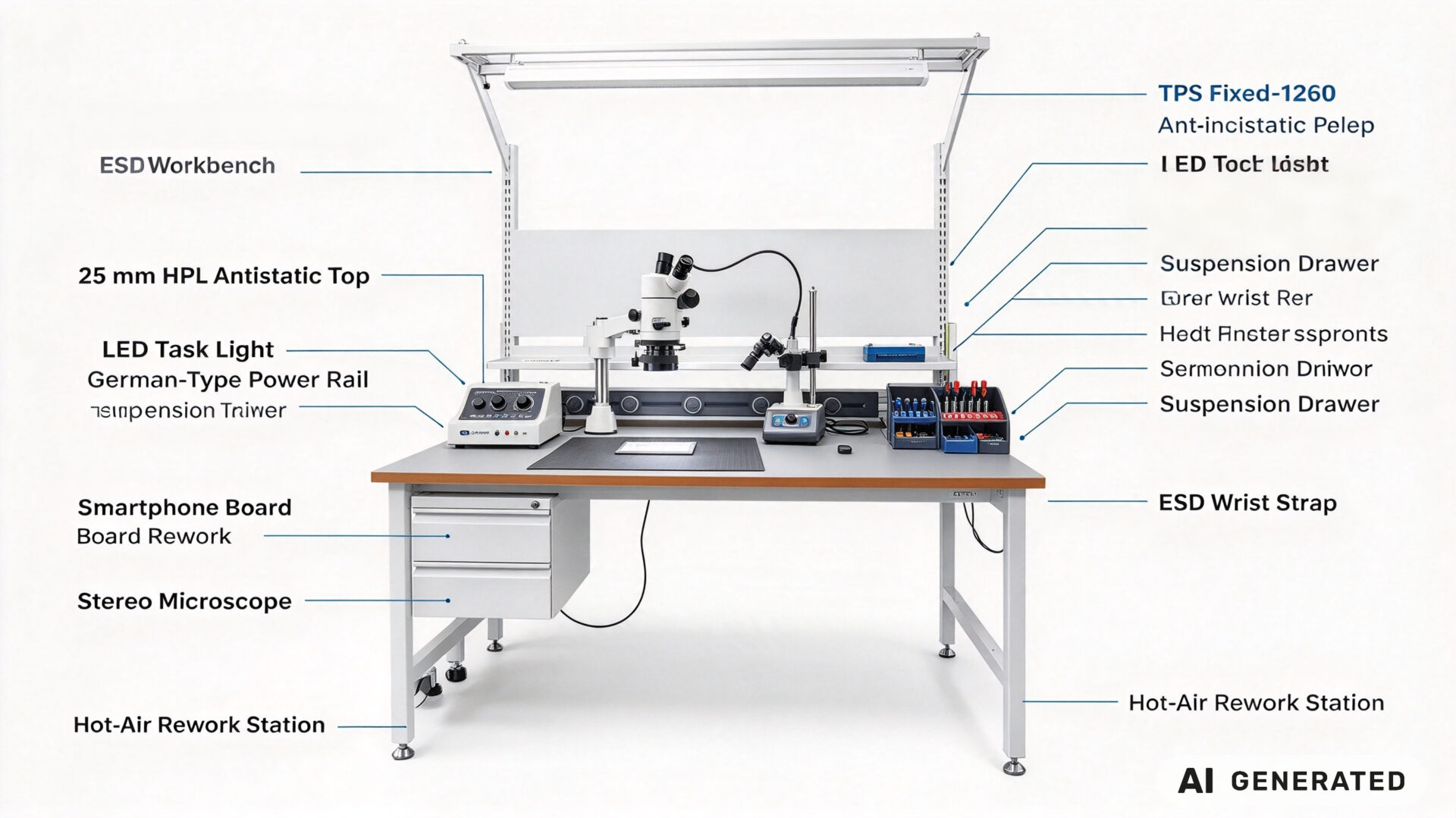
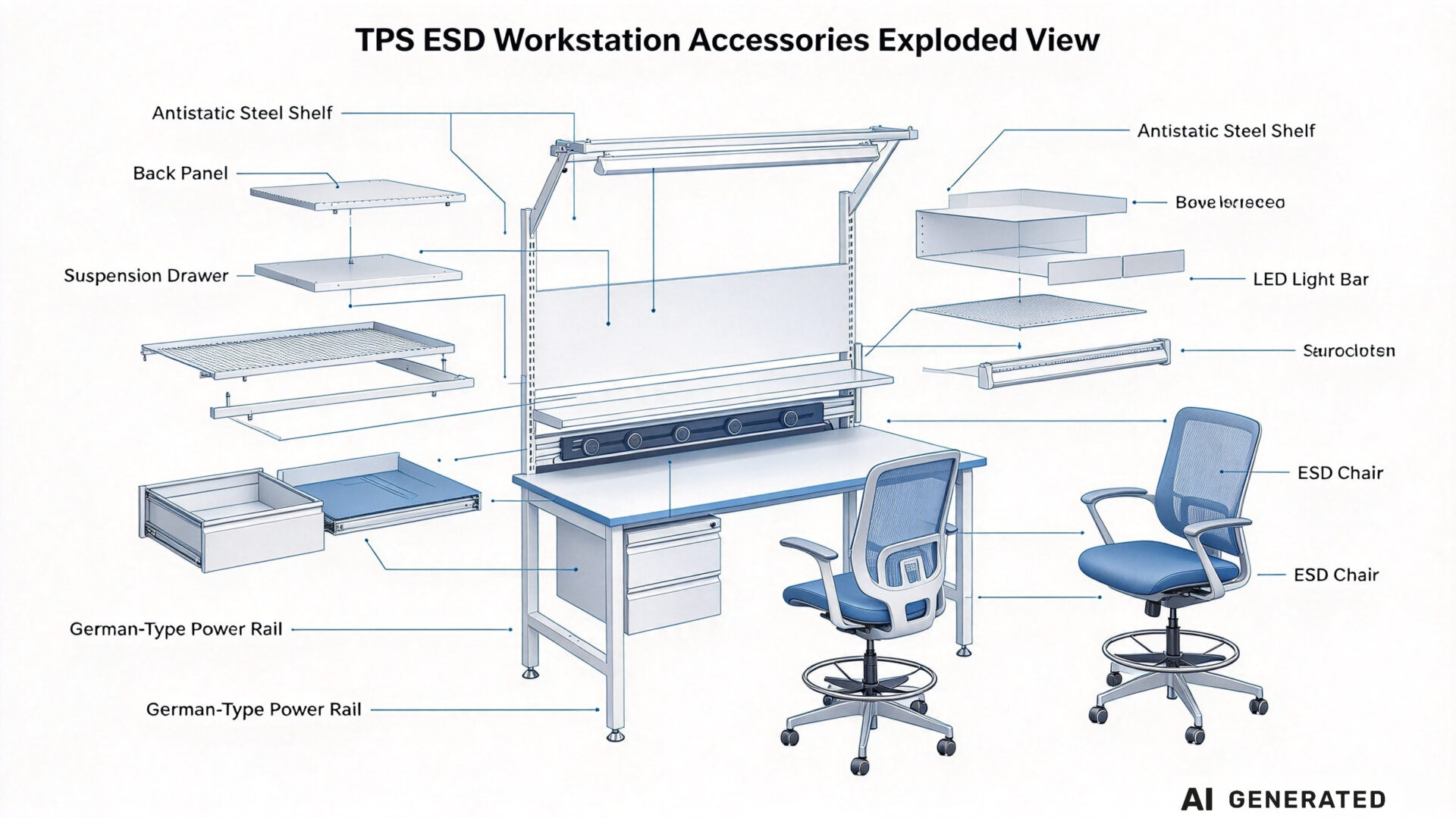
TPS offers a matching accessory family for the Fixed-1260: antistatic steel shelves, back panels, suspension drawers, LED light systems, German-type power rails, and ESD chairs. For a smartphone rework station, the practical configuration is:
- LED light bar mounted on the back panel, positioned to illuminate the work area without casting shadow from the operator’s hands.
- Power rail for the hot-air station, soldering iron, microscope illuminator, and bench power supply.
- Suspension drawer for tips, nozzles, tweezers, and small parts trays.
- Antistatic shelf for the microscope and for frequently used test equipment.
- ESD chair with a grounded seat and a height adjustment that brings the operator to the correct working height relative to the fixed 760 mm bench.
The modular system means the same bench frame can be reconfigured when the rework scope changes—for example from smartphone board repair to small-form-factor assembly—without replacing the bench.
3.3 Relocation options for a fixed frame
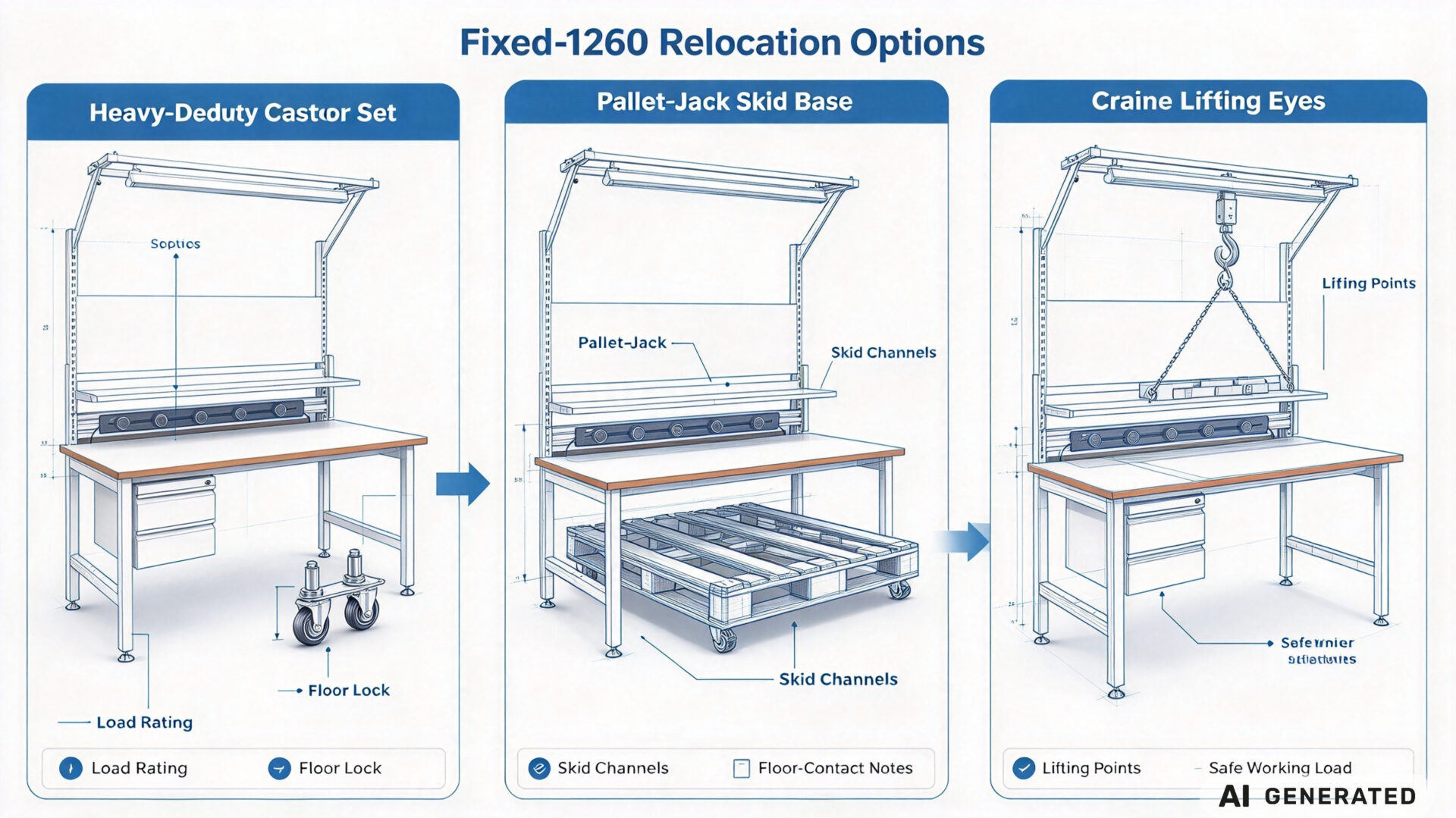
If the station must move, the relocation method has to chosen deliberately. Three options are common:
- Heavy-duty castor set: allows the bench to rolled between locations. The castors must rated for the loaded bench weight, and the ground cord must disconnected before the move and reconnected and verified afterward. A castor-mounted bench should not rely on the castors for earth bonding.
- Pallet-jack skid base: the bench lifted and moved as a unit, which is suitable for heavier configurations where castors would undersized. The bench must designed or adapted for the skid base, and the move requires a pallet jack and a clear route.
- Crane lifting eyes: for moving the bench into position during installation, not for routine relocation. Lifting points must rated and the load balanced.
None of these options is included in the standard Fixed-1260 configuration. They are additions or adaptations that must specified in the RFQ, and each one changes the mechanical interface and the verification procedure after a move.
4. Daily and periodic verification
The ESD control plan determines the verification interval, but the practical minimum for a rework station is a daily check before the first board is handled. The check covers the wrist strap, the worktop, and the ground connection. For a station that moves, the check is repeated after every relocation, because the move is the event most likely to break the ground path.
The verification record should include the date, the instrument used, the measured values, and the pass/fail result. That record is what an ESD auditor reviews; the product certificate alone is not sufficient evidence that the station is functioning on the day of the audit.
5. Product specifications
| Parameter | TPS Fixed-1260 |
|---|---|
| Type | Fixed ESD workbench |
| Dimensions (L × D × H) | 1220 × 600 × 760 mm |
| Height adjustment | None (fixed 760 mm) |
| Worktop | 25 mm ESD (HPL) laminate, RAL 7035 |
| Uniform static load | Up to 500 kg |
| ESD standard | IEC 61340-5-1:2016 |
| Humidity range | 10–60% RH |
| Accessory system | Antistatic shelves, back panels, suspension drawers, LED lighting, power rails, ESD chairs |
| Castors / lifting eyes | Not included as standard |
The table makes the boundary explicit: the Fixed-1260 is a fixed platform. The “mobile” and “height-adjustable” attributes have to added through the accessory or adaptation route, or addressed by selecting a different bench model.
6. RFQ checklist
To get a usable quotation for an ESD rework station, provide the following:
- Station type: Fixed installation, or relocatable—and if relocatable, the expected relocation frequency
- Operator posture: Seated or standing, and whether the adjustment is expected from the chair or from the bench
- Work content: Smartphone board rework, small-form-factor assembly, or mixed use
- Equipment load: Microscope, hot-air station, power supply, drawer stack, and total weight
- Grounding requirement: Whether a common ground cord, wrist strap and verification points are to be supplied
- Accessory list: Shelves, back panel, drawer, LED light, power rail, ESD chair
- Relocation method: Castors, skid base, or lifting eyes—and the floor condition along the route
- Documentation: ESD compliance certificate, grounding verification procedure, and accessory list
Providing these details prevents the most common mismatch: ordering a fixed bench for a station that has to move, or expecting height adjustment from a bench that does not have it.