

It also involves input range, output stability, ripple, protection behavior, SELV compliance, and—critically—whether the chosen power supply intended for continuous cabinet operation or for commissioning and test use.
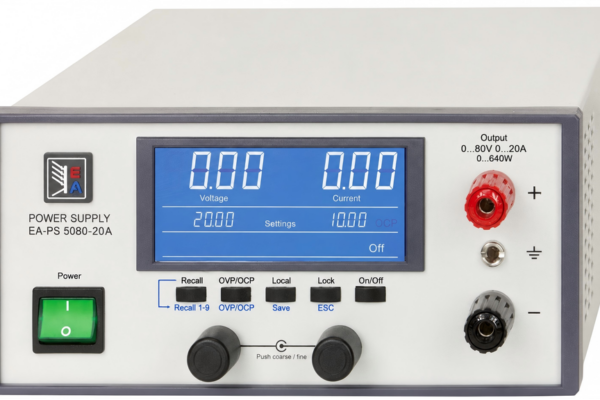
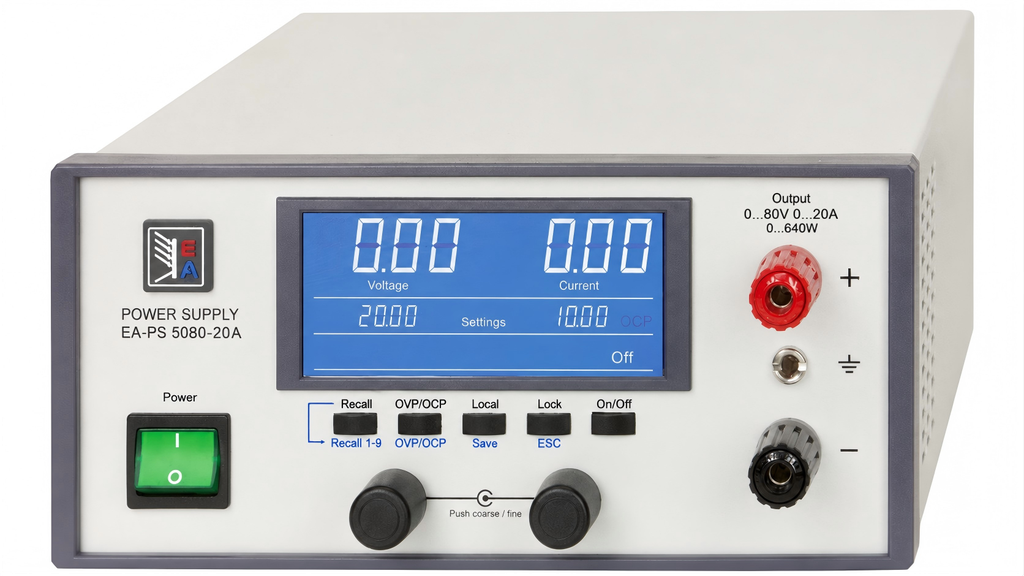
The EA-PS 5080-20A is a programmable desktop DC power supply with 90–264VAC input, active PFC >0.99, and an auto-ranging 0–80VDC / 0–20A / 640W output. It is designed for laboratory, test, and commissioning use—not as a DIN rail supply for permanent cabinet installation. This article explains where it fits, how to set it for a stable 24VDC rail feeding PLC and I/O circuits, and when a DIN rail supply is the correct choice instead.
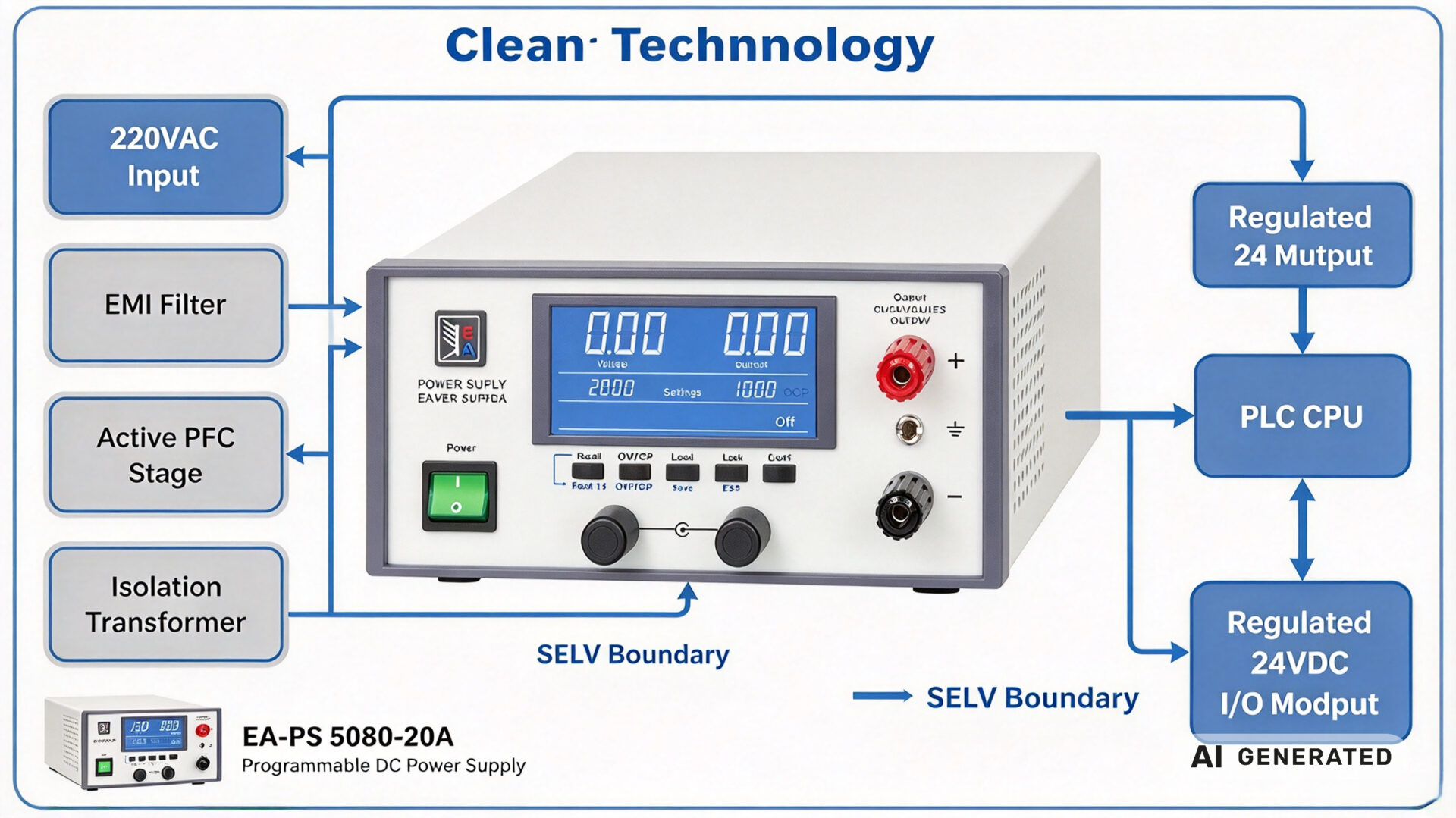
1. What 220VAC to stable 24VDC actually requires in a control cabinet
A 24VDC rail feeding PLC CPUs, I/O modules, sensors, and relays must stay within the PLC’s input tolerance under all load and mains conditions. IEC 61131-2 defines the electrical service conditions for programmable controllers, including the allowed input voltage range and ride-through requirements. The power supply is the component that must keep the rail inside that window.
The supply must also provide a SELV output, meet the applicable EMC standard for the installation environment, and—if it is installed permanently in the cabinet—be designed for continuous operation at the cabinet’s internal ambient temperature.
1.1 Two use cases: commissioning versus continuous cabinet operation
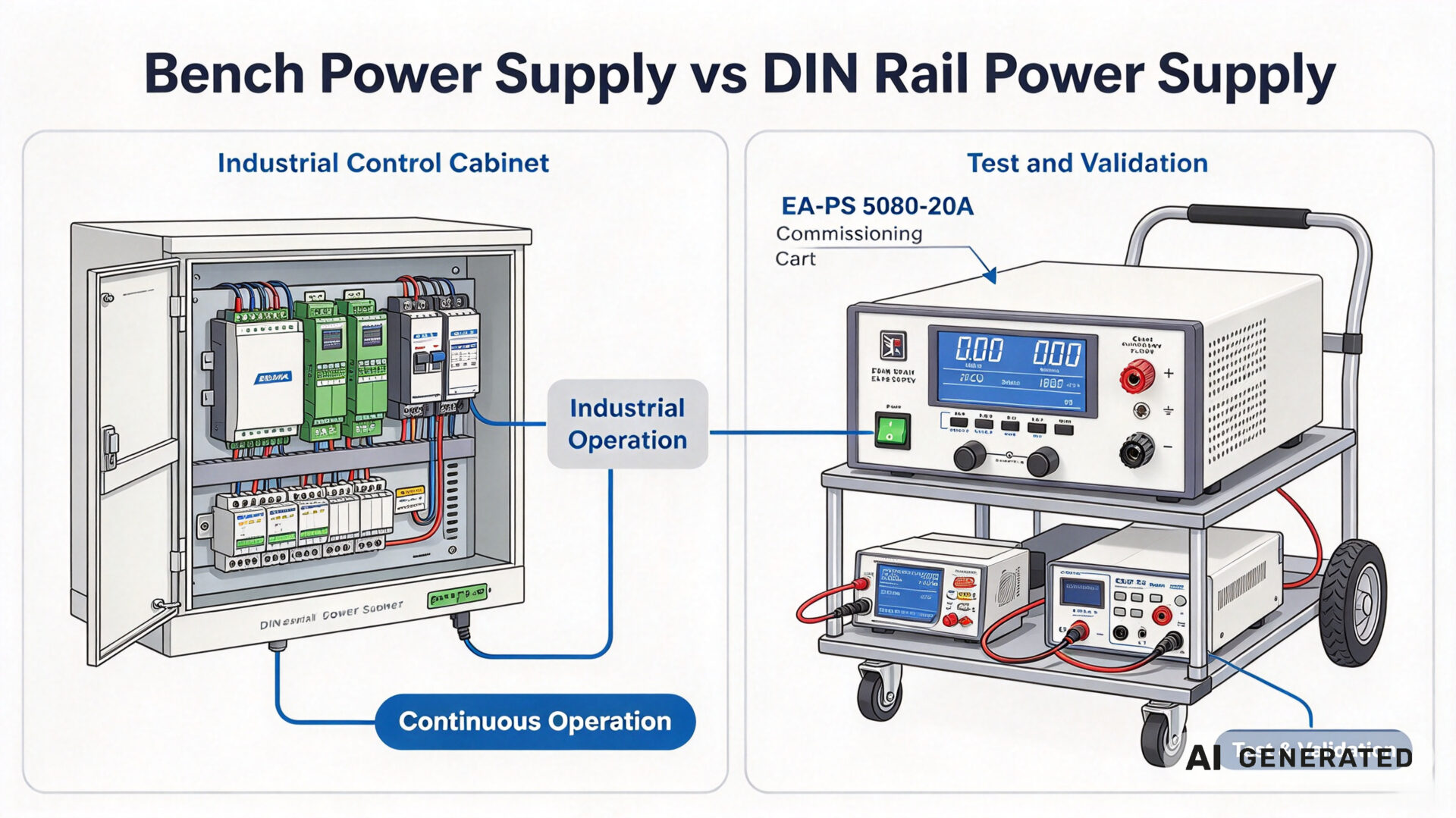
It is important to separate two scenarios that are often confused in procurement. The first is continuous cabinet operation: the supply is mounted on DIN rail, runs 24/7, and must survive the cabinet’s thermal and vibration environment. And the second is commissioning, test, and validation: the supply is used on a bench or a commissioning cart to power the PLC rack and I/O circuits while the panel is being built, wired, and tested.
The EA-PS 5080-20A is a bench programmable supply. It fits the second scenario. And it has a wide 90–264VAC input, a precise 24VDC setpoint, low ripple, and remote control for logging—all useful during commissioning. It is not a DIN rail supply and is not intended for permanent cabinet installation.
1.2 Why 24V stability matters for PLC and I/O circuits
Typical PLC 24VDC inputs accept a range of roughly 20.4V to 28.8V. If the rail sags below 20V during a load step or a mains dip, the PLC may reset or an I/O module may report a false input. If the rail rises too high, input protection circuits may clamp or the module may be damaged.
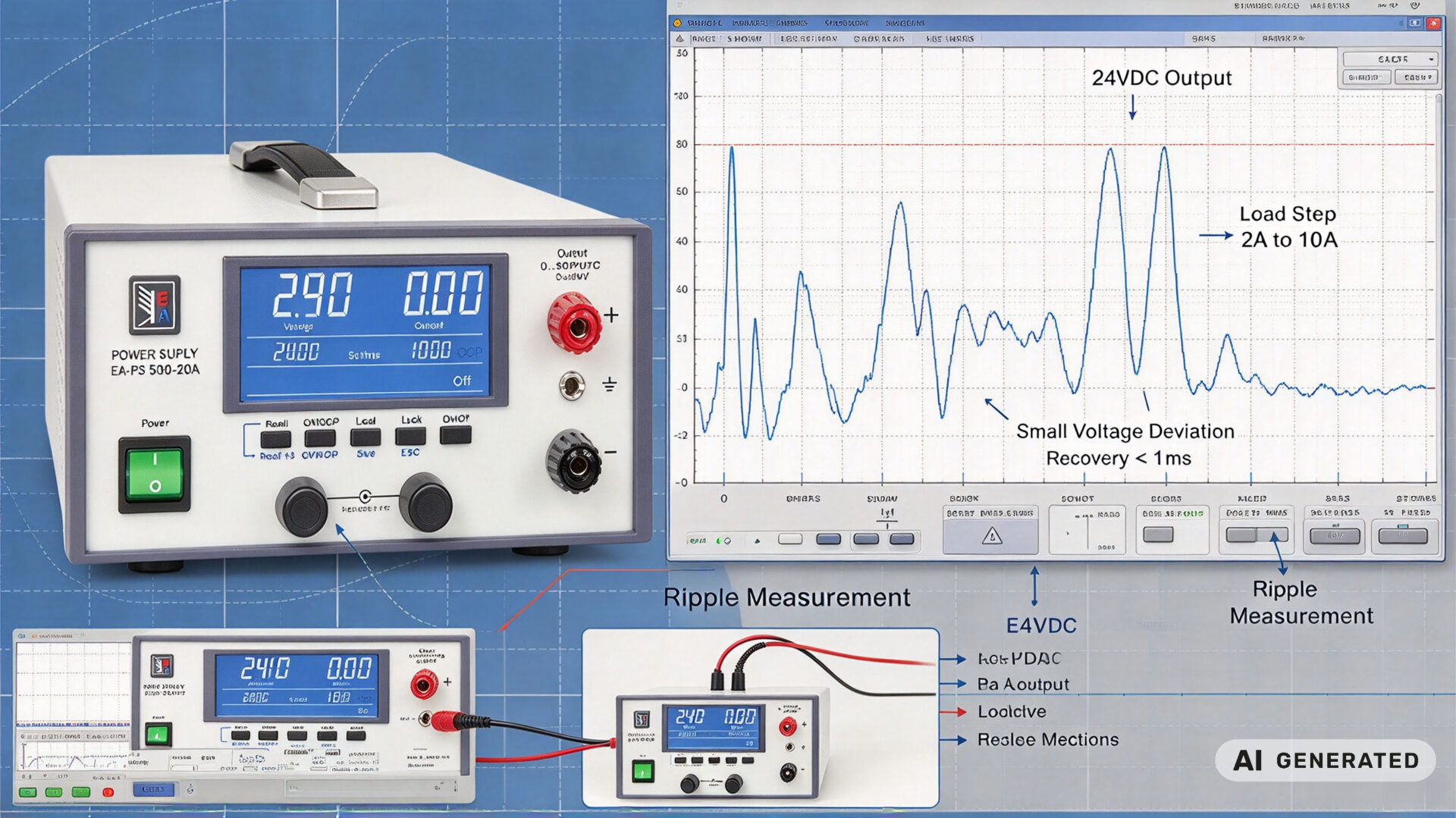
Stability has two components: steady-state accuracy and transient response. The EA-PS 5080-20A specifies <0.08% voltage load regulation, <0.02% line regulation, and <1ms load regulation time, which covers the load steps caused by relays, contactors, and I/O bank switching during commissioning.
2. Electrical performance of the EA-PS 5080-20A for 24VDC PLC loads
The EA-PS 5080-20A specified for laboratory and industrial test use. Its electrical performance is relevant to PLC and I/O commissioning because it determines how clean and how stable the 24VDC rail will be while the panel is being validated.
2.1 90–264VAC input and active PFC
The 90–264VAC input covers nominal 220VAC, 230VAC, and 240VAC supplies, as well as 110VAC and 120VAC where required. Active PFC with a power factor >0.99 reduces the input current harmonics that the supply injects back into the commissioning area’s distribution. That matters when the bench shares a circuit with sensitive test equipment.
2.2 Output regulation, ripple, and load-step response
For a 24VDC PLC rail, the relevant specifications are:
- Voltage accuracy <0.2%: the setpoint displayed is the setpoint delivered, within the specified tolerance.
- Ripple <80mV pp / <10mV RMS: low enough that the supply noise does not dominate the PLC input measurement during validation.
- Load regulation <0.08% and load regulation time <1ms: the rail recovers quickly after relay or contactor switching.
These figures are measured at the supply terminals. At the PLC terminals, remote sensing or short, adequately sized leads are needed to preserve them; otherwise the lead drop appears as an additional error.
3. Integration into panel build and commissioning
Using a bench supply for commissioning is a practical way to bring a panel up before the permanent DIN rail supply is installed, or to validate the 24VDC distribution independently of the final supply.
3.1 Wiring, grounding, and SELV boundaries
Connect the supply to the 220VAC mains through an RCD-protected circuit and a suitable breaker. Keep the 220VAC input wiring separated from the 24VDC output wiring. Bond the supply’s protective earth to the panel’s PE bar. The output is SELV; do not connect the 24VDC negative to protective earth unless the panel’s grounding concept explicitly requires it.
3.2 Protection settings for PLC and I/O loads
Set the output to 24.0V and configure OVP, OCP, and OPP before energizing the PLC rack. Set OVP just above the PLC’s maximum input voltage, and OCP just above the expected total load current, so that a wiring fault triggers a controlled shutdown instead of damaging the I/O modules. The EA-PS 5080-20A provides adjustable OVP, OCP, OPP, and overtemperature protection.
3.3 Remote control and logging during commissioning
The USB interface and the LabView VIs / Windows control software allow the 24VDC rail to logged during commissioning: startup, load steps, and the response to relay switching. That log becomes part of the commissioning record and helps diagnose intermittent I/O faults later. The TPS production category and TPS blog content provide related application context.
4. When a DIN rail power supply is the correct choice
If the requirement is a permanent 220VAC to 24VDC supply inside the control cabinet, the correct component is a DIN rail power supply designed for continuous operation, with the cabinet’s internal ambient temperature, derating curve, and the applicable safety and EMC standards verified. A bench programmable supply is not a substitute for that installation.
Typical decision points:
- Permanent cabinet installation: DIN rail supply, 24VDC output, continuous duty, derating verified at cabinet ambient.
- Commissioning and test: bench programmable supply, adjustable 24VDC, low ripple, logging capability.
- Panel build before final supply arrives: bench supply used temporarily, with the final DIN rail supply documented in the panel’s BOM.
For related power products, see the TPS-DM570T1512KIF and TPS-DM570T1512KIRF bidirectional DC-DC modules.
5. Product specifications
| Parameter | EA-PS 5080-20A | Typical DIN rail 24V supply |
|---|---|---|
| Input | 90–264VAC, 45–65Hz | 85–264VAC |
| Output | 0–80VDC / 0–20A / 640W, auto-ranging | 24VDC fixed, 10–40A |
| Mounting | Bench / desktop | DIN rail 35mm |
| Ripple | <80mV pp / <10mV RMS | Typically 100–200mV pp |
| Load regulation | <0.08% | 0.5–1% |
| Remote control | USB, LabView, Windows software | Usually none |
| Typical use | Commissioning, test, validation | Continuous cabinet operation |
The comparison shows why the two products are not interchangeable: they serve different installation and duty requirements.
6. RFQ checklist
To streamline quotation and evaluation for an ac 220v power supply used in PLC and I/O commissioning, provide the following:
- Use case: Commissioning/test bench, or permanent DIN rail cabinet installation
- Input: Nominal mains voltage, tolerance, and whether 110VAC operation is required
- Output: 24VDC setpoint, total load current, and peak current during relay/contactor switching
- Load list: PLC CPU, I/O modules, sensors, relays, and any 24VDC auxiliary loads
- Stability requirement: Acceptable voltage window and transient recovery time
- Protection settings: OVP, OCP, OPP thresholds for the connected loads
- Mounting: Bench, commissioning cart, or DIN rail
- Documentation: Datasheet, test report, and compliance documentation
Providing these details reduces clarification cycles. TPS’s engineering team can support selection, protection setting, and commissioning logging setup as part of the RFQ process.