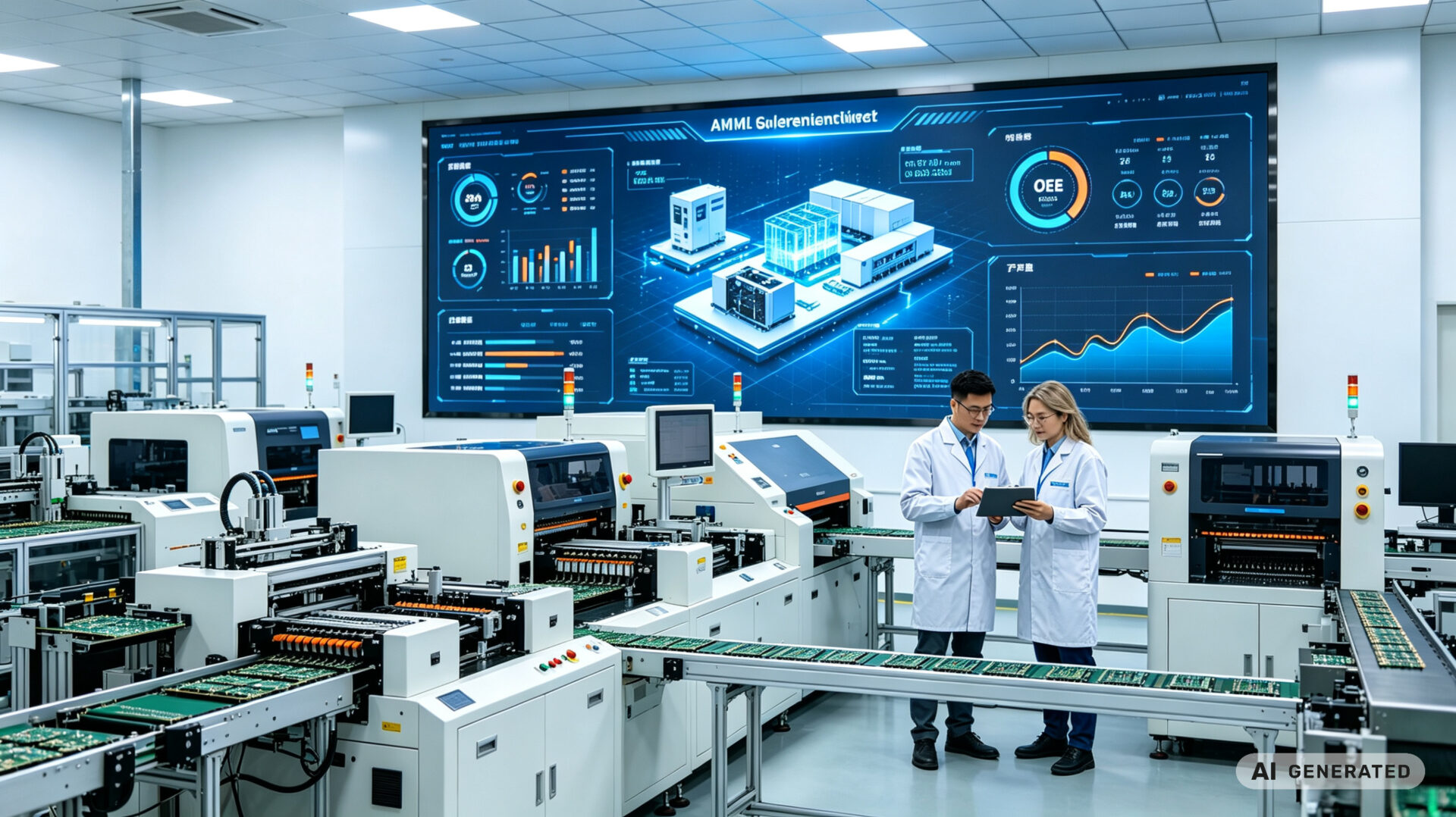


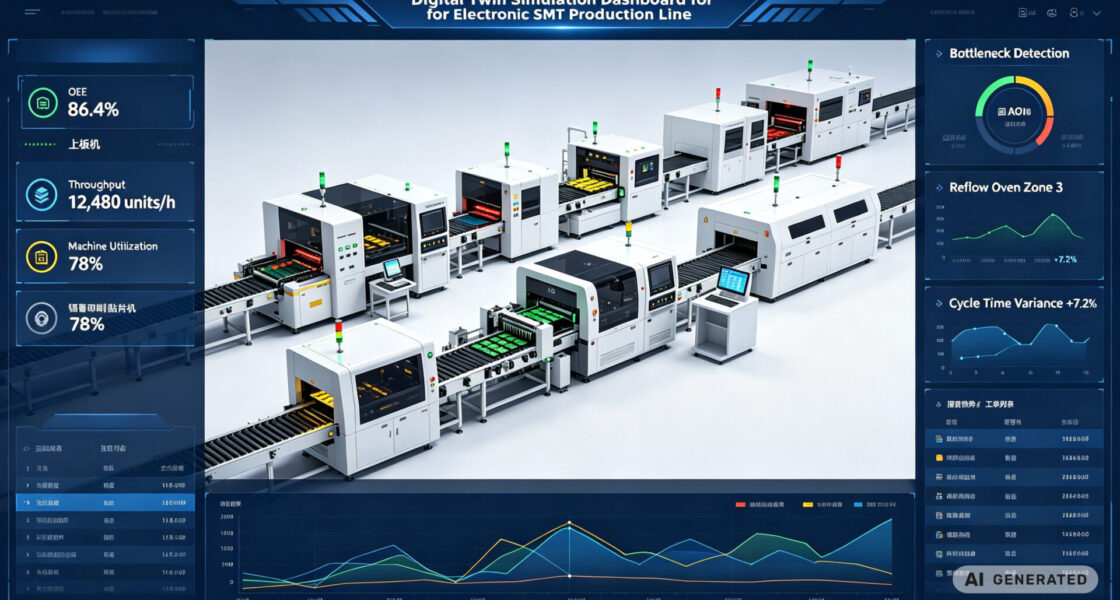
For system integrators, production engineers, and procurement teams in electronics manufacturing, optimizing a production line is not about guessing—it is about knowing. What if you could simulate every change before implementing it on the factory floor? What if you could predict bottlenecks, balance workloads, and validate SMT programs without stopping production?
TPS Elektronik’s smart manufacturing solutions enable electronics manufacturers to build digital twins of their production lines—virtual replicas that mirror physical processes in real time. From line balancing and throughput simulation to predictive maintenance and process optimization, TPS’s mechatronics and EMS integration capabilities provide the foundation for data-driven manufacturing that reduces downtime, improves yield, and accelerates time-to-market.
1. What Is a Digital Twin and Why Does It Matter for Electronics Manufacturing?
A digital twin is a virtual replica of a physical system—in this case, an electronics production line—that mirrors its real-time behavior through data collected from sensors, machines, and control systems. Unlike a static 3D model, a digital twin is dynamic and data-driven, continuously updated with real-time information from the factory floor.
In the context of electronics manufacturing, a digital twin enables manufacturers to:
- Simulate production scenarios before implementing changes on the factory floor—reducing trial-and-error costs
- Identify inefficiencies before they occur, enabling proactive rather than reactive decision-making
- Validate SMT programs and placements before production begins, eliminating manual errors and inconsistencies
- Optimize line design by analyzing alternative configurations virtually
- Reduce commissioning time by up to 80% through software simulation
Mechatronics—the integration of mechanical engineering, electronics, computer science, and control systems—is the foundation upon which digital twins are built. In smart factories, mechatronics connects robots, sensors, and software to share data that optimizes quality, throughput, and maintenance.
For electronics manufacturers, the benefits are tangible: improved Overall Equipment Effectiveness (OEE), reduced downtime, higher first-pass yield, and faster new product introduction (NPI). TPS Elektronik’s smart manufacturing solutions combine mechatronics expertise with EMS capabilities to deliver digital twin-enabled production lines—from electro-mechanical subassemblies to turnkey automated systems.
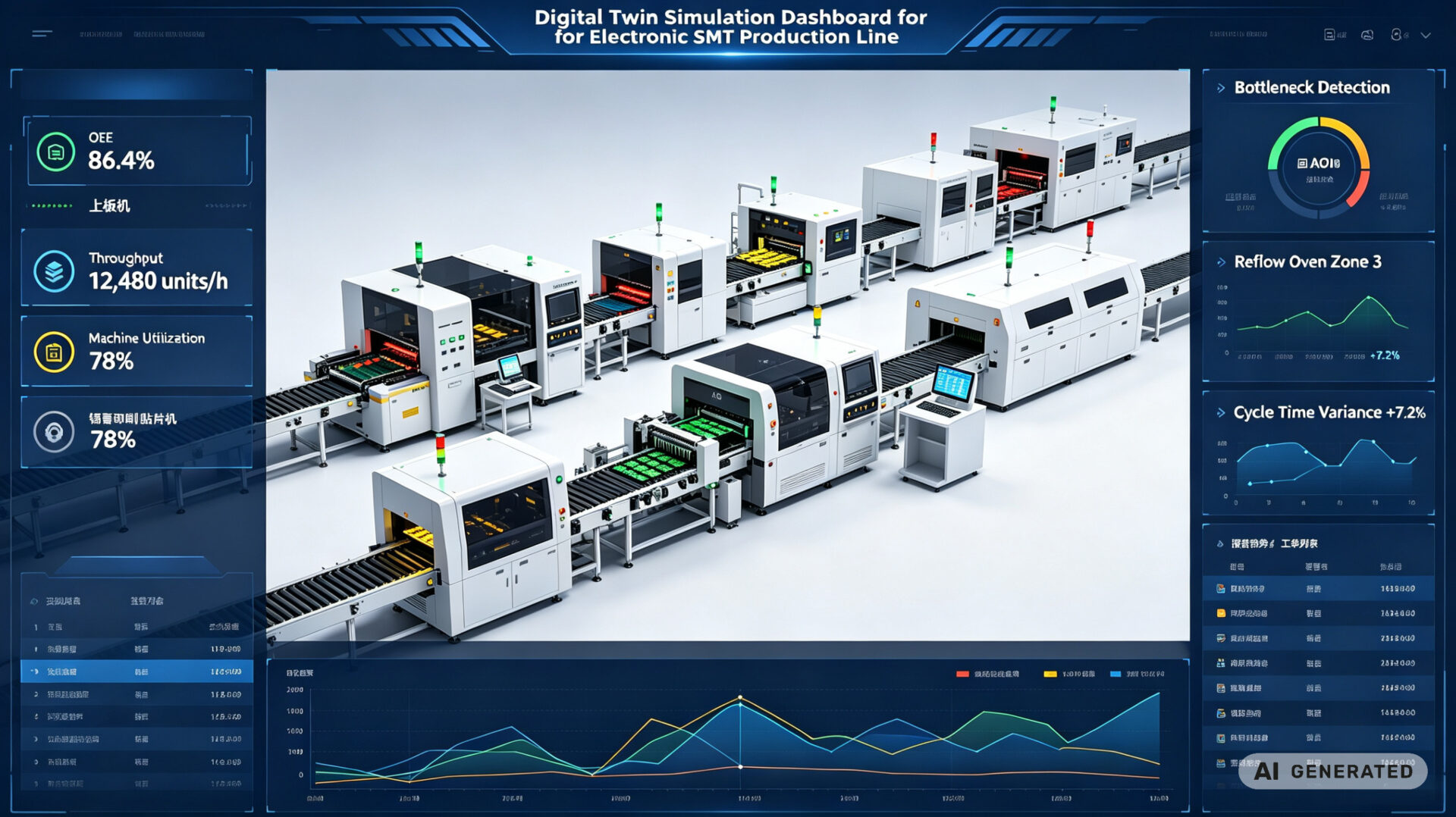
2. Building a Digital Twin of Your Electronics Production Line
Building a digital twin of an electronics production line is a structured process that integrates physical infrastructure, data acquisition, and simulation modeling. TPS Elektronik’s approach to digital twin manufacturing production follows a proven methodology:
Step 1: Physical Foundation
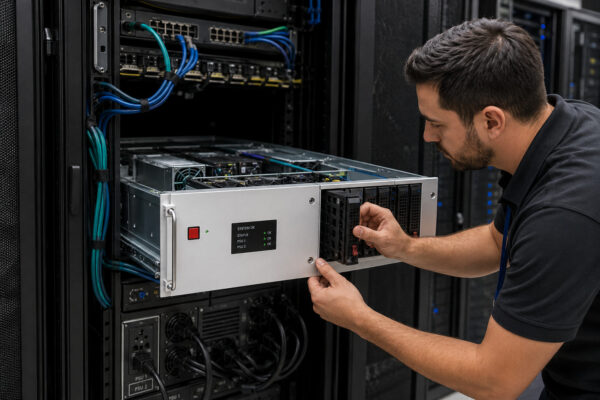
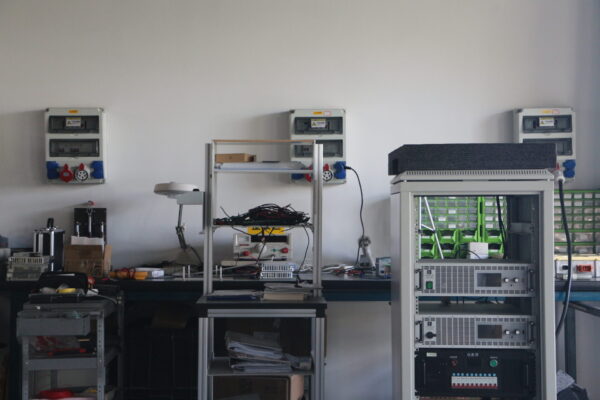
Smart manufacturing requires reliable digital systems and equally reliable physical infrastructure. TPS’s 19-inch industrial cabinets provide a standardized, mechanically robust, and adaptable foundation for industrial IT and control equipment. These cabinets designed with mechanical stability (supporting up to 1000 kg static loads), thermal management, and modular integration in mind.
Step 2: Data Acquisition and Connectivity
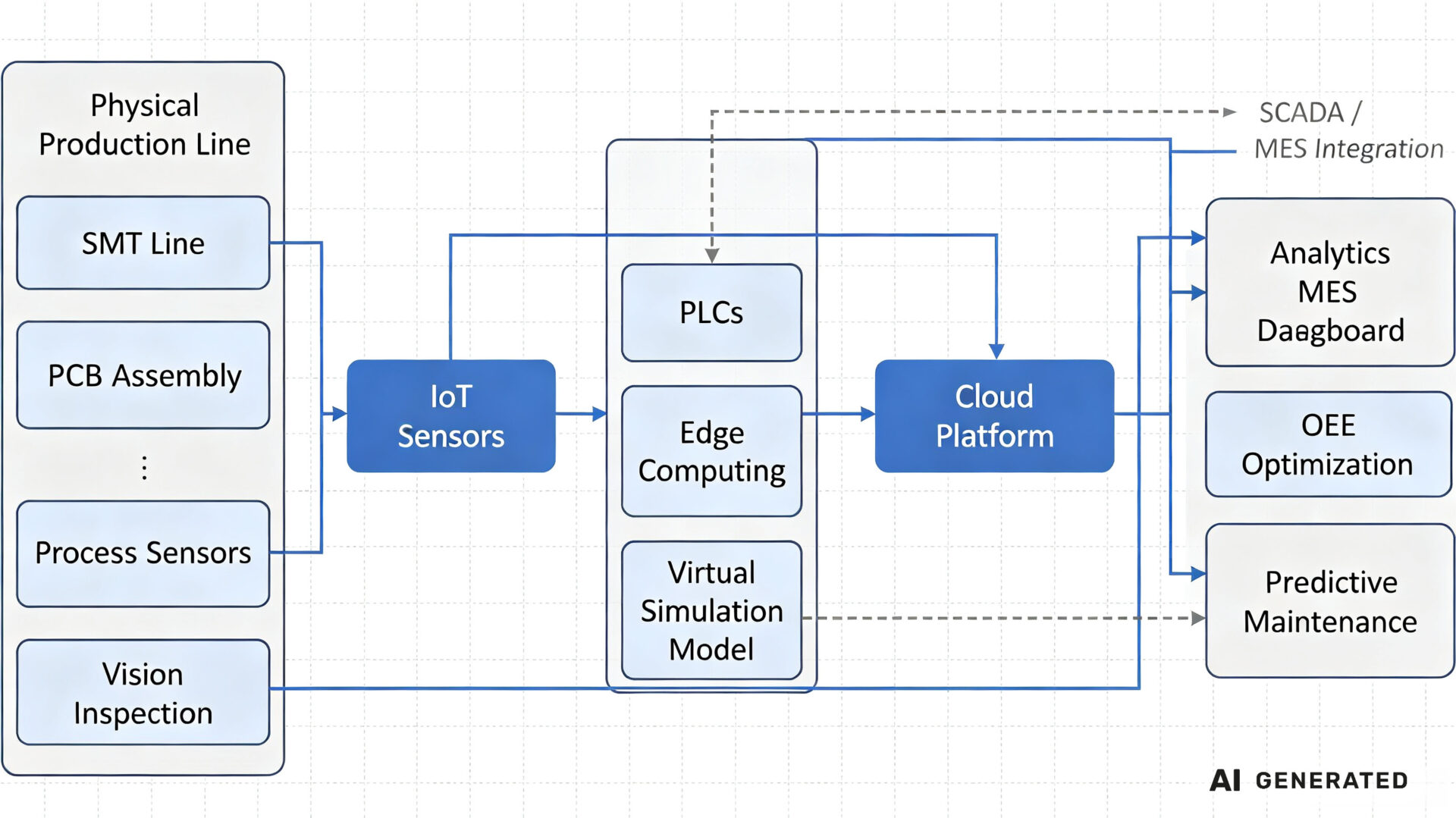
The digital twin is only as good as the data it receives. And TPS integrates PLC/IPC systems, safety PLCs, fieldbus networks, and SCADA/MES connectivity to collect real-time data from every machine and sensor on the production line. This includes:
- Machine status and cycle times from SMT placement equipment
- Temperature profiles from reflow ovens
- Inspection results from AOI and SPI systems
- Material flow data from conveyors and automated guided vehicles (AGVs)
Step 3: Virtual Modeling and Simulation
Using simulation platforms such as FlexSim and Visual Components, TPS builds a high-fidelity virtual model of the production line. This model includes all equipment, workstations, material flow paths, and operator interactions. The virtual model calibrated against historical production data to ensure accuracy.
Step 4: Real-Time Synchronization
The digital twin continuously updated with real-time data from the physical production line, enabling real-time monitoring, anomaly detection, and predictive analytics. When deviations detected—such as a component placement error or a temperature drift in the reflow oven—the digital twin can alert operators and recommend corrective actions.
For electronics manufacturing simulation, this integrated approach enables manufacturers to move from reactive troubleshooting to proactive optimization.
3. Simulation and Process Optimization: The Heart of the Digital Twin
The true power of a digital twin lies in its ability to simulate and optimize production processes before physical changes are made. This capability is particularly valuable in electronics manufacturing, where production lines are complex, changeovers are frequent, and downtime is expensive.
With a digital twin of your electronics production line, you can:
Simulate Production Scenarios Offline
Before implementing a new product introduction (NPI) or changing production parameters, engineers can simulate the entire process virtually. This includes validating SMT programs, optimizing placement sequences, and verifying that material flow is efficient. By catching issues in the virtual world, manufacturers avoid costly trial-and-error on the factory floor.
Identify and Eliminate Bottlenecks
Digital twin simulation reveals hidden bottlenecks that are not apparent during normal operation. By analyzing machine utilization, idle rates, and blocking rates, the simulation identifies which workstations are constraining overall throughput. Engineers can then test different configurations—adding a buffer, adjusting cycle times, or reallocating operators—to eliminate the bottleneck.
Optimize for High-Mix/Low-Volume Production
Electronics manufacturing increasingly involves high-mix, low-volume production with frequent changeovers. A digital twin enables manufacturers to simulate changeover scenarios, optimize setup sequences, and minimize changeover time—reducing the productivity loss associated with frequent product changes.
Reduce Commissioning Time
In a production line, commissioning a new machine or a new product can take days or weeks. With a digital twin, commissioning time can be reduced by over 80% by simulating and optimizing the process virtually. This accelerates time-to-market and reduces the risk of production delays.
4. Line Balancing and Throughput Optimization
Line balancing is one of the most impactful applications of digital twin technology in electronics manufacturing. An unbalanced production line—where some workstations overloaded while others are underutilized—wastes capacity, increases cycle time, and reduces overall equipment effectiveness (OEE).
A digital twin enables data-driven line balancing by simulating different configurations and identifying the optimal allocation of work across stations. Key optimization parameters include:
- Cycle time distribution: Ensuring that each workstation has approximately equal cycle times to maximize throughput
- Buffer allocation: Determining optimal buffer sizes between workstations to absorb variability without increasing work-in-progress (WIP)
- Operator allocation: Balancing manual and automated processes on the same lines
TPS Elektronik’s smart manufacturing solutions integrate line balancing simulation with the broader mechatronics and EMS workflow. TPS’s approach to process optimization simulation combines:
- PLC/IPC control integration for real-time data acquisition
- Motion control and servo systems for precise machine coordination
- Pneumatic and actuator integration for material handling and assembly
- SCADA/MES connectivity for data analytics and visualization
For electronics manufacturers, the results are significant: studies have shown that digital twin-enabled line balancing can increase productivity by over 13% and improve line balancing by over 8%, while equipment utilization increases by nearly 4.4%.
5. Quality and Yield Optimization Through Digital Twin Simulation
Quality and yield are the ultimate measures of electronics manufacturing performance. A production line that produces high-quality products with minimal rework is profitable; one that generates defects and scrap is not. Digital twin technology provides powerful tools for optimizing quality and yield.
Reflow Soldering Process Optimization
Reflow soldering is one of the most critical processes in surface-mount technology (SMT) assembly. Temperature profiles must be precisely controlled to achieve consistent solder joint quality. A digital twin of the reflow oven enables engineers to simulate temperature profiles, predict solder joint quality, and optimize oven settings without running production trials.
Placement Accuracy Validation
SMT placement machines must place components with micron-level accuracy. A digital twin can simulate placement programs, detect potential collisions or placement errors, and validate programs before they are deployed on the production line. This reduces the risk of misplacements that cause defects.
Defect Prediction and Closed-Loop Control
By integrating inspection data (from AOI and SPI systems) with the digital twin, manufacturers can predict defect patterns and implement closed-loop control. When a defect pattern is detected, the digital twin can recommend corrective actions—adjusting process parameters, recalibrating equipment, or reallocating resources—to prevent further defects.
Yield Optimization
The digital twin provides a virtual testbed for yield optimization experiments. Engineers can test different process parameters, material combinations, and equipment settings virtually, identifying the combination that maximizes yield—without risking production disruptions.
6. TPS Smart Manufacturing Capabilities: From Concept to Connected Factory
TPS Elektronik’s smart manufacturing solutions are built on a foundation of mechatronics expertise, EMS integration, and comprehensive automation capabilities. And TPS designs and builds mechatronic systems—from electro-mechanical subassemblies to turnkey automated lines—with assembly, testing, commissioning, and lifecycle support.
Mechatronics Integration:
TPS brings together mechanical design, electronics, control engineering, and embedded software to form functional systems. This integration is essential for digital twin implementation, as it ensures that the physical system and its virtual counterpart are aligned from the start.
EMS and Automation:
TPS provides end-to-end automated assembly solutions, handling the entire BOM and ensuring that every component—from PCBs and cable harnesses to machined parts and pneumatic assemblies—communicates perfectly with the PLC. This holistic approach reduces supply chain complexity and accelerates time-to-market.
Smart Factory Readiness:
TPS has extensive experience in assembling and testing intelligent mechatronic systems designed for IoT connectivity and smart factory environments. TPS’s capabilities include:
- PLC/IPC integration with safety PLCs and fieldbus networks
- SCADA/MES connectivity for real-time data analytics
- Motion control and servo integration for precision automation
- Documented FAT/SAT for quality assurance and compliance
From Pilot Cell to Full Line:
TPS supports projects from concept to commissioning, providing architecture concepts, risk assessment, and phased budgets—from a single pilot cell to a complete production line. This scalability ensures that digital twin capabilities can grow with your manufacturing operations.
For digital factory modeling production and virtual production line electronics applications, TPS provides the integrated mechatronics and EMS foundation that makes digital twin implementation possible—from physical infrastructure to data-driven optimization.