

Data Centers as Growing Energy and Thermal Systems
Data centers have become a critical part of modern infrastructure. Cloud computing, artificial intelligence, streaming services, and industrial digitalization rely on continuously operating server facilities. From an energy perspective, these installations are no longer marginal consumers. They represent concentrated electrical loads with high availability requirements and predictable operating profiles.
Alongside electrical consumption, data centers generate a significant amount of thermal energy. Electrical losses in power conversion, server operation, and auxiliary systems ultimately appear as heat. Traditionally, this heat has been treated as an unwanted by-product that must be removed to ensure reliable operation. Cooling systems are therefore designed primarily to reject heat to the ambient environment, often without further use.
As energy efficiency, grid capacity, and decarbonization become increasingly important topics, this approach is being re-evaluated. Waste heat from data centers is now increasingly considered a potential resource rather than an unavoidable loss.
Why Waste Heat Is a System-Level Challenge
Recovering and reusing waste heat is not a purely thermal problem. It is a system-level challenge that involves electrical design, thermal management, control strategies, and grid interaction.
From an electrical engineering perspective, several factors influence the quantity and usability of waste heat:
- Conversion losses in AC/DC and DC/DC power stages
- Load profiles and redundancy concepts
- Cooling architecture and temperature levels
- Integration with external energy systems
While improving electrical efficiency can reduce losses, it does not eliminate heat generation entirely. Even highly efficient power electronics dissipate energy during conversion. The question is therefore not how to remove heat as quickly as possible, but how to manage it intelligently within a broader energy system.
The challenge lies in matching the temperature level, timing, and location of waste heat generation with potential heat demand. This requires coordination across electrical, thermal, and infrastructure domains.
Finland as a Reference Example
Finland provides a relevant reference case for waste heat recovery from data centers. The country combines a cold climate with widespread district heating networks and a strong focus on energy system integration.
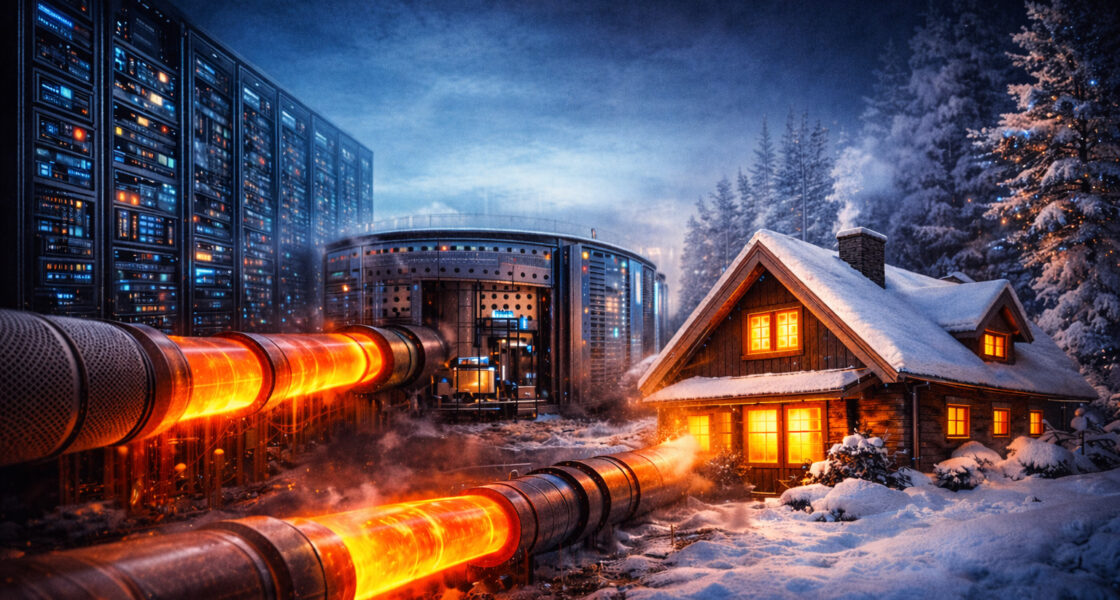
In several Finnish projects, heat generated by data centers is captured and transferred into district heating systems. Instead of rejecting low-grade heat to the ambient air, it is collected via liquid cooling loops and upgraded using heat pumps. The resulting thermal energy can then be supplied to residential and commercial buildings through existing heating infrastructure.
Some data centers are located underground, for example in former industrial facilities or tunnels. These environments can offer stable ambient conditions that support efficient thermal management. The focus, however, is not on architectural novelty, but on system integration and operational reliability.
Importantly, these projects do not treat data centers as isolated facilities. They are integrated into the local energy ecosystem, where electrical supply, thermal demand, and grid operation are considered together.
The Role of Power Electronics in Heat Generation and Efficiency
Power electronics play a central role in both the generation and management of waste heat in data centers. Every conversion stage — from grid connection to server-level power delivery — contributes to overall losses.
Key aspects include:
- Efficiency of rectifiers and converters
- Distribution architecture (AC versus DC)
- Redundancy and partial-load operation
- Bidirectional power flow capabilities
Higher efficiency reduces absolute losses, but more importantly, predictable and well-managed losses can simplify thermal integration. Power electronics designed for stable operation across a wide load range may support more consistent heat output, which can be beneficial for downstream heat recovery systems.
Bidirectional power systems are also increasingly considered in this context. While their primary function is electrical, they can support flexible operation and improved interaction with the grid. This flexibility may indirectly contribute to more stable thermal profiles and better integration into local energy systems.
Importance of System Integration
Effective waste heat recovery requires close coordination between electrical systems, thermal systems, and the public grid. Isolated optimization in one domain rarely leads to optimal results at system level.
Key integration aspects include:
- Electrical load management aligned with grid conditions
- Thermal storage to balance supply and demand
- Control systems that coordinate power and heat flows
- Interfaces between private facilities and public infrastructure
In Finland, district heating networks provide a ready-made interface for heat reuse. In other regions, similar integration may require additional infrastructure or alternative approaches. Nevertheless, the underlying principle remains the same: waste heat recovery only becomes viable when considered early in system design.
For engineers and planners, this means expanding the design scope beyond individual devices or subsystems. Power electronics, cooling systems, and grid interfaces must be evaluated as parts of a connected whole.
Implications for Future Infrastructure and Engineering Design
As data center capacity continues to grow, the relevance of waste heat recovery will increase. At the same time, electrical grids face growing pressure from electrification and digitalization.
From an engineering perspective, several implications emerge:
- Energy efficiency must be evaluated at system level, not only at component level
- Thermal effects should be considered during electrical system design
- Interfaces between private energy systems and public infrastructure will gain importance
- Flexibility and controllability will become key design criteria
Waste heat recovery is not a universal solution, nor is it applicable in every location. However, it illustrates how integrated thinking can unlock additional value from existing energy flows.
Conclusion: Waste Heat as a Design Consideration
The Finnish experience shows that waste heat from data centers can be treated as a design parameter rather than an unavoidable by-product. Achieving this requires technical coordination, appropriate infrastructure, and a system-oriented engineering mindset.
For power electronics engineers and system designers, this development highlights the growing importance of efficiency, controllability, and integration. Electrical systems do not operate in isolation. Their thermal behavior, grid interaction, and role within larger energy systems are increasingly relevant.
As energy systems evolve, waste heat recovery may support more resilient and efficient infrastructure — not through isolated innovation, but through careful system design and engineering collaboration.