

Precision Voltage Control with Galvanic Isolation
In electronics manufacturing, research, and repair environments, Electrostatic Discharge (ESD) represents a continuous risk to sensitive components. Even minor electrostatic events can damage assemblies, cause latent defects, or affect measurement accuracy.
Effective ESD protection therefore extends beyond wrist straps and grounded work surfaces. It also includes the selection of appropriate power sources. Adjustable AC isolation transformers are specifically suited for applications where variable voltage and electrical isolation are required within ESD-controlled areas.
This article explains the technical background, key selection criteria, and typical applications of adjustable AC isolation transformers, using the TPS-AIT1500300 as a practical example.
Key Takeaways
- Standard variable autotransformers (variacs) do not provide galvanic isolation and may introduce ground loop risks in ESD environments.
- An adjustable isolation transformer combines variable AC output with primary–secondary isolation.
- Galvanic isolation helps reduce unwanted common-mode effects between equipment and the ESD ground system.
- Integrated metering and overcurrent protection support controlled testing procedures.
- Typical selection criteria include isolation rating, output range, power capacity, protection mechanisms, and mechanical design.
Why Standard Variacs Are Not Ideal for ESD Zones
A conventional variac is a variable autotransformer with a single winding and movable contact. It enables efficient and continuous voltage adjustment. However, the input and output share a common electrical reference.
In ESD-controlled areas, this design can create challenges:
- No galvanic isolation between mains and output
- Increased likelihood of ground loop formation
- Potential influence on sensitive measurement setups
For basic voltage adjustment tasks, a variac may be sufficient. For ESD-sensitive testing, however, isolation is typically required.
From Autotransformer to Adjustable Isolation Transformer
An isolation transformer uses separate primary and secondary windings. This design provides galvanic isolation, meaning there is no direct conductive path between input and output.
An adjustable AC isolation transformer integrates:
- A true isolation transformer stage
- A variable output mechanism
- Protection and monitoring functions
The result is a variable AC power source that maintains electrical separation from the mains supply. This configuration supports controlled testing within grounded ESD infrastructures.
Product Example: TPS-AIT1500300 Adjustable Isolation Transformer
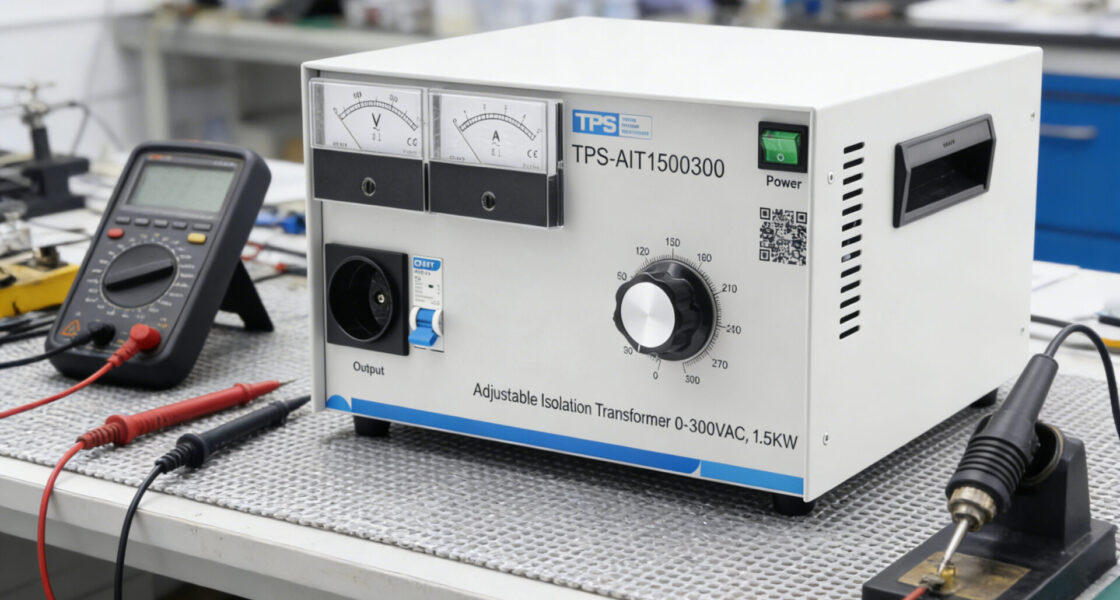
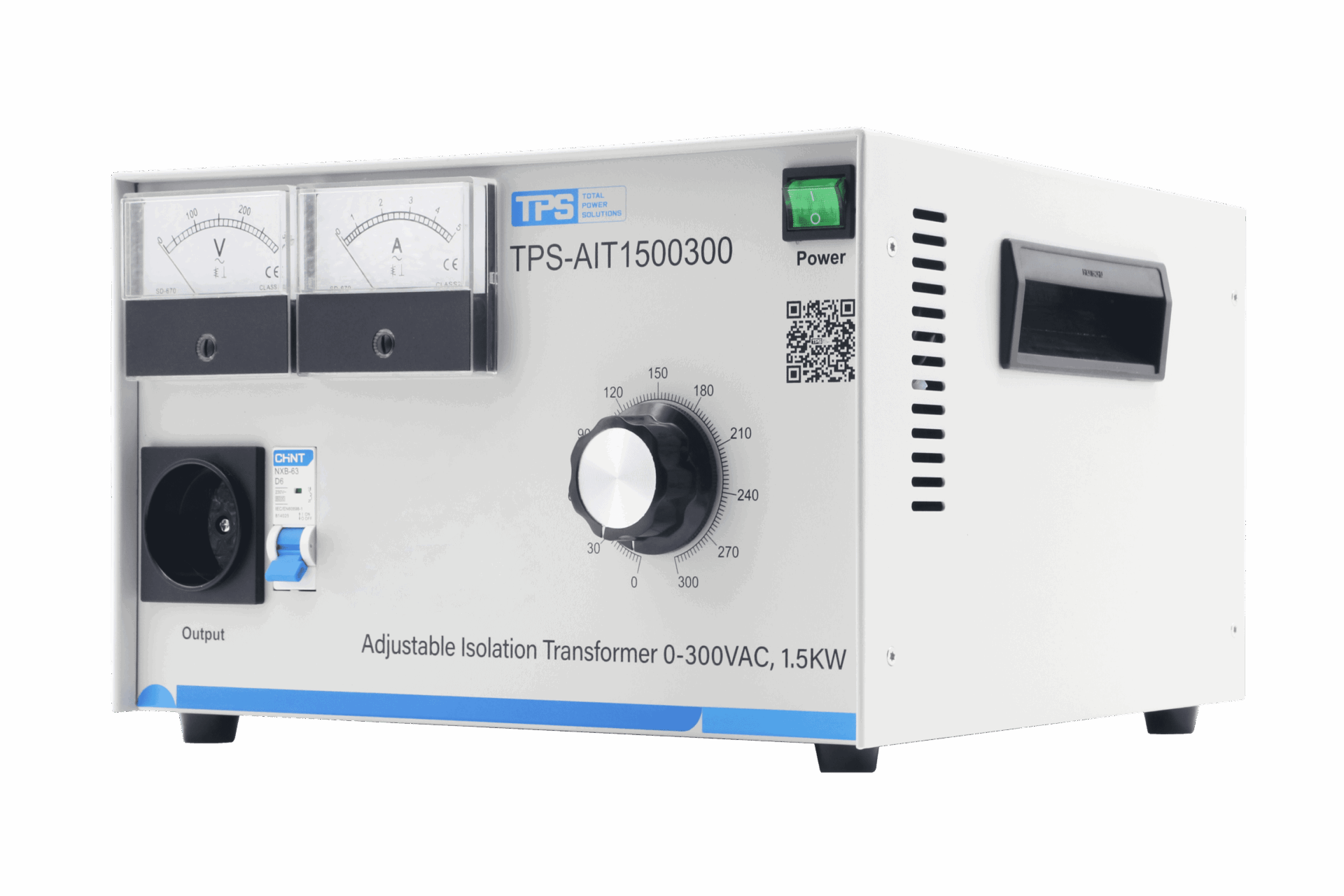
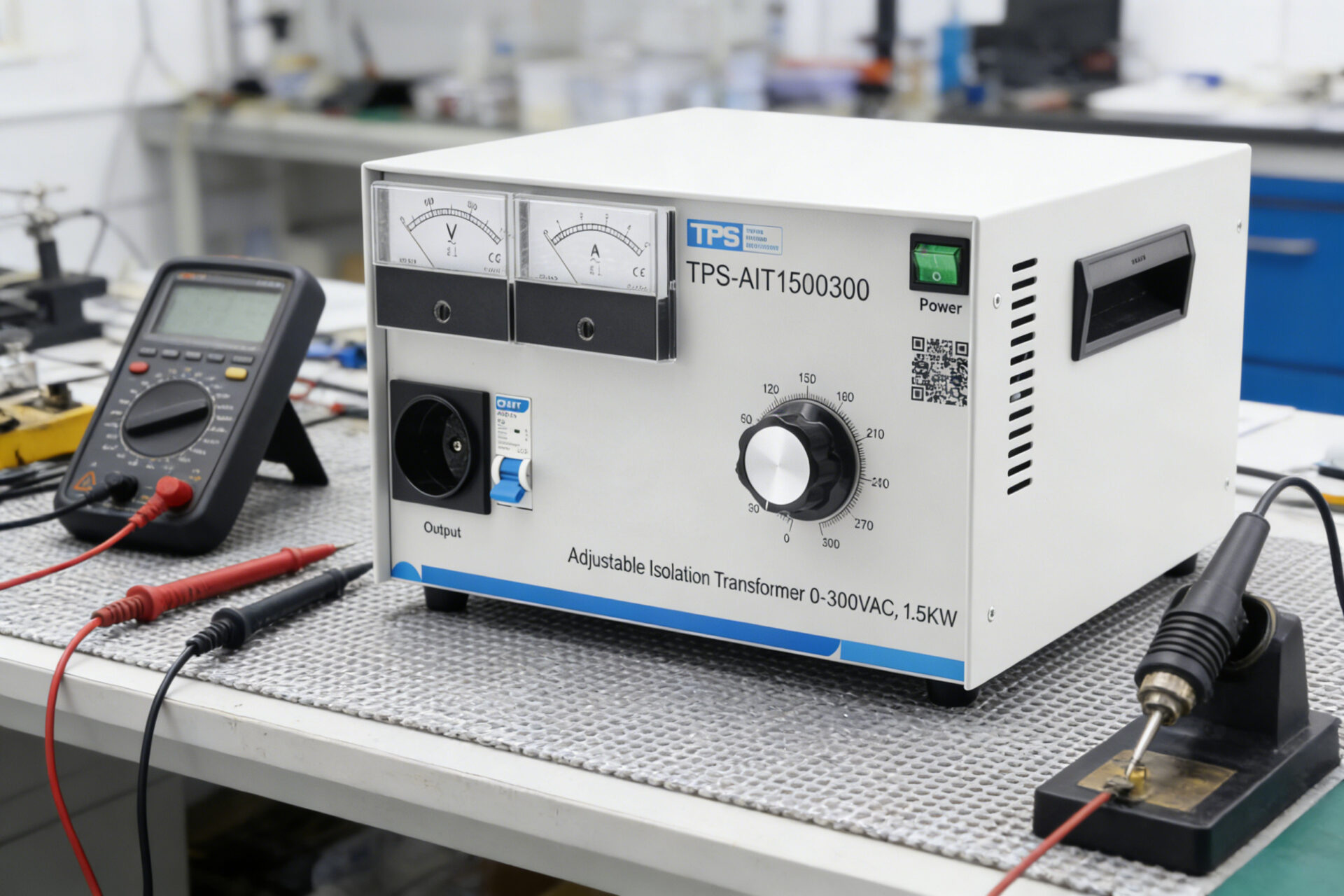
The TPS-AIT1500300 is a bench-top adjustable isolation transformer designed for laboratory, workshop, and quality assurance applications.
Key Technical Data
| Parameter | Specification | Practical Relevance |
|---|---|---|
| Input | 230 VAC, 48–62 Hz, 6 A | Suitable for standard European mains |
| Output (Adjustable) | 0 – 300 VAC, 4.5A, 1500W (1.5KW) | Wide adjustable range for functional and stress testing |
| Over Current Protection | 5A air circuit breaker | Protection for transformer and DUT |
| Metering | Analog voltmeter & ammeter | Direct visual monitoring of voltage and current |
| Isolation Rating | 3000 VAC (primary–secondary) | Reinforced separation between mains and output |
| Cooling | Convection | Low-noise operation, reduced maintenance |
| Dimensions / Weight | 301 × 276 × 183 mm / 21 kg | Stable bench-top installation |
The front panel layout includes a large voltage adjustment knob, integrated analog meters, and output receptacles for controlled operation.
Design Characteristics
- Convection cooling avoids fan noise and reduces dust intake.
- IP20 enclosure provides basic protection against contact with live parts.
- Robust mechanical housing supports regular laboratory or workshop use.
Operational suitability should always be assessed according to the specific environmental conditions of the installation site.
Typical Applications
1. Electronic Repair and Diagnostics
Technicians can gradually increase output voltage from 0 VAC while monitoring current consumption. This approach supports controlled fault detection, for example when checking for short circuits or abnormal inrush behavior.
Isolation reduces interaction between the device under test (DUT) and the building’s grounding system.
2. Research and Development (R&D)
In R&D environments, adjustable isolation transformers allow:
- Functional verification across different mains voltage levels
- Controlled undervoltage and overvoltage testing
- Reduced ground-related measurement disturbances when using oscilloscopes or analyzers
They are frequently used in prototype validation and design verification phases.
3. Quality Assurance and Production Testing
For QA processes, the adjustable output enables:
- Line regulation testing
- Functional validation at voltage extremes
- Controlled stress testing within defined limits
The integrated circuit breaker supports automated interruption in case of overload or device failure.
4. Education and Technical Training
In technical education, adjustable isolation transformers provide a practical platform to demonstrate:
- Transformer principles
- Voltage–current relationships
- Effects of input variation on system behavior
- Basic ESD protection concepts
Analog meters offer direct visual feedback, which can be beneficial in instructional environments.
5. Industrial and Automotive Workshops
Industrial control systems, PLCs, and automotive ECUs often require controlled voltage simulation during diagnostics. Adjustable isolation transformers can be used to reproduce defined voltage conditions in a workshop environment.
Application limits should always be verified against the technical specifications of both the transformer and the DUT.
Integration into an ESD Workstation
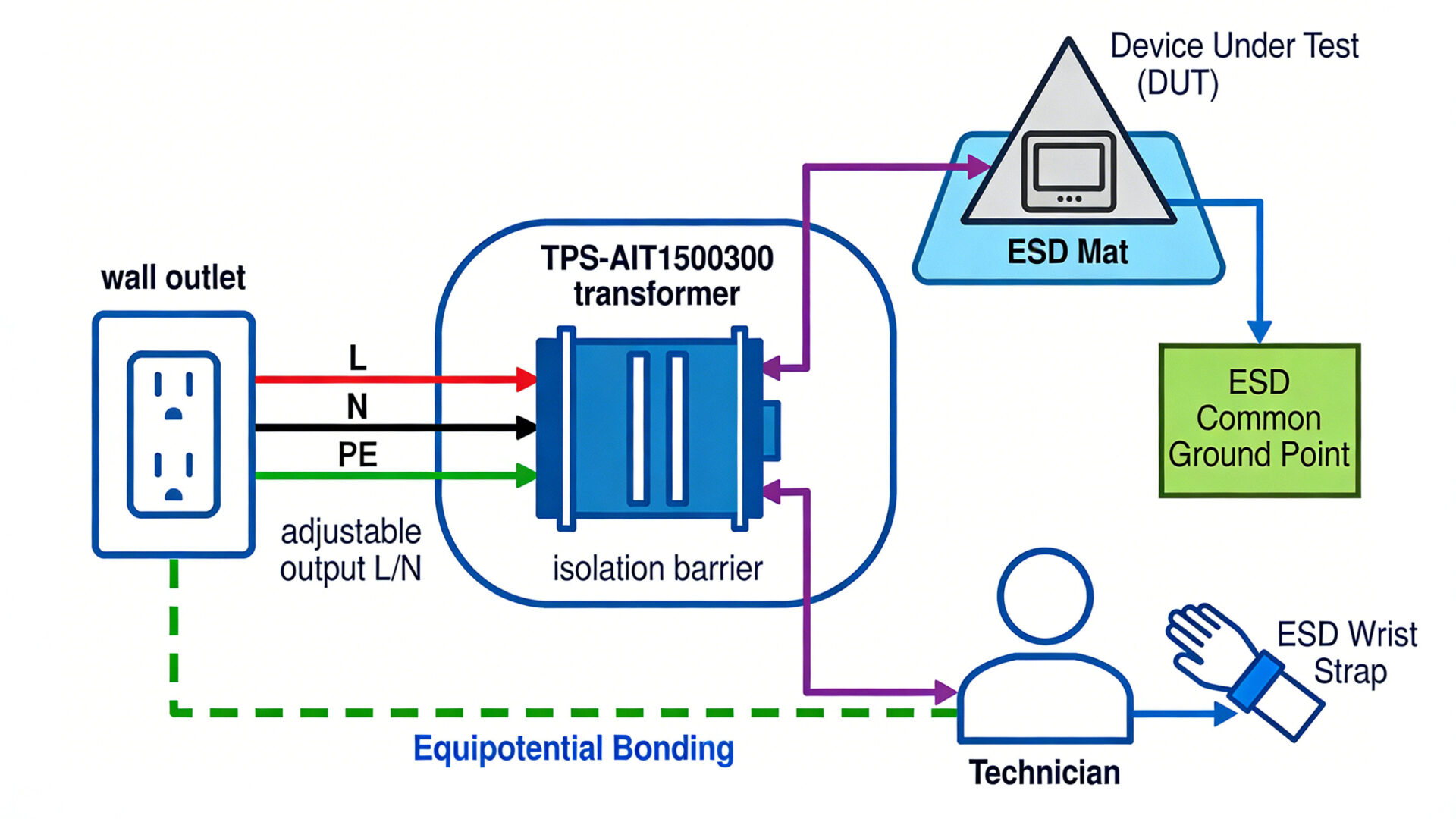
Correct grounding is essential.
- The transformer chassis must be connected to protective earth (PE).
- The ESD work surface and wrist straps connect to the ESD common point ground (CPG).
- The CPG is bonded to protective earth in a defined single-point configuration.
This grounding concept ensures that all conductive elements remain at a common reference potential while the isolation barrier separates the DUT from the mains supply.
Implementation should follow applicable ESD control standards and internal compliance procedures.
Conclusion
Adjustable AC isolation transformers provide a combination of variable voltage control and galvanic isolation. In ESD-controlled environments, this configuration can support safer testing procedures compared to non-isolated autotransformers.
The TPS-AIT1500300 represents a practical example of such a solution, offering:
- 0–300 VAC adjustable output
- 1500 W nominal capacity
- Integrated metering and overcurrent protection
- Primary–secondary isolation
For laboratories, repair facilities, training centers, and quality assurance stations, an adjustable isolation transformer can be a suitable tool where controlled voltage variation and electrical separation from the mains are required.
Selection should always be based on application requirements, power demand, and applicable safety standards.