ACDC Bidirectional Power Modules: Revolutionizing Battery Testing and Formation Systems

15 Min Reading time
Written by
Kael Yuan
Published on
26. February 2026

Key Takeaways

  • ACDC bidirectional power modules serve as the core technology in modern battery formation and testing systems. They enable precise, energy-efficient charge and discharge cycles for lithium-ion cell production and validation.
  • These advanced power converters perform dual functions. They act as precise AC to DC converters for controlled charging. They also serve as high-fidelity DC to AC inverters for regenerative discharging, recovering up to 93.5% of energy during testing.
  • They offer exceptional electrical performance. This includes high power factor (>0.99), low total harmonic distortion (THDi <5%), and voltage accuracy of 0.5%. These features ensure testing consistency and compliance with grid power quality standards.
  • Their modular design allows for parallel operation. This lets testing system manufacturers scale from single-channel R&D stations to high-throughput production line systems. Automatic current sharing ensures balanced power distribution.
  • Forced air cooling with intelligent thermal management maintains optimal operating temperatures. This enables reliable performance in demanding industrial environments without derating at 45°C.
  • Comprehensive safety features and certifications include UL, CE, TUV, and RoHS compliance. This ensures reliable operation in industrial battery manufacturing facilities worldwide.

The Driving Force: From Energy-Consuming to Energy-Recovering Testing

The global transition to electrification has placed unprecedented demands on battery technology. Performance and reliability begin long before cells reach electric vehicles or energy storage systems. The formation and testing phase is one of the most critical—and energy-intensive—stages in battery manufacturing. Here, newly assembled lithium-ion cells undergo their initial charge and discharge cycles. This activates electrode materials, forms stable solid-electrolyte interphase (SEI) layers, and screens for defects.

Traditional testing systems use resistive loads that dissipate energy as heat. These have become increasingly unsustainable amid rising energy costs and environmental imperatives. This challenge has catalyzed a fundamental transformation in battery manufacturing infrastructure. Bidirectional power conversion technology is now the cornerstone of next-generation, energy-recyclable testing systems.

Core Principle: Unified Bidirectional Power Conversion

At the heart of this transformation lies the bidirectional AC-DC power module. This sophisticated electrical converter enables “regenerative” or “energy-recyclable” testing. Unlike conventional systems, bidirectional modules integrate both charging and discharging functions within a single, intelligent unit. Conventional systems use separate AC to DC power supplies for charging and resistive electronic loads for discharging.

During battery charge cycles, these modules operate as high-precision AC to DC converters. They transform grid electricity into meticulously controlled DC power. During discharge cycles, the same hardware seamlessly transitions to function as a grid-tied DC to AC inverter. It converts the stored DC energy from the battery back into clean AC electricity. This energy can be fed directly back into the facility’s electrical system.

This elegant dual capability transforms battery testing. It changes from a costly, wasteful necessity into a controlled, energy-efficient process. It delivers superior test parameter control while dramatically reducing operational expenses and environmental impact.

Technical Foundation: Precision Power Conversion for Battery Applications

Advanced Power Semiconductors and Topology

The TBM14V series of bidirectional power modules exemplifies the advanced engineering required for modern battery testing. These systems are built upon sophisticated power semiconductor topologies. They typically utilize insulated-gate bipolar transistors (IGBTs) or advanced silicon carbide (SiC) MOSFETs. These are arranged in bridge configurations that facilitate true bidirectional energy flow.

A fundamental requirement in industrial settings is galvanic isolation between the AC grid and the DC battery circuits. This is achieved through high-frequency transformers. This isolation is critical for safety. It is especially important in multi-channel test racks where numerous cells are processed simultaneously.

The control system is often centered on powerful digital signal processors (DSPs) or field-programmable gate arrays (FPGAs). It executes complex algorithms that manage everything from basic charge/discharge sequences to intricate multi-stage formation profiles. This management occurs with millisecond precision.

Accuracy and Stability: Keys to Consistent Testing

High-performance bidirectional modules are distinguished by their exceptional accuracy and stability. Specifications include voltage control precision of ±0.5% and excellent current regulation. These ensure consistent formation results, which is a non-negotiable requirement for final battery quality and performance.

A maximum ripple voltage of 500mV is crucial. Excessive voltage fluctuation can induce unwanted electrochemical stress on cells during testing. This stress can compromise cycle life and performance predictability.

When operating in inverter mode during discharge cycles, these modules maintain impeccable grid-compliant power quality. Their total harmonic distortion (THDi) is consistently below 5%. Their power factor exceeds 0.99. This ensures seamless energy reinjection into the facility’s mains. It avoids causing disruptive harmonics or incurring utility penalty charges for poor power factor.

Rapid Mode Switching and Parallel Scalability

The operational agility of these modules is another key advantage. They have a rapid switching time of less than 10 milliseconds between rectifier (charge) and inverter (discharge) modes. This enables sophisticated testing protocols that accurately simulate real-world usage patterns. These include rapid transition tests to evaluate battery response to sudden load changes. They also include precise pulse testing for power capability assessment and complex profile testing that mimics specific application duty cycles.

The seamless voltage switching during these mode transitions prevents potentially damaging voltage spikes or interruptions. Such issues could invalidate test results or harm sensitive battery management electronics.

For system builders, the inherent parallel operation capability is crucial. It supports configurations of up to eight modules with automatic current sharing. This maintains imbalance below 5%. It enables seamless power scaling from compact benchtop R&D setups to full-scale, high-throughput production-line systems.

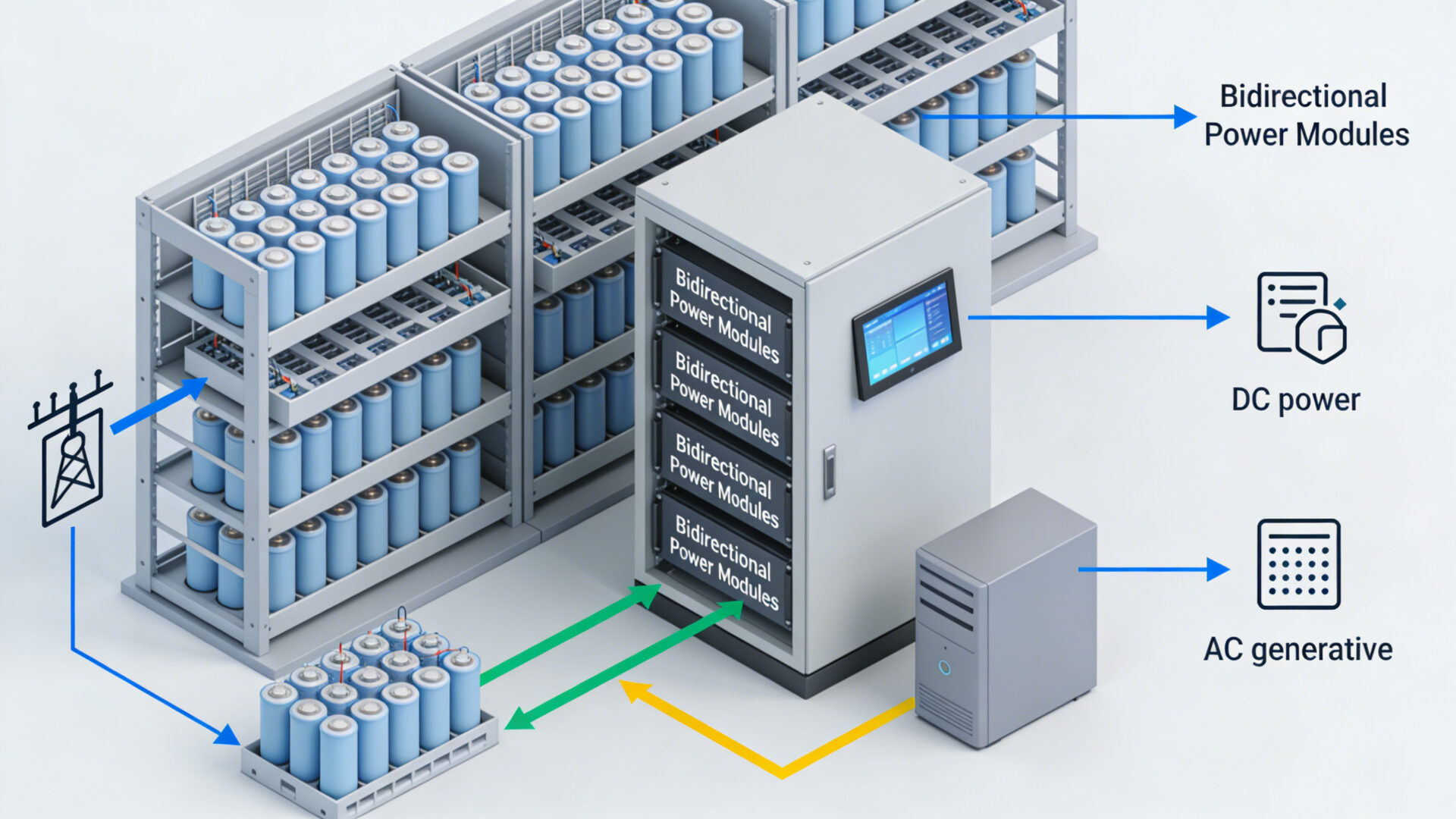
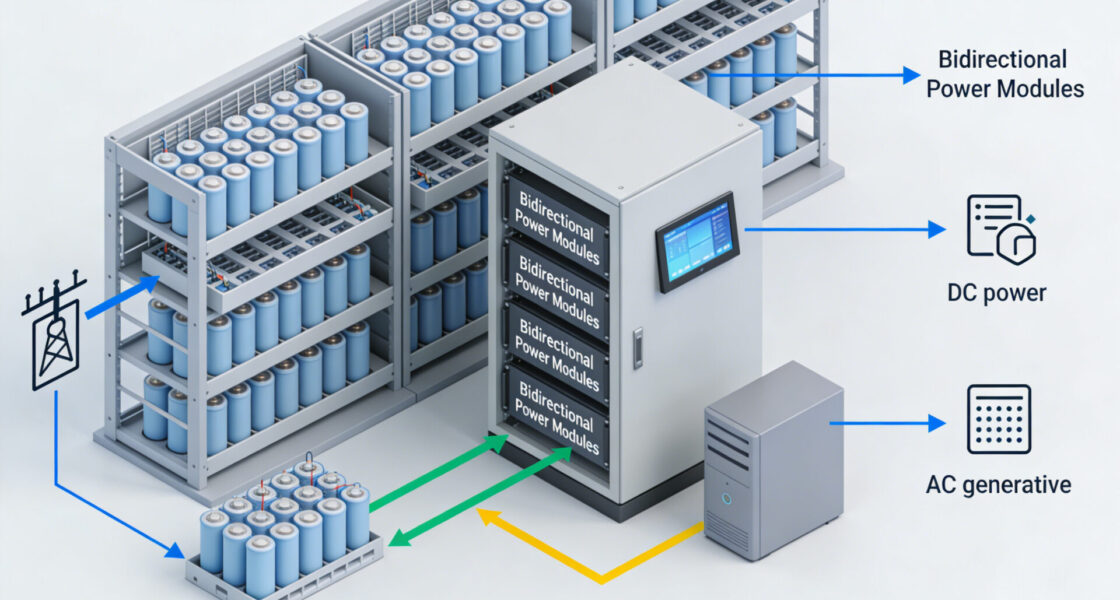
System architecture of an industrial battery formation and testing rack, highlighting the integration of bidirectional AC-DC power modules and the energy flow path between the electrical grid and battery cells under test.

Core Application: Battery Formation – Activating Cell Chemistry

Formation Process Overview: Shaping the Electrochemical Microstructure

Battery formation is the most critical and defining application for bidirectional power modules. This initial conditioning involves a series of meticulously controlled charge and discharge cycles. These cycles literally “form” the electrochemical microstructure of a lithium-ion cell.

The process typically begins with a low-current charge. This gradually builds the crucial solid-electrolyte interphase (SEI) layer on the anode. This passivating layer dictates long-term cycle life, safety, and performance stability. Subsequent cycles may incorporate various rest periods, differing charge rates (C-rates), and specific depth-of-discharge (DoD) patterns. All are carefully designed to optimize the cell’s characteristics for its intended application, whether for electric vehicles, grid storage, or consumer electronics.

Traditional Limits and the Regenerative Solution

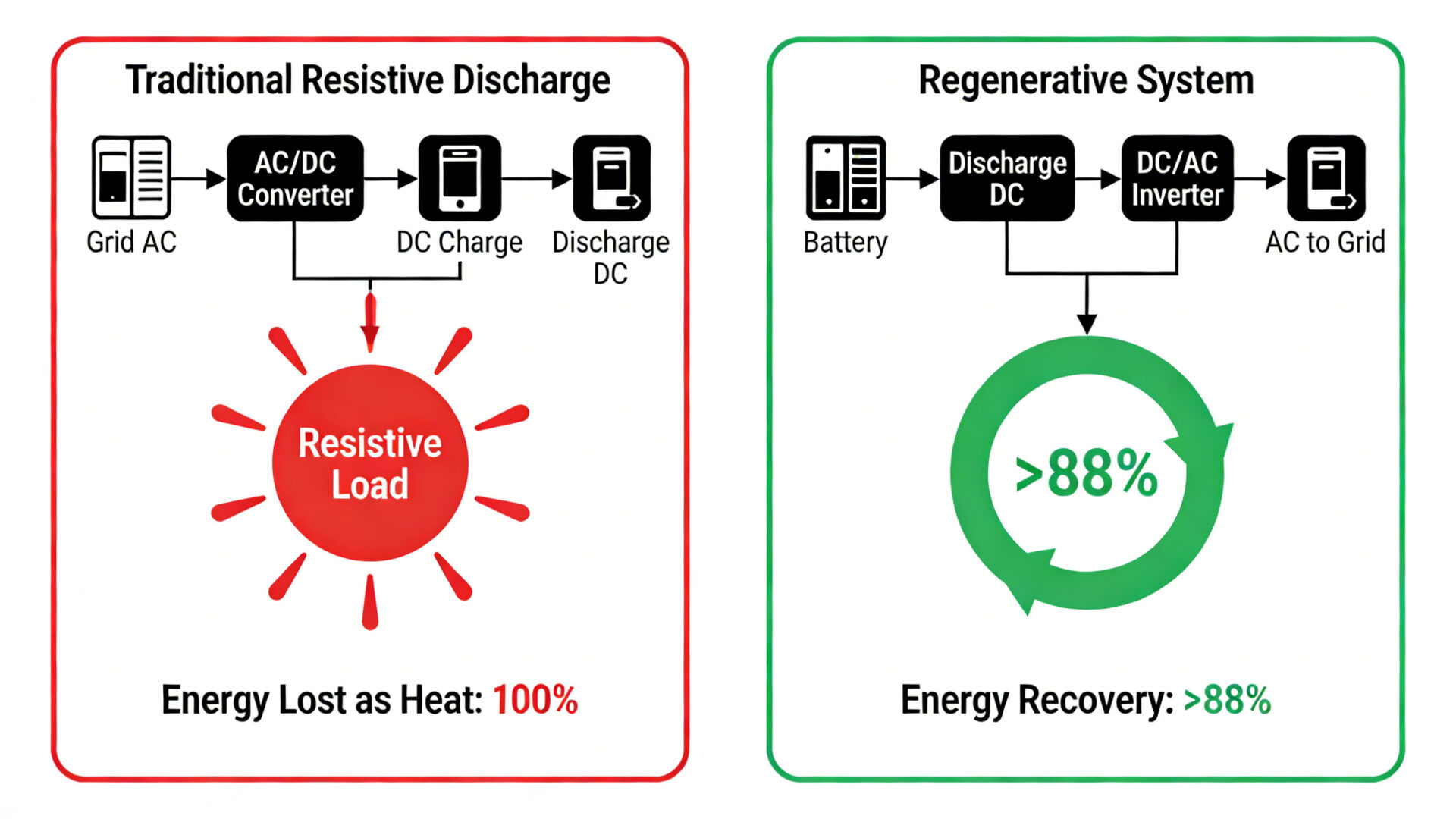
Traditional formation systems rely on separate charging equipment and resistive discharge loads. They suffer from significant limitations. Their overall energy efficiency rarely surpasses 40-50%. The entirety of the discharge energy is irrecoverably converted into waste heat. This represents a substantial operational cost. It also creates major thermal management challenges, requiring extensive and expensive cooling infrastructure.

Furthermore, control precision during the discharge phase is inherently limited. Resistive loads offer crude, inefficient regulation compared to the active, precise control of a bidirectional inverter.

Regenerative systems built around bidirectional modules disrupt this paradigm. They provide instrument-grade control throughout the entire charge-discharge cycle. Their energy recovery efficiencies reach 86% to 88.5%. This means the vast majority of the discharge energy is recuperated and returned to the facility. The result slashes energy costs, minimizes cooling demands, and creates a more stable thermal environment for consistent testing.

Quantifying the Economic Impact

The economic impact is substantial and calculable. Consider a medium-scale battery production facility. It operates a formation line with 100 channels, each rated at 2.4kW (240kW total). A traditional resistive system operating 24/7 would consume approximately 2.1 million kWh annually. A regenerative system with 88% discharge efficiency would reduce this net consumption to about 252,000 kWh. This is an annual saving of around 1.85 million kWh.

At industrial electricity rates, this translates to direct cost savings of hundreds of thousands of dollars per year. It ensures a rapid payback period for the capital investment in advanced technology. Beyond direct savings, the enhanced process control improves first-pass yield and cell quality uniformity. These factors directly reduce scrap rates, improve product value, and lower long-term warranty risks.

Comparative diagram illustrating energy flow: traditional battery testing with resistive discharge (high energy loss as heat) versus modern regenerative testing using a bidirectional power converter (high energy recovery back to the grid).

Comprehensive Cell Testing and Validation

While formation establishes the foundational cell chemistry, comprehensive testing encompasses a broader suite of procedures. These are essential for quality assurance, performance grading, and application-specific validation. These tests typically follow the formation process. They include capacity verification, cycle life testing, rate capability assessment, and various abuse tests. Each category presents distinct power requirements that bidirectional modules are uniquely equipped to satisfy.

Capacity testing determines the actual energy storage capability of each cell. It demands instrumentation-grade accuracy in both charge and discharge measurements. Bidirectional systems provide the integrated, high-precision measurement capabilities needed for reliable data. They often achieve better than 0.05% accuracy for current and voltage.

Cycle life testing evaluates long-term degradation over hundreds or thousands of cycles. It benefits enormously from energy recovery. A 1,000-cycle test on a high-capacity cell can involve transferring hundreds of kilowatt-hours of energy. Recovering 88% of this energy dramatically alters the economics of such extended, resource-intensive validation protocols.

Rate capability testing characterizes performance at different charge and discharge currents. It requires power converters with excellent dynamic response. The fast slew rates (exceeding 1A/μs) of modern bidirectional modules enable precise pulse testing. This is crucial for characterizing a cell’s internal impedance and peak power capability.

For abuse testing, comprehensive protective features become invaluable. These tests include short-circuit simulation, overcharge, and over-discharge evaluations. Integrated fault protection guards against overcurrent, overvoltage, overtemperature, and reverse polarity conditions. This safeguards both the expensive test equipment and the batteries under evaluation.

The modular design philosophy allows test system engineers to architect optimal solutions. Power resources can be optimally allocated across different test types within a single rack. This maximizes capital utilization and flexibility.

Energy Recyclable Aging: Sustainability Meets Throughput

Battery aging tests represent the most prolonged and resource-intensive validation procedures. They often run continuously for weeks or months to simulate years of field use. Traditional aging systems face a fundamental bottleneck. It is the trade-off between test chamber density and thermal management. The copious heat generated by resistive discharge limits how closely cells can be packed. This constrains facility throughput and demands massive cooling infrastructure.

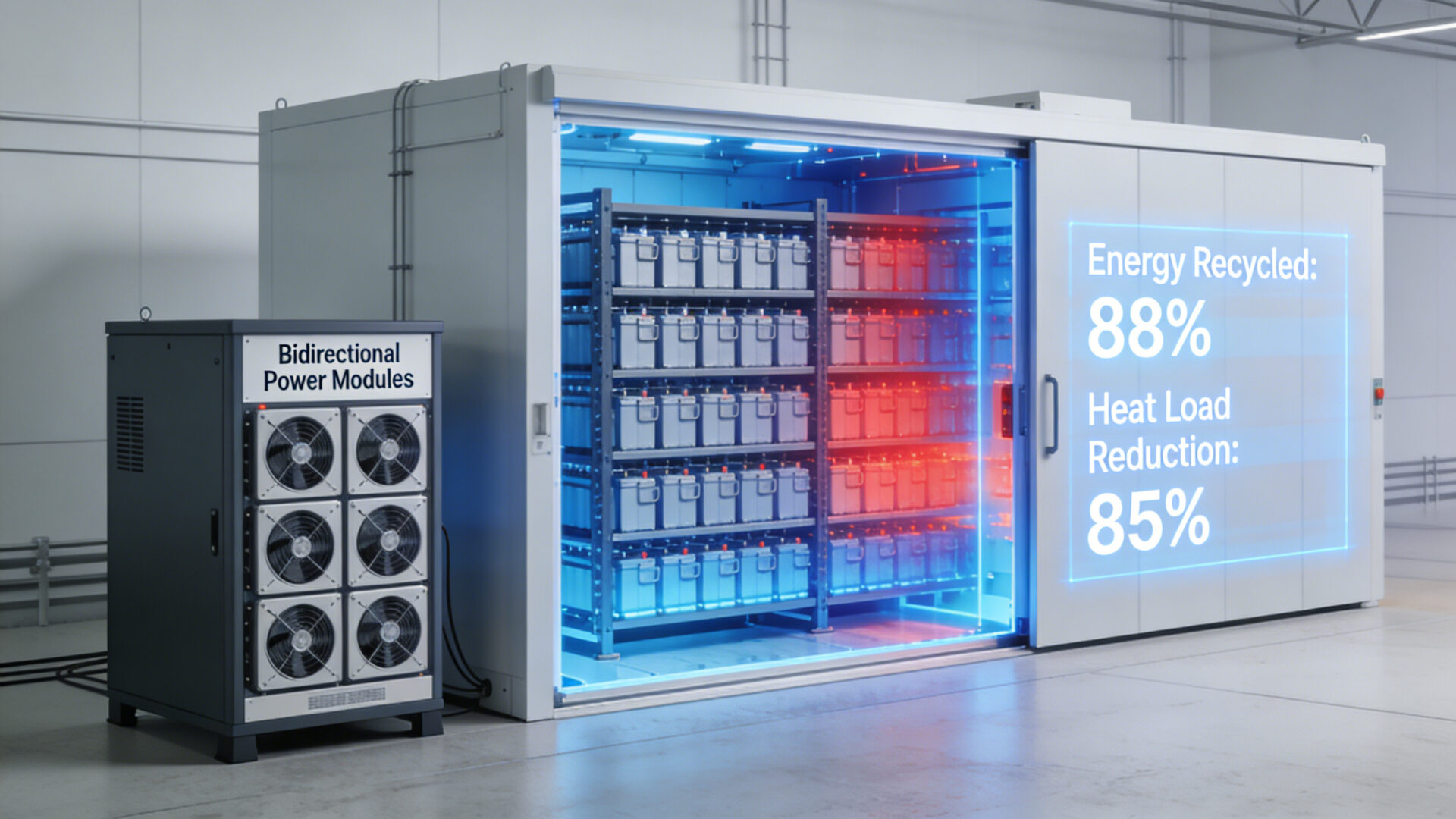
Energy recyclable aging systems revolutionize this dynamic. They are powered by bidirectional modules. By recovering most of the discharge energy rather than dissipating it as heat, these systems drastically reduce the thermal load. For instance, a 50kW aging rack would generate approximately 42.5kW of waste heat with resistive discharge. A regenerative system with 88% efficiency cuts this thermal output to about 6kW. This is a reduction of over 85%.

This transformational decrease allows for significantly higher cell density within environmental chambers. It increases overall facility capacity without expanding cooling plants. It also promotes superior temperature uniformity for more consistent and reliable aging data.

The operational benefits are multifaceted. Reduced heat generation extends the lifespan and reliability of test chamber cooling systems. It also lowers their maintenance needs. A cooler operating environment inherently diminishes the risk of thermal runaway events during testing of defective cells.

Most importantly, the dramatic reduction in energy cost makes comprehensive aging studies economically viable. Where a 2,000-cycle life test might have been prohibitively expensive, regenerative systems make it standard practice. This leads to better-understood battery safety margins and more accurate lifetime predictions. Ultimately, it produces superior products.

Cutaway view of a high-density, energy-recyclable battery aging test chamber. The design utilizes bidirectional power modules to minimize thermal load, allowing for increased cell capacity and stable temperature distribution.

System Integration and Scalable Architecture

The full value of bidirectional power modules is realized through their integration into complete, automated test systems. Modern battery test platforms combine precision power conversion, synchronized measurement, sophisticated control, and comprehensive safety subsystems. The modular architecture of products like the TBM14V series is foundational to this integration. It enables manufacturers to build scalable solutions ranging from single-channel R&D workstations to massive, multi-rack production line systems.

In a typical implementation, multiple bidirectional modules operate in parallel. They are under the master coordination of a system controller. This controller manages complex test sequences and orchestrates safety interlocks. It also aggregates high-volume data acquisition and interfaces with factory networks.

The parallel operation capability enables linear power scaling. It seamlessly supports multiple units with automatic current sharing. This preserves the precise, independent control of each test channel. This distributed architecture also introduces valuable redundancy. Should one module require service, the remaining modules can continue operating at a derated capacity. This avoids a complete and costly production halt.

Communication interfaces are the nervous system of these integrated solutions. Most advanced modules support industry-standard protocols like CAN bus. This is for real-time, robust control and status reporting. It is complemented by Ethernet or RS485 for higher-level system integration and data logging.

This connectivity enables critical features. These include remote monitoring and control, automated report generation, and deep integration with Manufacturing Execution Systems (MES). Such integration is for full traceability and quality management. The ability to precisely timestamp every test event and correlate it with electrical parameters is invaluable. It fosters process optimization and root-cause analysis, leading to continuous improvement in battery manufacturing quality.

Performance Specifications: Engineered for Industry

The technical specifications of a bidirectional power module directly translate to performance in a battery test setting. High conversion efficiency is not merely an energy-saving metric. It is 93.5% in AC to DC mode and 86-88.5% in DC to AC mode. This efficiency directly correlates with thermal performance and long-term reliability. Lower conversion losses mean less internal heat generation. This reduces stress on components and enhances the module’s operational lifespan.

The high power factor (>0.99) ensures the system presents a nearly ideal resistive load to the facility grid. This minimizes reactive power draw. It prevents penalty charges from utilities and reduces stress on the site’s electrical distribution infrastructure.

Output specifications are tailored to battery testing needs. A 14VDC output range perfectly accommodates testing of most single lithium-ion cells or small series strings. The 15VDC input range for inverter operation aligns with typical cell discharge voltage profiles. Current capabilities from 161A to 189A support the testing of high-capacity pouch or prismatic cells, as well as multi-cell parallel configurations.

The 0.5% voltage accuracy is critical. It ensures every cell in a batch receives an identical formation profile. The tightly controlled 500mV ripple voltage is essential. It prevents undesired electrochemical side reactions during testing.

Environmental specifications reflect the realities of industrial deployment. The full-load operating temperature range of 10°C to 45°C accommodates most manufacturing environments without requiring derating. Intelligent power management activates only at higher ambient temperatures to protect the hardware. A wide storage temperature range ensures resilience during shipping or facility shutdowns. Clear derating guidelines for operation at altitudes above 1000m guarantee reliable performance for factories in diverse geographical locations. These comprehensive specs ensure consistent, reliable performance in any setting.

Economic and Operational Advantages

Adopting a regenerative testing system represents a strategic capital investment. It has a compelling and multi-faceted return. The financial analysis encompasses both direct, quantifiable savings and significant indirect benefits. These enhance overall manufacturing competitiveness.

Direct savings stem primarily from drastically reduced energy consumption. Substantial additional savings come from lower cooling requirements. There are also potential reductions in facility electrical infrastructure costs, such as transformer and distribution sizing.

The economic case is powerful. Consider a facility with 500kW of test discharge capacity operating continuously. Annual energy consumption with resistive loads could exceed 4 million kWh. A regenerative system with 88% recovery efficiency can reduce this net consumption by over 80%. This leads to annual savings in the range of several hundred thousand dollars. It ensures a typical payback period of 1-3 years on the technology premium.

Indirect benefits further strengthen the proposition. The reduced thermal load can cut cooling system capital costs by up to half. Operational costs can be reduced even more. The ability to pack cells more densely in aging chambers increases throughput without physical expansion.

Most importantly, enhanced process control and consistency improve product yield and quality. This reduces scrap rates and strengthens brand reputation. These values far exceed mere energy savings.

Future-Proofing for Next-Generation Battery Technologies

The battery industry is in a state of rapid evolution. Emerging technologies will present new formation and testing challenges. These include silicon-anode cells, solid-state electrolytes, and lithium-metal chemistries. These next-generation batteries may require more precise voltage plateaus. They might need different SEI formation strategies or testing under inert atmospheres.

Bidirectional power modules are poised to meet these demands. This is particularly true for those leveraging wide-bandgap semiconductors like SiC and GaN. The higher switching frequencies and faster control loops enabled by these materials will allow for even more precise pulse shaping and dynamic response. This is essential for characterizing advanced cell behaviors.

The integration of smarter digital controls and data analytics will enable adaptive formation protocols. Here, the test profile dynamically adjusts in real-time based on the cell’s electrical response. This optimizes quality and throughput.

Furthermore, as sustainability mandates tighten, the role of the bidirectional module will expand. It will evolve from a component within a tester to an active node in a smart factory microgrid. Future systems may feature enhanced grid-support functions. This would allow test facilities to participate in demand response programs. They could also seamlessly integrate with on-site solar PV and storage. This maximizes both economic and environmental benefits.

Conclusion: The Strategic Imperative for Advanced Power Conversion

The integration of high-performance bidirectional AC-DC power modules is no longer a luxury in battery manufacturing. It is a strategic imperative for achieving excellence in quality, efficiency, and sustainability. These systems replace the archaic paradigm of wastefully dissipating energy as heat. They implement a closed-loop, energy-recycling model. This addresses the core challenges of modern battery production. These challenges include escalating energy costs, stringent quality requirements, and pressing environmental responsibilities.

The technical merits of modern modules provide the essential foundation. They are exemplified by high efficiency, superior power quality, robust parallel operation, and rigorous safety certifications. This foundation is needed to build resilient, scalable, and intelligent test infrastructure. Such infrastructure is required for the terawatt-hour-scale battery economy of the future.

For industry stakeholders, investment in this technology transcends a simple equipment upgrade. It represents a commitment to manufacturing leadership, operational excellence, and sustainable growth. As the industry continues its explosive expansion, those equipped with this technology will be best positioned. They will deliver the high-performance, reliable, and cost-effective batteries needed to power the global transition to clean energy.

Name
Checkbox
For information see Privacy.