

A reliable power source is a fundamental requirement for any electronic system. Selecting the appropriate AC-DC power supply is therefore a key engineering decision, influencing system performance, thermal behavior, safety compliance, cost structure, and long-term reliability.
Within power-conversion design, two architectures are commonly used: open-frame power supplies and enclosed power supplies. While both serve the same purpose, their construction, integration approach, and application focus differ significantly.
This article provides an application-driven comparison that goes beyond basic specifications. It examines structural characteristics, technical trade-offs, and typical use cases to support informed design decisions across industrial automation, lighting, medical equipment, and communication systems.
Core Architectural Definitions
Open-Frame Power Supplies
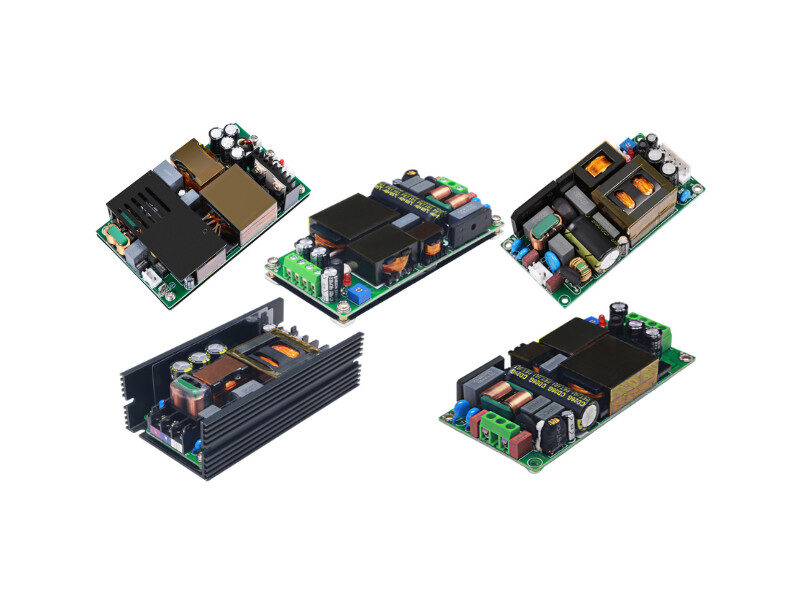
An open-frame power supply integrates its functional components—input filtering, switching circuitry, transformer, and output regulation—onto a single printed circuit board (PCB). The assembly is typically mounted to a metal frame or baseplate that provides mechanical stability and mounting points. No full protective enclosure is present, leaving components exposed.
This architecture is intended for direct integration into host equipment. Thermal management relies primarily on natural convection, supported by airflow within the surrounding system enclosure. Due to their compact form factor and DIN-rail compatibility, open-frame power supplies are widely used inside industrial control cabinets and embedded systems.
For OEM applications installed in protected environments, open-frame designs offer a compact and cost-efficient DC power solution.
Enclosed Power Supplies
Enclosed power supplies house all electronic components within a protective casing, typically manufactured from steel, aluminum, or high-grade plastic. The enclosure serves several important functions:
- Mechanical protection
- Reduced exposure to dust and moisture
- Improved electromagnetic shielding
- Prevention of accidental contact with live components
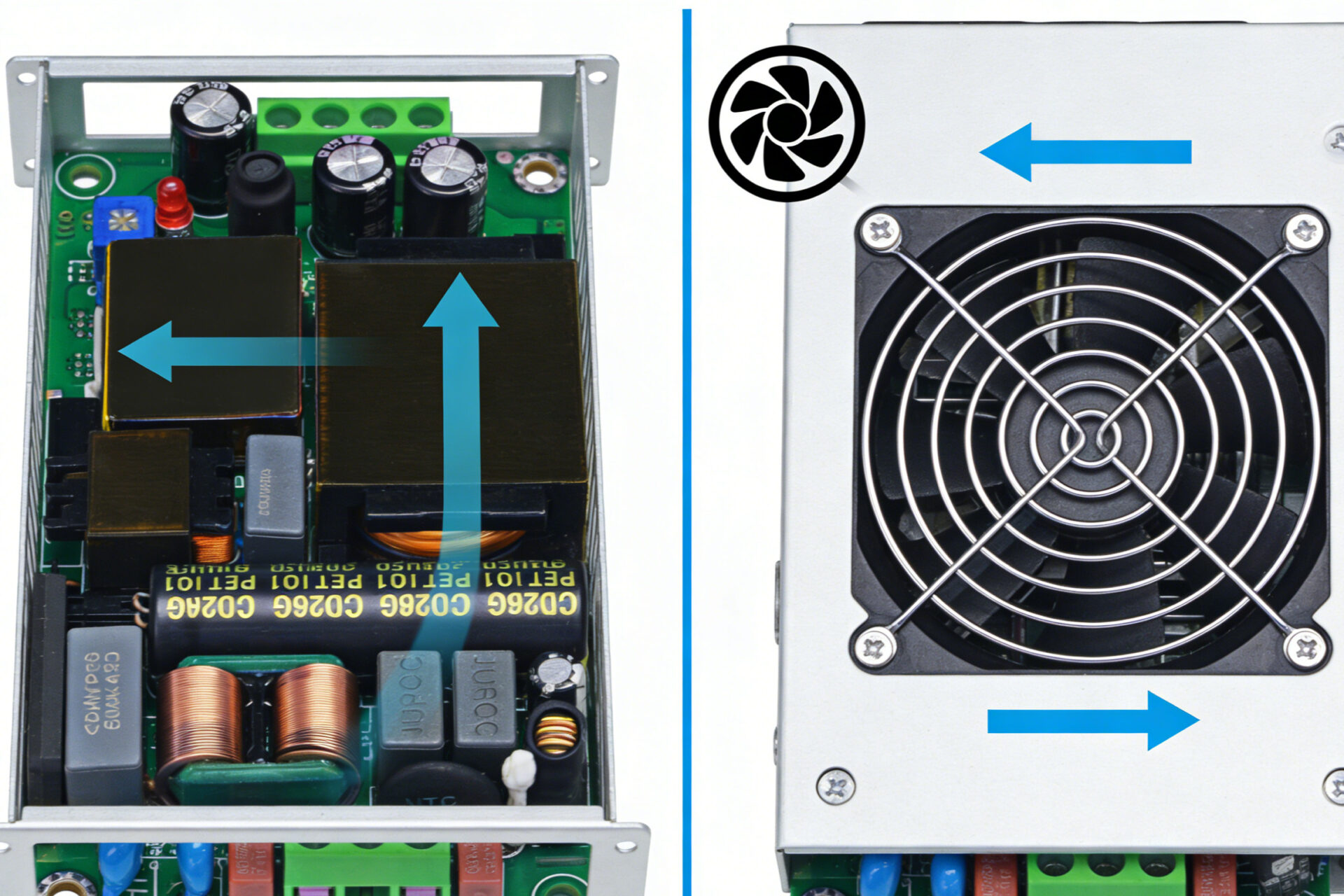
Thermal management depends on power level and design. Lower-power models may rely on finned housings for passive cooling, while medium- and high-power units often incorporate active fan cooling. This enables enclosed power supplies to deliver rated output power across a broader range of ambient conditions, making them suitable for standalone operation or environments without secondary protective housings.
Technical Differentiators
Thermal Management: Passive vs. Active Cooling
Thermal strategy is one of the most important differentiators between open-frame and enclosed power supplies.
Open-frame power supplies rely on the system designer to provide suitable ambient conditions. Natural convection enables silent operation and eliminates wear-related components, but may require output derating at elevated temperatures. In practice, a 150 W open-frame unit may be specified for reduced continuous output when operating in high-temperature environments.
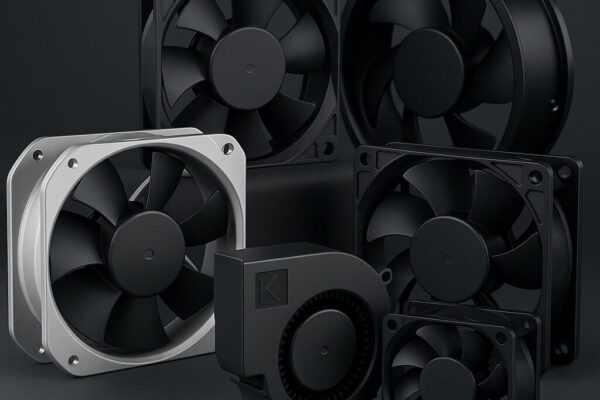
Enclosed power supplies with integrated fans manage heat internally. Active airflow allows them to sustain rated output power in confined or warmer spaces. This comes at the cost of added acoustic noise and dependence on moving parts. Many modern designs mitigate these effects through temperature-controlled fans. Fanless enclosed variants with larger heatsinks are also available, typically requiring more installation space for comparable power levels.
Mechanical Protection and Environmental Resistance
Open-frame power supplies provide no inherent environmental protection. They must therefore be installed within an enclosure that provides the required ingress protection (IP rating). This makes them suitable for clean, controlled environments such as machine cabinets or internal compartments of appliances.
Enclosed power supplies integrate mechanical and environmental protection directly into the product. Depending on design, IP ratings may range from basic finger-safe protection (e.g. IP20) to sealed solutions intended for harsh industrial or outdoor environments. This reduces installation complexity and improves robustness in field-deployed systems.
Electrical Safety, EMC, and Compliance
Both architectures can be designed to comply with international safety standards such as IEC/EN/UL 62368-1, though the implementation differs.
In open-frame designs, safety isolation is implemented directly on the PCB through controlled creepage distances, clearance gaps, and insulation systems. The surrounding end-product enclosure is responsible for preventing user access.
Enclosed power supplies benefit from their grounded casing, which improves electromagnetic compatibility (EMC) performance and provides an additional protective barrier. This can simplify compliance in applications requiring low emissions or high immunity, such as laboratory, medical, or communication equipment.
Features and Adjustability
Modern power supplies—regardless of form factor—commonly include features such as:
- Active Power Factor Correction (PFC)
- Wide-range AC input (typically 90–264 VAC)
- Adjustable or selectable DC output voltages
In open-frame designs, adjustment elements are typically set during manufacturing or commissioning. In enclosed power supplies, voltage adjustment is often accessible through the housing, which can be advantageous for service, testing, or configurable systems.
Application-Specific Considerations
Industrial Automation and Control Cabinets
Industrial control systems frequently use open-frame or DIN-rail-mounted power supplies due to space constraints and controlled environmental conditions. Their compact size, passive cooling, and cost efficiency make them well suited for PLCs, sensors, and actuator subsystems. Enclosed power supplies are typically reserved for field-mounted devices or installations exposed to environmental stress.
LED Lighting Systems
LED drivers are a specialized form of AC-DC power supply. In integrated luminaires, open-frame or semi-open designs are often thermally coupled to the fixture housing. For outdoor or industrial lighting applications, enclosed or fully potted drivers are commonly used to withstand environmental exposure. In both cases, efficiency and thermal management directly influence LED lifetime.
Medical and Healthcare Equipment
Medical applications impose strict safety and leakage current requirements, defined by standards such as IEC 60601-1. Certified enclosed power supplies are typically used, as their casing supports reinforced isolation, EMC control, and hygienic cleaning. In these systems, the power supply is a safety-relevant component within the overall risk-management strategy.
Telecommunications and Data Communication
Telecommunication and data infrastructure relies on enclosed, modular power supplies designed for high efficiency, redundancy, and serviceability. Rack-mounted systems often support hot-swap operation and N+1 redundancy. The enclosure plays a critical role in EMC containment and operational stability in high-density installations.
Decision Criteria
When selecting between open-frame and enclosed power supplies, the following questions can guide the decision:
- Integration: Embedded within a larger system or used as a standalone unit?
- Environment: Controlled enclosure or exposed operating conditions?
- Thermal concept: Passive convection or active cooling required?
- Safety standards: General industrial or medical-grade requirements?
- Serviceability: Fixed installation or field replacement?
- Features: Input range, adjustability, and size constraints?

Conclusion
Choosing between open-frame and enclosed power supplies is not about identifying a universally superior solution. Instead, it involves aligning the power supply architecture with the technical, environmental, and regulatory requirements of the application.
Open-frame power supplies are well suited for integrated systems in protected environments, offering compact design, passive cooling, and cost efficiency. Enclosed power supplies provide a self-contained solution with enhanced mechanical protection, safety, and thermal independence, making them appropriate for field-deployed, safety-critical, or service-oriented applications.
By understanding these architectural trade-offs, designers can move beyond basic datasheet comparisons and select an AC-DC power supply that supports long-term system performance, compliance, and reliability.