


Table of contents
What this update means for integrators & procurement
In industrial electronics projects, purchasing decisions typically extend beyond unit pricing. They are influenced by market access requirements, test documentation, audit readiness, and the ability to scale production consistently.
A common challenge arises when engineering completes a design and manufacturing is capable of production, but market entry is delayed due to unclear acceptance criteria or incomplete documentation. Procurement teams are then required to align standards, test definitions, and documentation under time pressure.
This update outlines how TPS structures sales engagements to support:
-
Reduced clarification loops between teams
-
Clear alignment between engineering, manufacturing, and procurement
-
Structured preparation for multi-region market entry (EU, US, China)
This approach is particularly relevant for:
-
Multi-region rollouts with evolving regulatory expectations (e.g., CE, EMC, labeling)
-
Cross-functional coordination between development, production, and compliance
-
Cost optimization initiatives requiring stable QA/QC processes
-
Vendor qualification where test evidence must be clearly documented
From production readiness to market entry: a structured approach
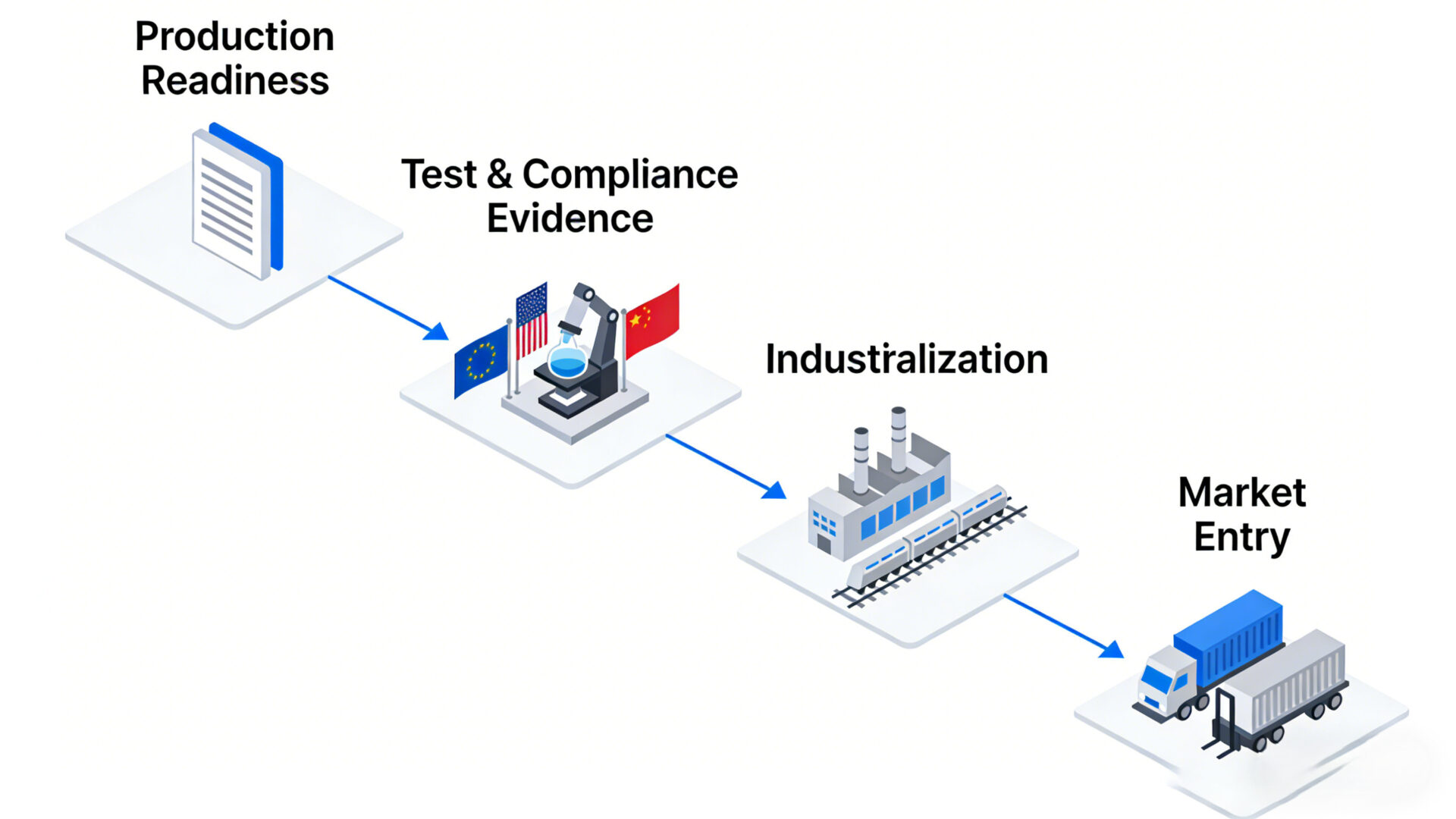
TPS supports projects through a structured process that connects technical development with commercial rollout.
The model aligns:
-
Engineering outputs (specifications, limits, test plans)
-
Manufacturing conditions (process stability, yield, suppliers)
-
Market requirements (documentation, labeling, regional considerations)
Typical phases
-
Discovery & scope definition
Clarification of use case, target regions, and acceptance criteria -
Evidence planning
Definition of test methods, standards, and documentation structure -
Industrialization
Stabilization of processes and implementation of repeatable QA/QC controls -
Market entry preparation
Preparation of labeling, manuals, declarations, and regional handover steps
Early alignment in these phases can help reduce delays during compliance review or vendor qualification.
ompliance and test readiness
Procurement decisions often depend on how clearly testing and compliance are documented. Beyond confirming that tests were performed, buyers typically require:
-
Defined test methods and standards
-
Acceptance limits and tolerances
-
Sample sizes and traceability
-
Handling of borderline results
Material testing example: Rockwell hardness
For mechanical components such as mounting structures or enclosures, hardness testing can support consistency evaluation.
To ensure comparability between suppliers, documentation should specify:
-
Test scale (e.g., HRC, HRB)
-
Applied standard (e.g., ASTM E18)
-
Defined acceptance range
Nondestructive testing (NDT)
NDT methods allow validation of component integrity without damaging parts. Typical applications include detection of:
-
Surface defects
-
Internal voids
-
Material inconsistencies
Test results should be structured in a consistent QA report format, particularly for international projects.
ESD and EMC context (CE-related)
The term “ESD test CE” is often used imprecisely. In practice, buyers require:
-
Definition of the intended immunity environment
-
Reference to the relevant EMC standard family
-
Structured documentation supporting compliance
For CE-marked products, the CE mark indicates conformity with applicable EU requirements and should only be applied where relevant regulations require it.
Cost reduction with controlled quality
Cost reduction initiatives in manufacturing must be linked to defined QA/QC processes to maintain consistency.
Rather than focusing only on unit cost, TPS connects cost measures to:
-
Process stability
-
Inspection strategies
-
Defined acceptance criteria
QA/QC framework for procurement alignment
A structured quality annex typically includes:
-
Specification limits vs. process control limits
-
Sampling plans and inspection frequency
-
Measurement system control (calibration, fixtures, revisions)
-
Deviation handling (retest, quarantine, corrective action)
This approach supports consistent supplier evaluation and reduces ambiguity in RFQs.

RFQ-ready checklist
To enable an efficient proposal process, a structured RFQ package should include:
-
Target regions: EU, US, China
-
Application context: power levels, operating conditions, lifecycle expectations
-
BOM considerations: alternates, lifecycle risks, compliance-sensitive components
-
Test requirements: EMC, ESD, material testing, NDT (if applicable)
-
Documentation scope: manuals, labeling, declarations, revision control
-
Commercial parameters: forecast, MOQ, lead times, change management
For projects involving digital or security-related requirements, alignment with recognized frameworks (e.g., NIST guidelines) may also be relevant.
Next steps
For projects approaching vendor selection or market entry, initiating an inquiry allows TPS to map a structured project path across:
-
Production readiness
-
Evidence planning
-
Industrialization
-
Market entry preparation
FAQ
Does TPS support more than manufacturing?
Yes. The Global Sales Partner model includes support for documentation, compliance preparation, and market entry activities, depending on the project.
How is “acceptable” defined in QA/QC?
Through explicit acceptance criteria, sampling plans, traceability rules, and defined deviation processes.
What does “ESD test CE” mean in practice?
It generally refers to EMC immunity requirements, relevant standards, and supporting documentation for compliance—not just isolated testing.
Can TPS support China market entry?
TPS provides support for industrialization and implementation in China as part of global project workflows.
Is cost reduction possible without affecting quality?
Cost measures are linked to QA/QC controls to maintain consistency and reduce variability risks.
Ready to convert requirements into an RFQ-ready plan?
Contact TPS Sales