

You’ve never seen it, but you’ve probably felt it. That tiny zap when you touch a door handle after walking across a carpet. A fleeting annoyance—harmless, you think. But for the microchip inside your smartphone, that same zap delivers a death sentence in microseconds.
Every year, static electricity silently destroys billions of electronic components before they ever reach your hands. Damage often hides—latent, waiting to surface weeks or months later as an inexplicable freeze, a flickering screen, a device that “just died.” And the only thing standing between you and that frustration is a piece of equipment you’ve likely never noticed: an ESD cart.
No other force in modern manufacturing is as invisible, yet as destructive, as electrostatic discharge. You won’t see burn marks. You won’t hear any noise. It simply kills—quietly, efficiently, and without a trace. The Roman philosopher Lucretius once wrote, “Nothing can be created from nothing.” In electronics manufacturing, the corollary holds equally true: nothing is destroyed without a cause. However, with ESD, the cause often remains invisible, and we only discover the destruction when it’s too late.
But a silent guardian fights this invisible war. A fleet of unassuming heroes moves through the clean corridors of factories, carrying circuit boards with the same care a sommelier carries a vintage Bordeaux. Their mission: to ensure that the device you unbox tomorrow works perfectly, every time.
Key Takeaways
- Electrostatic discharge (ESD) can destroy sensitive electronic components at voltages as low as 30 volts—far below what the human body can feel.
- Latent ESD damage remains invisible during manufacturing but causes premature device failure in the hands of consumers.
- A complete ESD control program relies on specialized equipment including esd trolleys, pcb racks, and esd safe carts to maintain a continuous path to ground.
- ESD carts are not ordinary carts; they feature ESD laminate top surfaces, ESD powder painted metal frames, ESD universal wheels, and wheels with fixing locks (locking caster wheels) to ensure static-safe mobility.
- From pcb storage to final assembly, every stage of electronics production depends on moveable carts and rack carts to transport sensitive components without introducing static damage.
1. The Invisible Assassin: Why ESD Is the Silent Enemy of Electronics
There was a time when static electricity served as nothing more than a parlor trick—a spark to amuse guests, a crackle in the dark. But in the age of microchips, that spark has become a saboteur.
Consider this: a human can feel static discharge at about 3,000 volts. Yet a modern microprocessor, with traces measured in nanometers, can be destroyed by a discharge of just 30 volts. That’s one hundred times less than what you can feel. The components inside your smartphone, your laptop, your car’s electronic control unit—they are all vulnerable. Moreover, the damage, when it happens, often remains invisible to the naked eye.
Engineers call this “latent failure.” A component that has been zapped by static doesn’t necessarily die on the spot. Instead, it becomes a ticking time bomb. It passes quality control. It survives the first month of use. And then, one day, it simply stops working. The screen goes black. The phone won’t turn on. The car’s infotainment system freezes. You blame the manufacturer. But the real culprit is a spark that happened weeks or months earlier, on a factory floor, in a moment no one noticed.
“In vino veritas,” the Romans said—in wine, there is truth. In electronics, the truth is that static exists everywhere. Consequently, the only defense is a system of protection that begins the moment a component is born and does not end until the device is sealed in its final housing. At the heart of that system lie the unsung workhorses of the electronics industry: esd trolleys, pcb racks, and the entire family of static-safe transport equipment.
2. A Journey Begins: From Bare Boards to Living Circuits
Every electronic device begins as a bare printed circuit board—a blank canvas of copper traces and fiberglass. Before soldering a single component, these boards must travel. They move from storage to assembly, from assembly to testing, from testing to packaging. At every step, they remain vulnerable to damage.
Imagine a vineyard. The grapes are delicate, easily bruised, easily spoiled. They must be harvested with care, transported with precision, and processed without contamination. The same holds true for circuit boards. But instead of grapes, we have microchips. Instead of wine, we have the devices that power modern life.
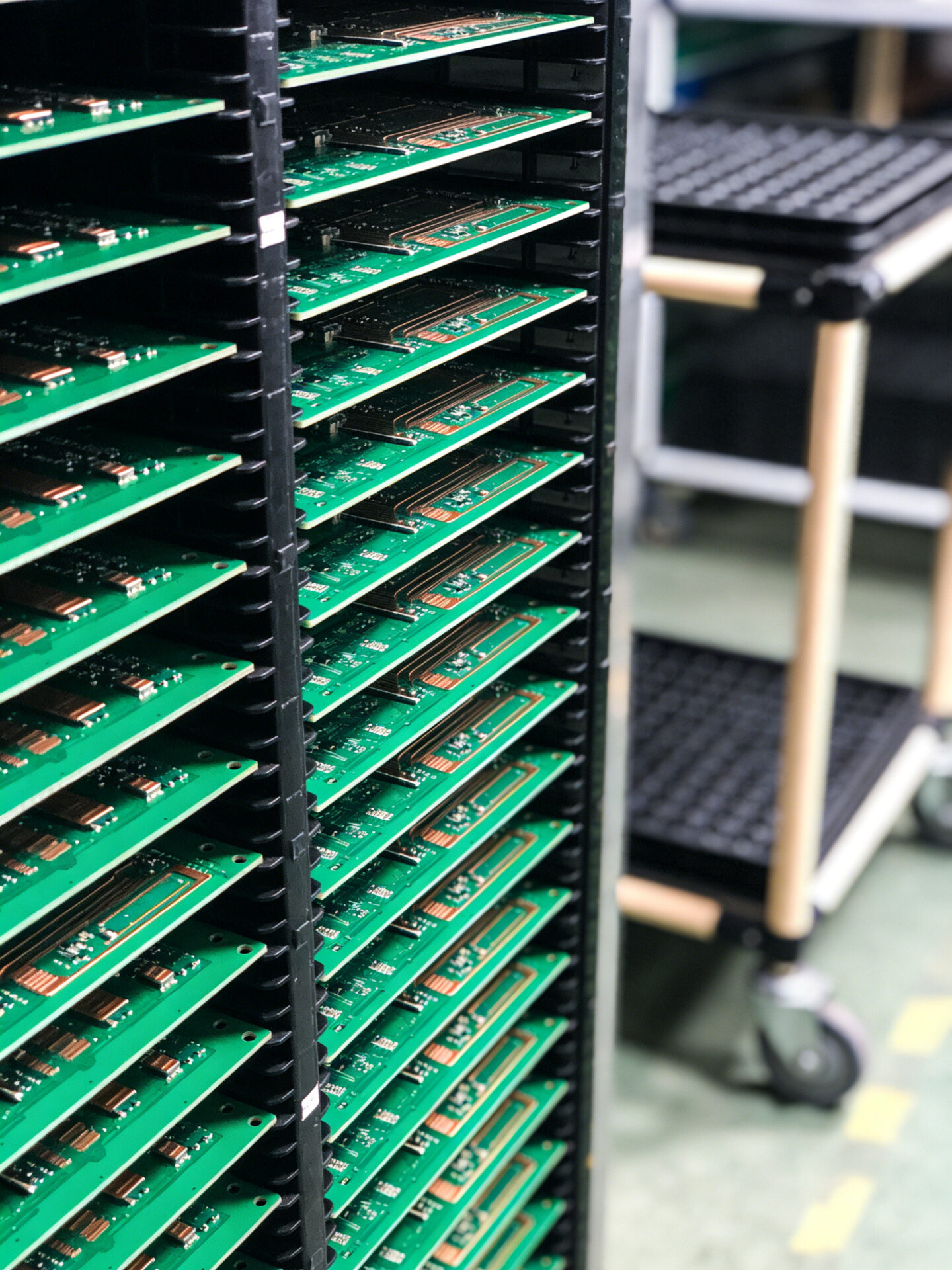
The first stop on this journey is pcb storage. Bare boards arrive in stacks, each one separated by conductive foam or placed in pcb racks. These racks are not simple shelves. Engineers design them to hold boards vertically, preventing scratches and, more importantly, preventing static buildup. A pcb rack made of static-dissipative material ensures that any charge that accumulates drains safely away before it can reach a sensitive component.
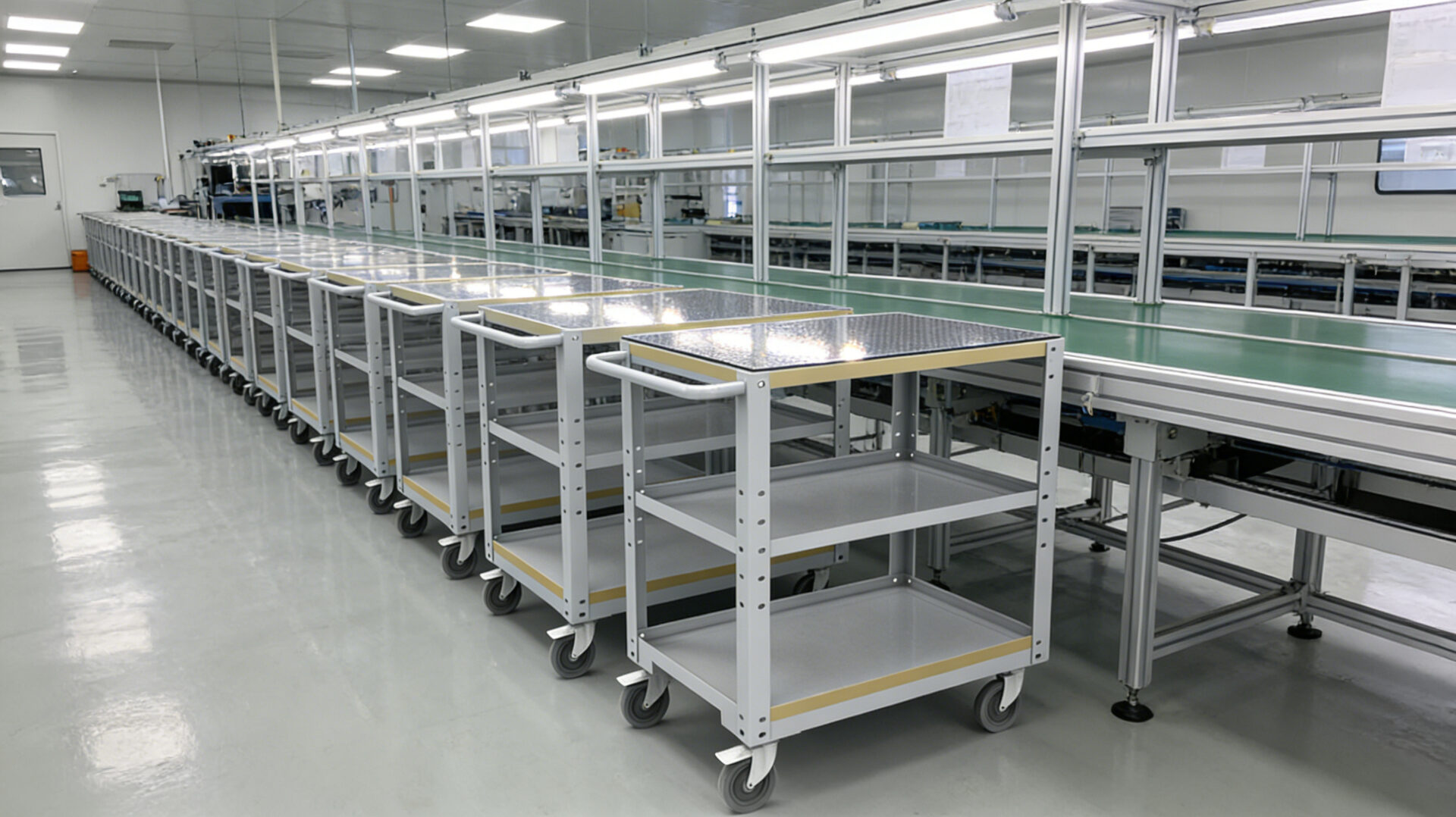
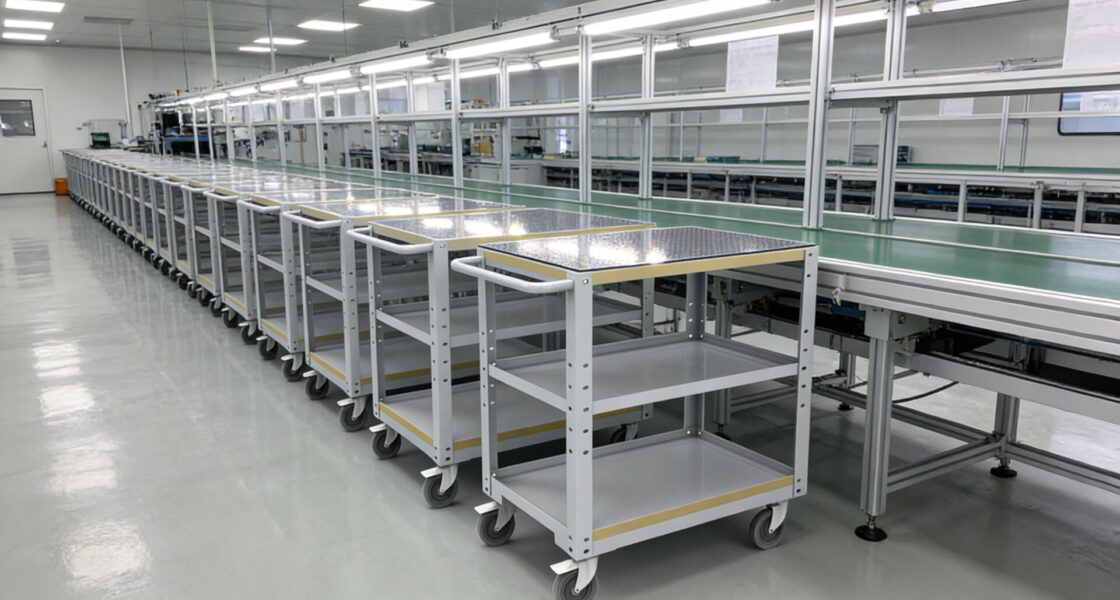
From storage, operators load the boards onto an esd tray cart. This cart, like all esd safe carts, features an ESD laminate top—a work surface that dissipates static rather than allowing it to build up. Its frame is coated with ESD powder painted metal frame, a specialized finish that contains conductive particles, turning the entire structure into a path to ground. Furthermore, it rolls on ESD universal wheels made from conductive rubber, ensuring that even movement doesn’t generate static. Two of those wheels come equipped with wheels with fixing locks—or locking caster wheels—so that when the cart stops, it stays exactly where you need it.
This is not a simple cart. This is a mobile fortress for fragile electronics.
3. The Silent Flow: How ESD Carts Orchestrate Component Movement
In electronics manufacturing, precision is everything. A component misplaced by a fraction of a millimeter can render an entire circuit board useless. Similarly, a static discharge too small to feel can destroy a chip that took weeks to fabricate. Given these risks, orchestrating the movement of components through a factory demands the same precision as the assembly itself.
This is where esd trolleys take center stage. They are not merely passive transporters; they are active participants in the ESD control system. Engineers design each cart to maintain a continuous electrical path from the components it carries, through its ESD laminate top and ESD powder painted metal frame, down through its ESD universal wheels, and into the conductive floor. Every element serves an intentional purpose.
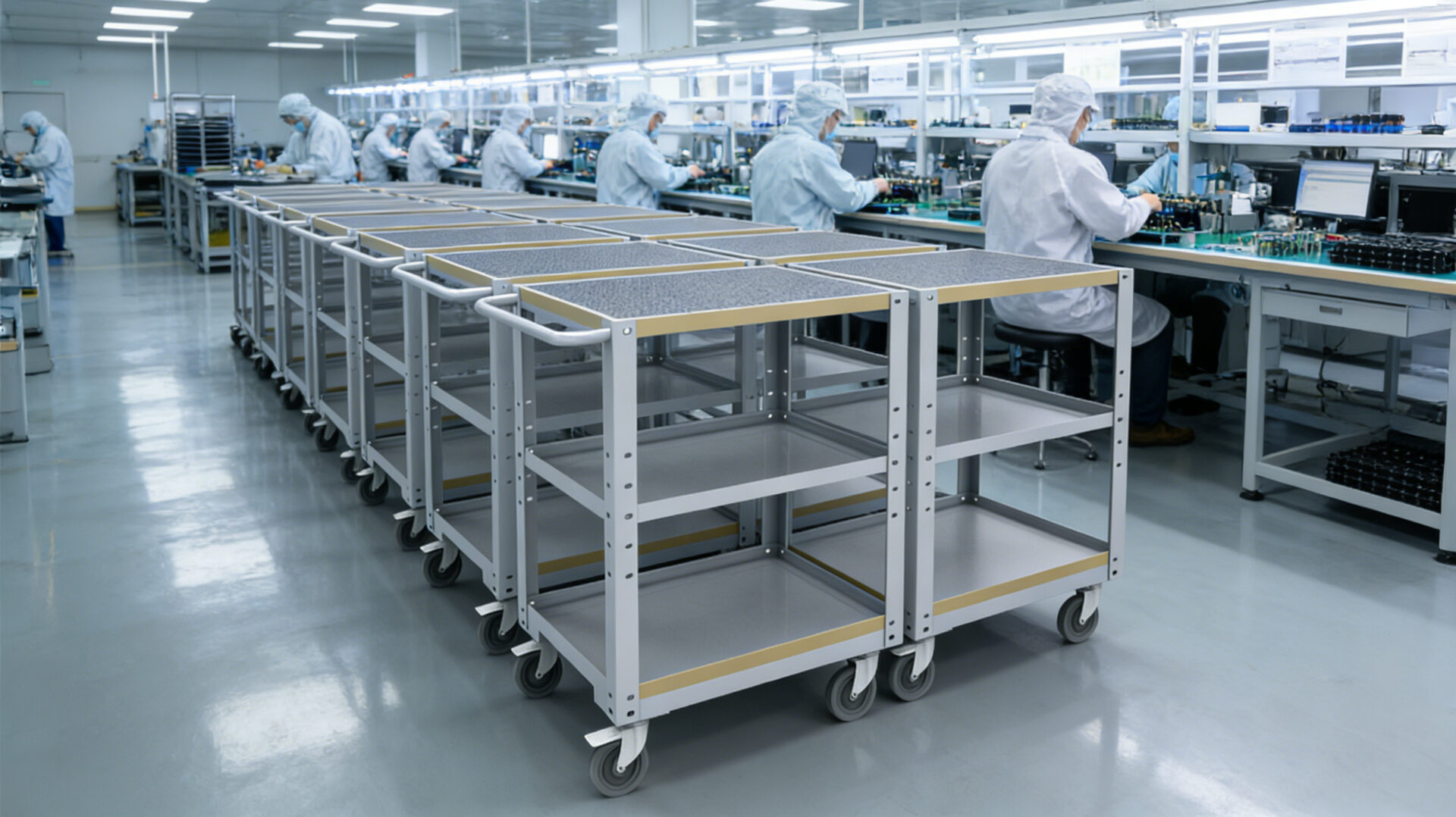
When a pcb cart arrives at the surface-mount technology (SMT) line, operators position it precisely using its locking caster wheels. They unload the pcb racks and feed them into machines that place components with microscopic accuracy. After soldering, they transfer the populated boards to another esd tray cart—this time with conductive foam liners that cradle each board individually.
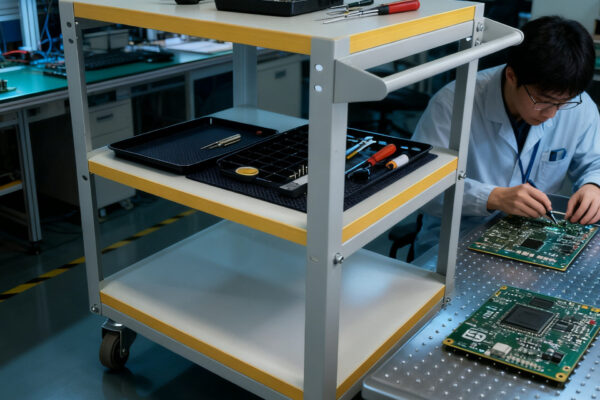
An ESD workstation cart might be positioned nearby, serving as a mobile bench for operators who perform manual assembly tasks. Its ESD laminate top provides a static-safe surface for adding connectors, displays, or batteries. Tools hang from rails; components sit in esd trays; the entire station is ready to move wherever it is needed next.
This is the rhythm of modern electronics production: a continuous flow of components, carried by moveable carts and rack carts, each one designed for a specific stage of the journey. At every stage, the same principles apply: control static, maintain grounding, protect the product.
4. The Anatomy of an ESD Cart: Engineering the Invisible
What makes an ESD cart different from any other cart? The answer lies in three critical elements: materials, wheels, and grounding.
First, consider materials. A standard metal cart can act as a capacitor—storing static and then discharging it unpredictably. A plastic cart may insulate components from ground, allowing dangerous potentials to build. But an esd safe cart is built with purpose. Its frame is steel or aluminum, coated with ESD powder painted metal frame. This coating contains carbon or other conductive particles, creating a surface that safely bleeds static to ground.
Second, examine the work surfaces. Many esd carts feature an ESD laminate top—a high-pressure laminate with a conductive layer. Some also incorporate esd tray shelves that operators can remove and use independently. Manufacturers test these surfaces to ensure their surface resistance falls between 1×10⁶ and 1×10⁹ ohms—the range required by standards like ANSI/ESD S20.20.
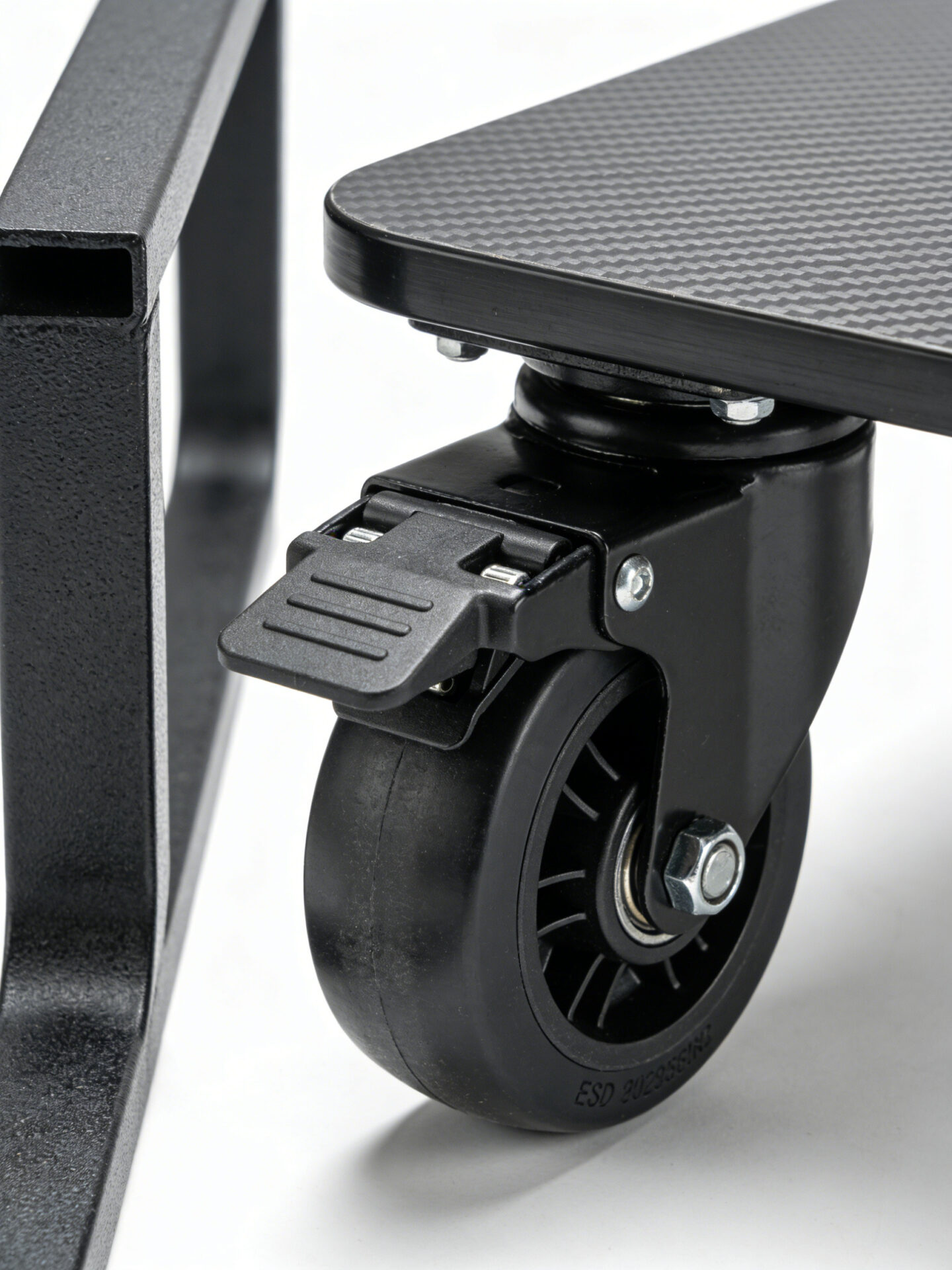
Third, focus on the wheels. The ESD universal wheels on a quality esd cart are made from conductive rubber or polyurethane. They do not insulate the cart from the floor. Instead, they complete the grounding path. When the cart needs to stay put, wheels with fixing locks—or locking caster wheels—engage to hold it steady.
Some manufacturers go further, adding esd cart covers to protect contents from airborne contaminants, or integrating grounding chains that drag along the floor for continuous grounding even on non-conductive surfaces. These are not optional luxuries. They are essential components of a certified ESD control program.
5. A Cart for Every Task: Specialized Solutions Across the Production Line
Just as a master craftsman selects the right tool for each job, an electronics factory uses different carts for different stages of production. Engineers optimize every cart for its specific role.
For incoming materials, a component handling cart with adjustable dividers keeps reels of capacitors, resistors, and integrated circuits organized and ESD-safe. When it comes to the SMT line, a PCB transport cart is precisely sized to accept standard PCB magazines, ensuring smooth transfer to automated equipment.
For manual assembly, operators can use an ESD workstation cart as a mobile bench. Operators can customize it with tool rails, document holders, and extra shelves. Its ESD laminate top provides a reliable work surface, and its ESD universal wheels allow them to reposition it as workflows change.
For test and repair, an ESD service cart—or Electronic repair cart—carries oscilloscopes, soldering stations, and replacement parts directly to the faulty unit. Technicians can perform rework without ever leaving the ESD-protected zone, reducing the risk of additional static damage.
For finished goods, a static safe cart with padded shelves transports completed devices to packaging. By the time a smartphone reaches this stage, it has been handled, stored, and moved entirely within an ESD-controlled environment. Every cart in this journey—whether it’s called an Electronics assembly cart, Electronics manufacturing cart, ESD handling cart, or ESD repair trolley—plays a role in that protection.
6. The Night Shift: Why ESD Protection Never Sleeps
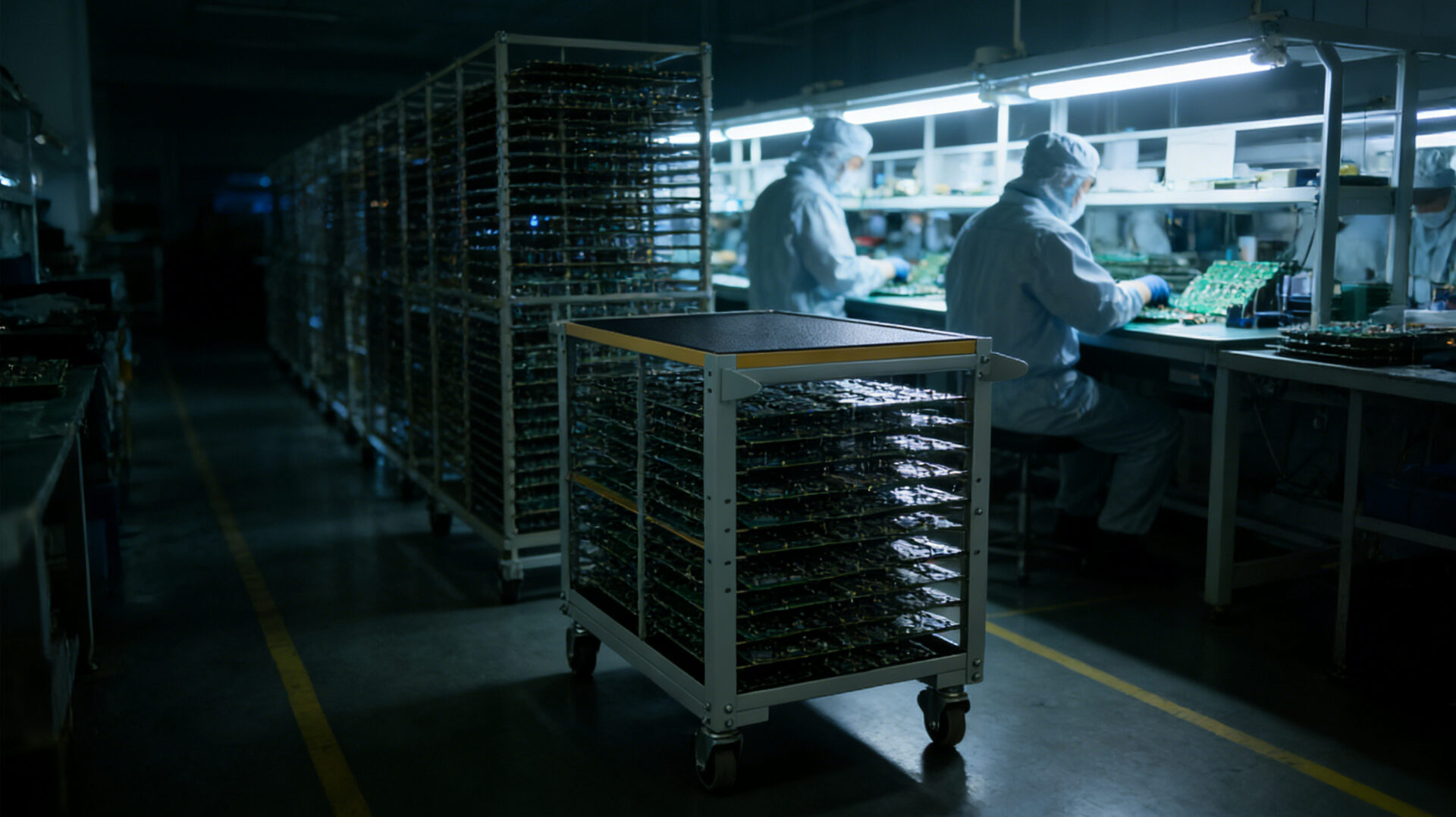
In many electronics factories, production runs 24 hours a day, seven days a week. The esd trolleys never stop. The pcb racks are constantly being loaded and unloaded. The esd safe carts move through aisles in the middle of the night, carrying components that will become tomorrow’s consumer electronics.
This round-the-clock operation demands equipment that is not only safe but also reliable. Engineers design the locking caster wheels to engage smoothly thousands of times. Meanwhile, the ESD universal wheels must maintain conductivity despite constant rolling. Additionally, the ESD laminate top must resist scratches and contamination without losing its static-dissipative properties.
And the people who operate these carts? They are the unsung heroes of the production floor. A driver starts the day by checking each esd cart, ensuring that the wheels are clean, the frame is properly grounded, and the esd trays are free of debris. At the end of each line, the cart returns to its station, ready for the next load.
7. Beyond the Factory Floor: ESD Carts in Repair Centers, Labs, and More
The journey doesn’t end when the device leaves the factory. Throughout its life, an electronic product may need service, repair, or rework. In fact, every time someone opens it, the device becomes vulnerable to static again.
This explains why professional repair centers rely on the same equipment as manufacturers. An Electronic repair cart in a service center might be smaller than its factory counterpart, but it shares the same essential features: ESD laminate top, ESD powder painted metal frame, ESD universal wheels, and locking caster wheels.
Research and development labs also depend on Sensitive equipment cart designs. Prototype boards are often one-of-a-kind, irreplaceable. Transporting them between workbenches, test chambers, and analysis stations requires the same static-safe handling as full-scale production.
Even in fields far from consumer electronics, ESD protection matters. Medical device manufacturers, aerospace contractors, and automotive suppliers all use esd safe carts to protect the sensitive electronics that go into pacemakers, flight control systems, and autonomous vehicles. A static discharge in any of these contexts could have consequences far beyond a dead smartphone.
8. Choosing the Right ESD Cart: A Guide for Manufacturers and Service Centers
Selecting the right esd cart for your operation requires careful consideration. Here are the factors that matter most:
Load capacity: A pcb cart for bare boards needs only light-duty capacity, while a component handling cart carrying reels of heavy connectors may need to support 100 kg or more. Our TPS-RV01, TPS-RV02, and TPS-RV03 models, for example, offer a cart capacity of 150 kg, with shelves rated at 50 kg per level.
Dimensions: Match cart size to aisle widths, workstation heights, and storage areas. The TPS-RV series measures 600x500x750 mm, while the TPS-TV series offers 650x450x750 mm or 650x450x1160 mm options—providing flexibility for different facility layouts.
ESD performance: Verify that the cart meets ANSI/ESD S20.20 or IEC 61340-5-1 standards. Look for features like ESD laminate top, ESD powder painted metal frame, and conductive casters—all standard in our TPS series.
Mobility: ESD universal wheels should swivel smoothly. At least two wheels should have wheels with fixing locks (locking caster wheels) to secure the cart during loading and unloading.
Special features: For cleanroom applications, consider esd cart covers to minimize particle generation. For repair stations, an ESD repair trolley with built-in power outlets may be ideal.
Many manufacturers offer custom configurations, allowing you to combine esd tray shelves, pcb racks, and tool organizers on a single moveable cart platform. An ESD mobile cart can also be fitted with bumpers for automated guided vehicle integration, or with additional grounding points for sensitive operations.
9. Maintenance: Keeping Your ESD Protection Effective for Years
Even the best anti-static trolley requires regular attention to remain effective. Over time, dirt, wear, and damage can compromise conductivity. A simple maintenance program can extend the life of your esd carts and ensure consistent protection.
Inspect wheels and casters weekly: Check that ESD universal wheels are free of debris and maintain electrical continuity. Replace any wheels with cracks, flat spots, or worn tread.
Clean surfaces with ESD-safe solutions: Use cleaners specifically formulated for static-safe surfaces. Standard household cleaners may leave insulating residues that compromise the ESD laminate top or esd tray surfaces.
Verify ground path monthly: Measure resistance between the cart’s work surface, frame, and floor. For ESD safe transport, resistance should remain within 10⁶–10⁹ ohms.
Check locking mechanisms: Ensure wheels with fixing locks engage fully and hold the cart steady. Worn locking caster wheels can lead to accidents or unintended movement.
Inspect esd cart covers: If used, look for tears or punctures that could compromise both ESD protection and contamination control.
Document all inspections and establish a scheduled maintenance plan. This not only extends the life of your moveable carts and racks but also supports compliance with quality management systems like ISO 9001 and ESD control program audits.
10. The Innovation That Pays: Why ESD Protection Is an Investment, Not a Cost
Innovation in electronics manufacturing isn’t always about faster chips or smaller components. Sometimes, it’s about the quiet innovations in material handling that enable those chips to survive the journey from factory to consumer.
Manufacturers who invest in comprehensive ESD programs—including high-quality esd trolleys, pcb storage systems, and rigorous process controls—see measurable returns. As a result, rework costs decrease. Likewise, warranty claims drop. Customer satisfaction improves. Ultimately, the brand reputation for reliability grows.
Consider the numbers: A single latent ESD failure that leads to a product return can cost a manufacturer hundreds of dollars in logistics, replacement, and customer support. Multiply that by thousands of units, and the savings from effective ESD protection run into the millions.
Beyond cost, there is the matter of trust. When consumers buy a smartphone, a laptop, or a medical device, they place their trust in the manufacturer. They trust that the device will work when they need it most. That trust is earned through rigorous quality control—and ESD protection is a cornerstone of that control.
11. Product Spotlight: TPS Series ESD Trolleys
Our TPS series represents the culmination of years of experience in static-safe material handling. Designed specifically for electronics manufacturing environments, these esd trolleys combine robust construction with precise ESD control features.
The TPS-RV series (models RV01, RV02, and RV03) features an ESD laminate top with a metal frame finished in ESD powder painted metal frame. Each cart is equipped with ESD universal wheels, with two wheels featuring wheels with fixing locks for stability during loading. With dimensions of 600x500x750 mm and a total cart capacity of 150 kg (shelf capacity 50 kg for multi-shelf models), these carts are ideal for general component transport and pcb storage applications.
The TPS-TV series (models TV01, TV02, and TV03) offers an all-steel construction with the same ESD powder painted metal frame finish. Available in 650x450x750 mm (TV01 and TV03) and 650x450x1160 mm (TV02) configurations, these esd safe carts provide additional flexibility for facilities with varying height requirements. Like the RV series, they feature ESD universal wheels with locking caster wheels for secure positioning.
Both series support customization to meet specific facility needs, including adjustable shelf heights, esd cart covers for contamination control, and additional esd tray configurations.
12. Conclusion: Invisible Guardians, Visible Reliability
There is an old saying: “What is essential is invisible to the eye.” It applies to love, to friendship, and, surprisingly, to the manufacturing of electronics. The ESD carts that glide through factories, the pcb racks that cradle delicate boards, the esd safe carts that transport finished products to packaging—they remain invisible to the consumer. Yet they are essential to the reliability that consumers depend on.
Next time you unbox a new phone, or power up a laptop, or trust a medical device with your health, remember the journey it took to reach you. Remember the invisible battle against static electricity that was fought and won. And remember the quiet heroes of that battle—the esd trolleys that carried components safely through production lines, the pcb racks that held delicate boards in perfect alignment, the ESD universal wheels that rolled silently across conductive floors, the locking caster wheels that held everything steady at each critical stop.
They may never appear in a product brochure. They may never be mentioned in a marketing campaign. But without them, the devices that define modern life would be far less reliable—and far more fragile.
In wine, there is truth. In electronics, there is a quiet truth as well: the best protection is the one you never see.