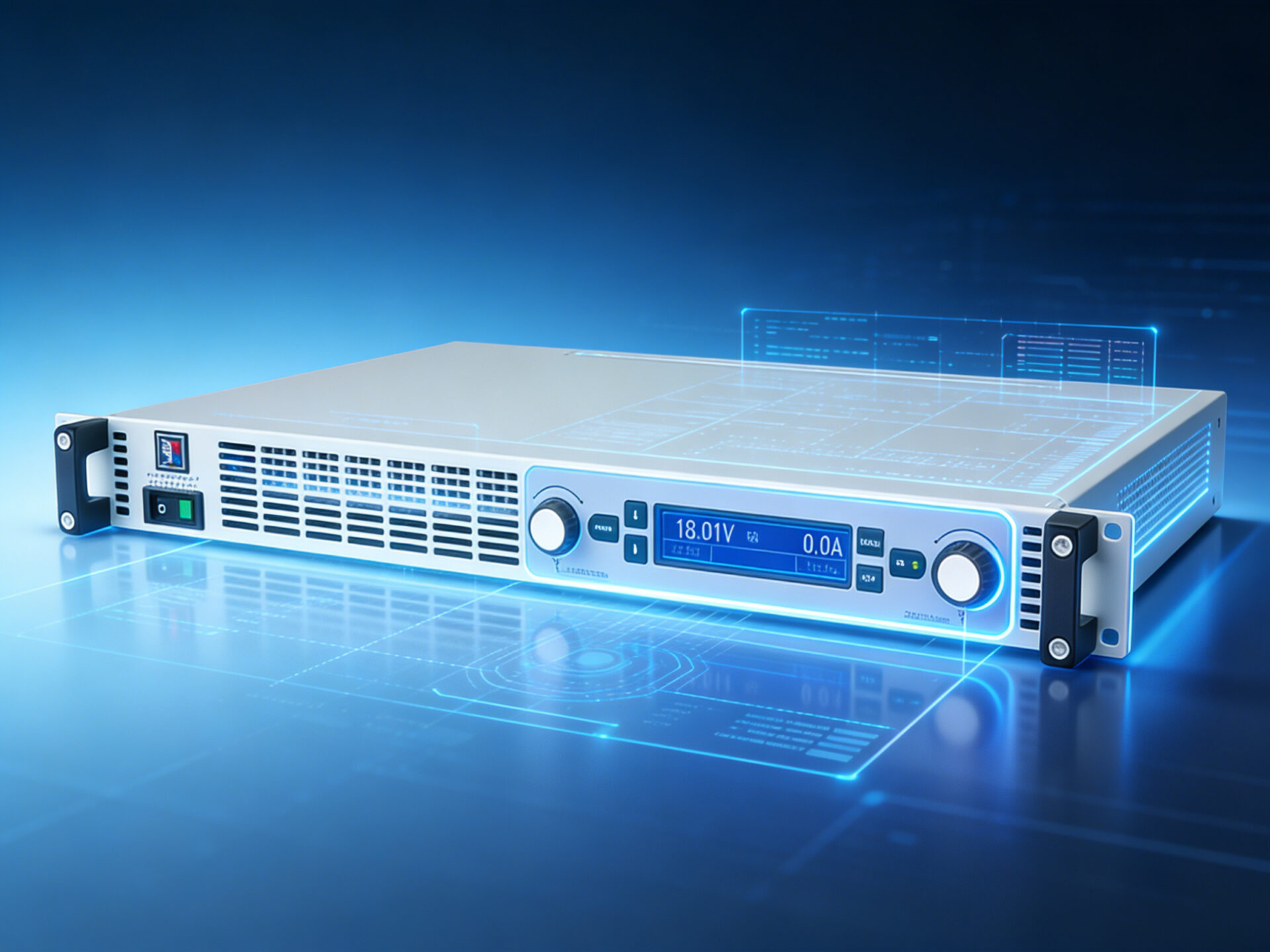


In industrial automation, research and development, telecommunications, and test engineering, available space is often a limiting factor. Rack units, benchtop area, and control cabinet volume are finite resources that directly influence system design, scalability, and cost. Engineers and system integrators are therefore increasingly required to balance functional density with reliability, thermal performance, and maintainability.
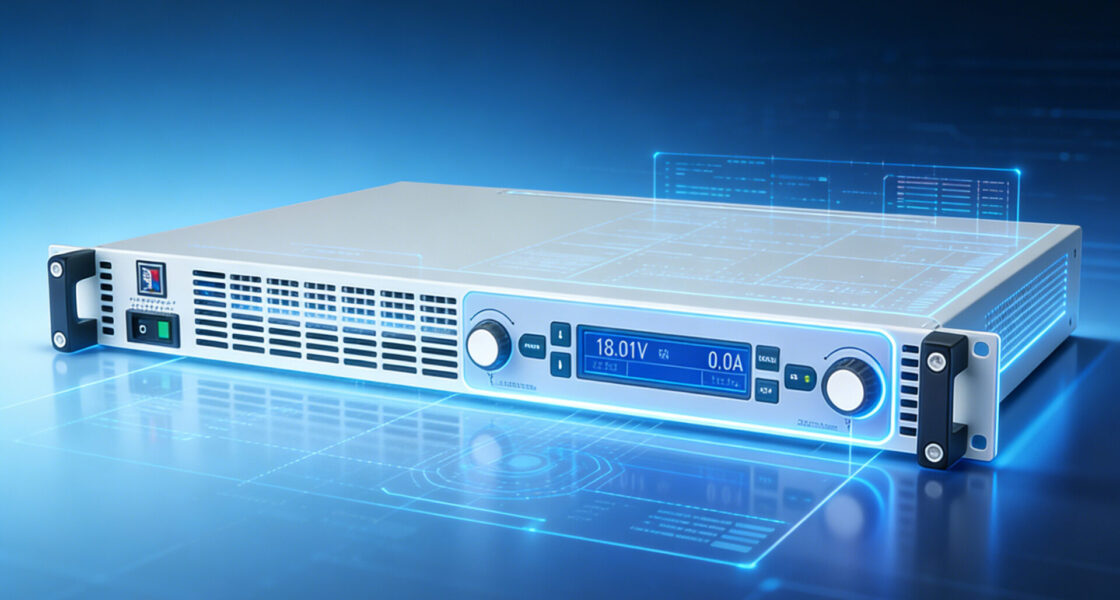
Within this context, the 1U programmable DC power supply has become a practical solution for applications where space efficiency, modularity, and precise power control are required. By combining a compact mechanical form factor with modern power-conversion and control technologies, 1U rack-mount DC power supplies enable high power density without the footprint associated with traditional large-format instruments.
This article provides a structured overview of 1U programmable DC power supplies, including their technical characteristics, advantages compared to larger form factors, typical application areas, and key selection criteria for industrial and laboratory use.

Key Takeaways
- The 1U form factor (1.75″ / 44.45 mm height) enables high equipment density in standard 19″ racks, allowing significantly more programmable power channels compared to 3U systems.
- Modern 1U programmable DC power supplies achieve high efficiency (typically >90%, depending on model and operating point) through advanced topologies and optimized thermal design.
- These power supplies are well suited for space-constrained environments such as automated test systems, compact industrial control cabinets, laboratory setups, and mobile test racks.
- Despite their compact size, 1U units commonly offer precise regulation, low output ripple, comprehensive protection functions, and digital remote control via USB, Ethernet, or GPIB.
- Selecting the appropriate 1U power supply requires balancing electrical requirements, communication interfaces, thermal conditions, and mechanical integration constraints.
Why the 1U Form Factor Matters
The “U” in 1U refers to a standardized rack unit height of 1.75 inches (44.45 mm). In installations where multiple instruments, controllers, and power sources must coexist in a limited vertical space, this standard becomes a critical design parameter.
Traditional benchtop or rack-mounted DC power supplies often occupy 3U or more. While suitable for standalone use, this approach quickly becomes impractical when multiple independent power channels are required. In contrast, a 1U programmable DC power supply allows significantly higher stacking density. For example, a standard 42U rack can theoretically accommodate 42 individual 1U devices, compared to only 14 units at 3U height.
Beyond space savings, this density supports modular system architectures. Each device under test (DUT) or functional subsystem can be powered by an independent, programmable supply, which is particularly useful in parallel testing, multi-board validation, and scalable test platforms.
Engineering Considerations Inside a 1U Chassis
Thermal Management
Heat dissipation is one of the primary challenges in compact power supplies. To address this, modern 1U designs typically incorporate:
- High-efficiency switching topologies, such as LLC or phase-shifted full-bridge converters, reducing thermal losses.
- Optimized internal layouts, positioning heat-generating components close to airflow paths.
- Actively controlled fans, adjusting airflow based on load and temperature conditions.
- Metal chassis designs that contribute to heat spreading and mechanical stability.
Depending on model and operating conditions, efficiencies above 90% are common, helping to maintain reliable operation in dense racks.
Power Density and Electrical Performance
Advances in semiconductor technology, surface-mount components, planar magnetics, and digital control enable substantial output power in a compact enclosure. Typical 1U programmable DC power supplies cover output ranges from several hundred watts up to approximately 3 kW.
Despite their size, these units commonly provide:
- Low output ripple and noise suitable for sensitive electronic loads
- Tight line and load regulation
- Fast transient response for dynamic loads
- Integrated protection functions such as OVP, OCP, OPP, and OTP
Exact performance values depend on the specific model and configuration.
1U vs. Traditional Large-Format Power Supplies
| Feature | 1U Programmable DC Power Supply | Traditional 3U/4U Power Supply |
|---|---|---|
| Space Efficiency | Very high | Limited |
| Channel scalability | Modular, easy to expand | Often fixed |
| System Flexibility | High | Moderate |
| Portability | Relatively easy | Bulky |
| Cooling margin | Compact, airflow-dependent | More internal volume |
| Typical use cases | Dense test systems, compact labs | High single-channel power |
Unless an application requires extremely high single-channel output beyond typical 1U limits, compact rack-mount supplies offer advantages in modularity and system density.
Typical Application Areas
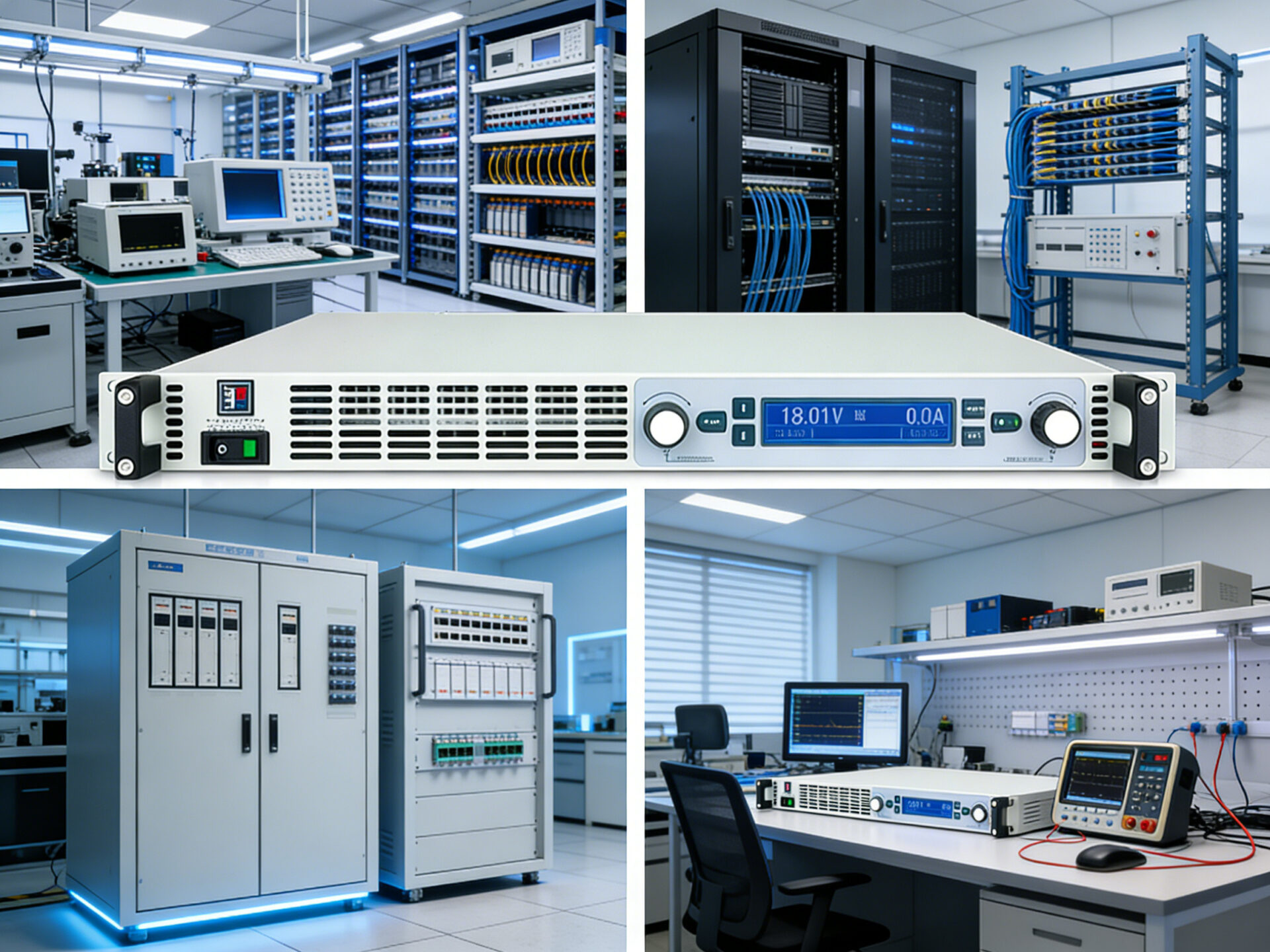
- Automated Test Equipment (ATE)
1U programmable DC power supplies are widely used in ATE racks, where multiple independently controlled voltage rails are required. Standardized digital interfaces simplify integration into automated test software. - Telecommunications and Networking
Compact rack-mount supplies support testing and validation of telecom equipment requiring multiple regulated DC rails. Wide AC input ranges support global deployment. - Industrial Automation and Control Cabinets
In space-constrained control panels, 1U DC power supplies can provide logic or auxiliary voltages while minimizing cabinet depth and layout complexity. - Research and Development Laboratories
Rack-mounted or under-bench 1U systems help preserve benchtop space while offering laboratory-grade programmability and monitoring features. - Computer and Server Power Supply Testing
Multiple 1U units can be combined to simulate different voltage rails during PSU testing, enabling compact and configurable test setups.
Selecting the Right 1U Programmable DC Power Supply
Key selection criteria include:
- Electrical ratings: Voltage, current, and power with appropriate safety margins
- Output quality: Ripple, noise, regulation, and transient response
- Interfaces: USB, Ethernet (LXI), or GPIB depending on system requirements
- Mechanical integration: Airflow direction, terminal access, rack compatibility
- Support and documentation: Warranty, service availability, and technical support
Considering total cost of ownership—including space utilization and scalability—is recommended.
Conclusion
The ongoing trend toward compact, modular, and networked systems has increased demand for space-efficient power solutions. Within this landscape, 1U programmable DC power supplies offer a practical balance of size, performance, and flexibility for many industrial and laboratory applications.
By carefully matching electrical requirements, environmental conditions, and system architecture, engineers can use the 1U form factor to build scalable and maintainable power infrastructures without unnecessary spatial overhead.