

Why this shift matters for industry
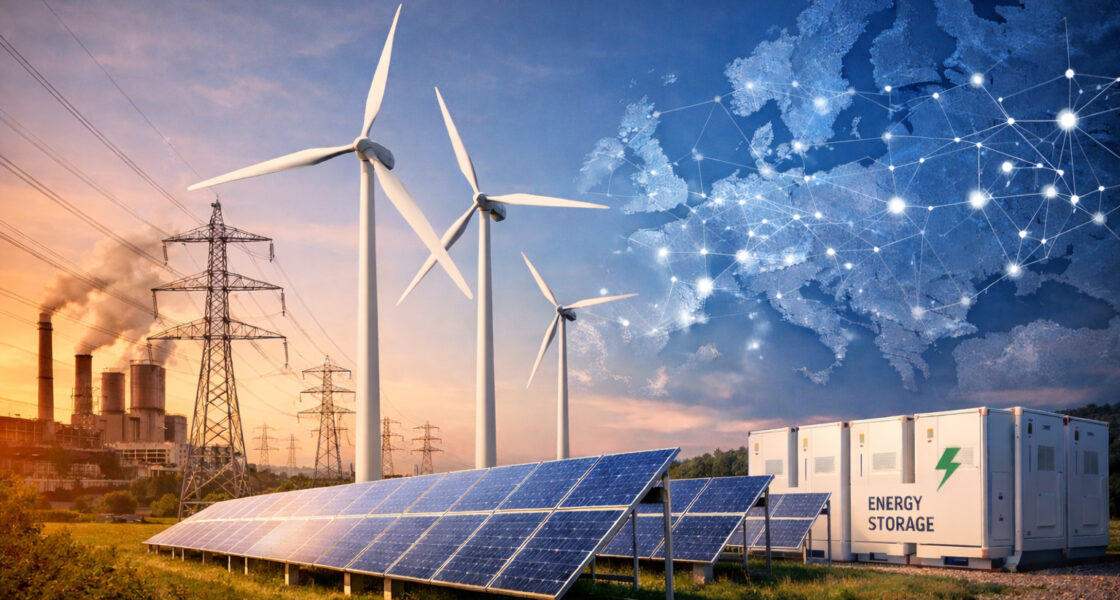
In recent years, wind and solar power have reached a combined share in the European Union’s electricity generation that exceeds fossil fuel–based generation on an annual basis. This development marks a structural change in how electrical energy is produced and managed across Europe.
For industrial companies, engineering teams, and procurement decision-makers, this shift is not primarily a political milestone. It directly affects grid behavior, power availability patterns, pricing volatility, grid connection requirements, and long-term infrastructure planning. Understanding the technical implications is increasingly relevant for both energy-intensive industries and manufacturers integrating electrical systems into their products or facilities.
Technical background: How wind and solar reshape the power system
Variable renewable generation
Wind and solar power belong to variable renewable energy (VRE) sources. Their output depends on weather conditions rather than on dispatchable fuel input. Unlike conventional thermal power plants, generation cannot be scheduled freely and must be integrated into the power system as it becomes available.
Key technical characteristics include:
- Non-dispatchable primary generation
- Forecast-based operation (day-ahead and intraday)
- Output variability on multiple time scales (minutes to seasons)
Residual load and system balancing
As wind and solar production increases, system operators focus on residual load. This is the remaining electricity demand after renewable generation has been accounted for. Residual load must be covered by:
- Flexible conventional generation
- Energy storage systems
- Demand response
- Cross-border electricity exchange
The balance between these elements defines system stability rather than total installed capacity alone.
Inverter-based resources
Most solar PV plants and modern wind turbines connect to the grid via power electronic converters. This changes grid dynamics compared to synchronous generators.
Relevant technical aspects include:
- Grid-following versus grid-forming inverter control
- Reactive power provision and voltage regulation
- Frequency support through control algorithms
- Reduced short-circuit contribution compared to rotating machines
These factors influence grid studies, protection design, and connection requirements.
Typical applications in industrial and B2B environments
Industrial electricity procurement
Industrial consumers increasingly interact with renewable generation through:
- On-site photovoltaic systems
- Off-site renewable power purchase agreements (PPAs)
- Electricity contracts indexed to wholesale market conditions
Each approach has different technical and operational implications, particularly regarding load matching and exposure to variability.
Electrification of processes
As renewable electricity availability increases, electrification of certain industrial processes becomes technically relevant, for example:
- Electric process heating at low and medium temperatures
- Electrified auxiliary systems (pumps, compressors, drives)
- Hybrid systems combining electrical and thermal energy sources
These applications often require careful load profiling and grid impact assessment.
Flexibility and storage solutions
To manage variability, industrial sites may deploy:
- Battery energy storage systems for peak management
- Load shifting strategies within production constraints
- Automated demand response interfaces
Such systems are typically designed to support operational stability rather than to replace grid supply.
Grid connection and compliance projects
New generation assets, storage systems, or large electrical loads commonly require:
- Load-flow and short-circuit studies
- Harmonics and power quality assessments
- Coordination with distribution or transmission system operators
These activities are increasingly standard in industrial project planning.
Engineering and design considerations
Grid capacity and congestion
In many regions, available grid capacity is a limiting factor. High renewable penetration can lead to:
- Local congestion
- Redispatch measures
- Curtailment of generation during constrained periods
Engineering decisions often need to account for grid reinforcement timelines and connection conditions.
Power quality and EMC aspects
Converter-dominated systems can influence:
- Harmonic distortion
- Voltage fluctuations
- Interaction with existing industrial loads
Mitigation measures may include filtering, reactive power control, or adapted transformer design, depending on system configuration.
Protection and fault behavior
Lower fault currents from inverter-based resources affect:
- Protection coordination
- Fault detection sensitivity
- Islanding behavior
These aspects are typically addressed during detailed electrical design and commissioning.
Operational flexibility versus efficiency
Design trade-offs often arise between:
- Optimizing for steady-state efficiency
- Maintaining sufficient ramping and response capability
- Minimizing cycling stress on equipment
The appropriate balance depends on application requirements and grid conditions.
Standards and regulatory context in the EU
Wind and solar integration is commonly discussed within the framework of EU-level and national regulations. In industrial practice, the following are often relevant:
- Renewable Energy Directive (RED III)
Defines EU-wide targets for renewable energy deployment and provides a planning framework, without prescribing specific technical solutions. - ENTSO-E network planning and adequacy assessments
Used by system operators and policymakers to evaluate long-term system reliability and flexibility needs. - Grid connection codes and national technical rules
Specify requirements for generation units and large consumers, including fault ride-through, reactive power capability, and control behavior. - Power quality and EMC standards
Standards such as EN 50160 and relevant IEC 61000 series documents are commonly referenced when assessing compatibility with public grids.
Applicability and enforcement depend on country, grid level, and project scope.
Conclusion: A structural change with practical implications
The fact that wind and solar generation have overtaken fossil fuels in the EU electricity mix reflects a fundamental transformation of the power system. For industrial stakeholders, the relevance lies less in headline figures and more in the resulting technical conditions: variability, inverter-dominated grids, evolving grid requirements, and a stronger emphasis on flexibility.
Engineering, procurement, and system design decisions increasingly need to account for these factors. A clear technical understanding supports realistic planning, compliant integration, and informed evaluation of future projects—without assuming uniform outcomes across regions or applications.