

Key Takeaways
- Modern EMS programs increasingly rely on integrated mechatronics engineering services, where mechanics, electronics, controls, and software are developed in parallel from concept through ramp-up.
- Disciplined DFM/DFA supports the transition from early concepts to reproducible precision components manufacturing and scalable precision parts production within defined tolerance, takt-time, and cost frameworks.
- Selecting the right partner requires comparing companies for mechatronics engineering based on system capabilities, verification methods, and test depth—not on machine lists alone.
- Search-intent terms and vendor names frequently appear in RFPs. These references are best used to clarify scope and expectations, rather than to pre-select suppliers.
- In Europe, buyers may refer to officina meccaniche (mechanical workshops). Alignment is improved by mapping workshop capabilities to full mechatronics integration and validation requirements.
Mechatronics in the EMS Context
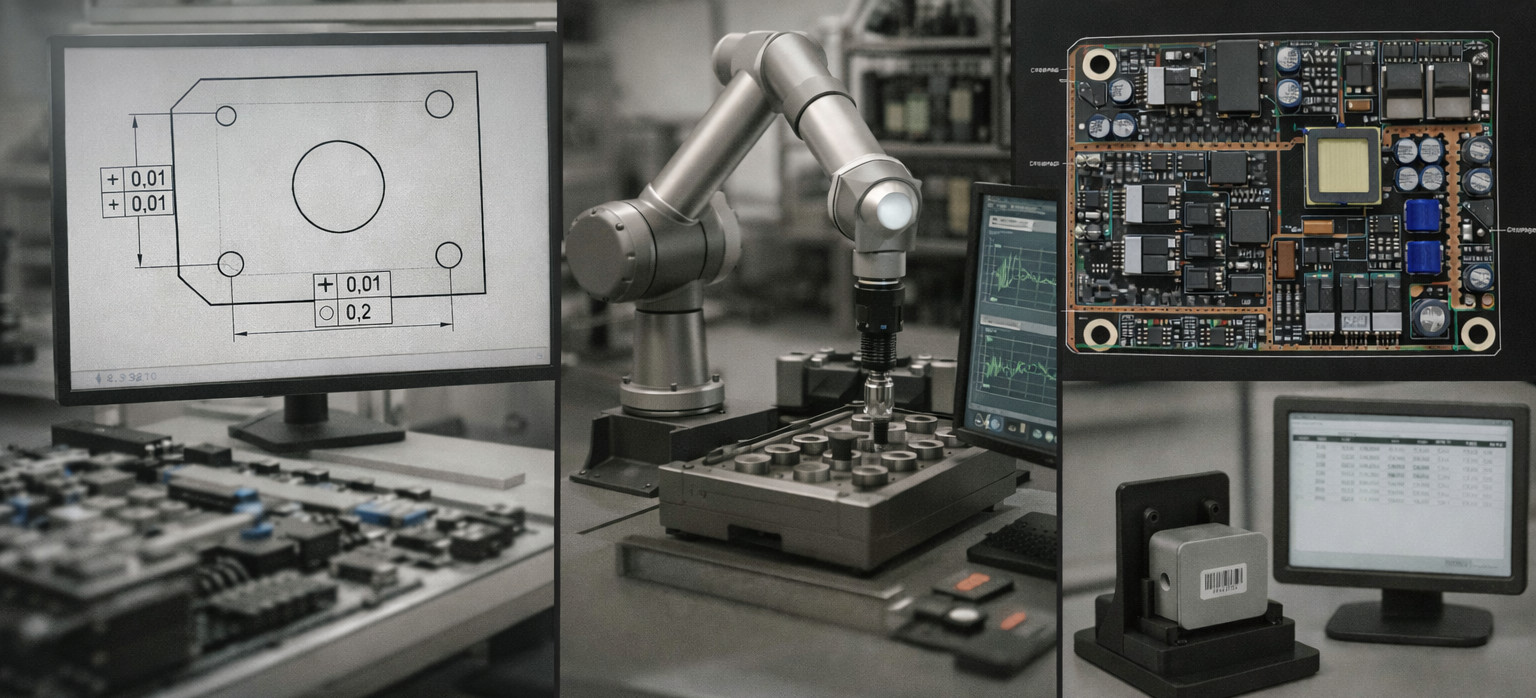
Mechatronics brings together mechanical design, electronics, control engineering, and embedded software to form functional systems. Typical applications include collaborative robots for assembly, AGVs operating in mixed traffic, and industrial instruments with integrated calibration or diagnostics.
Within an EMS environment, the focus lies on system integration and continuity. Development, verification, and production are connected through a consistent data flow, allowing feedback from testing and field operation to inform further iterations.
What “EMS Mechatronics” Delivers in Practice
Systems Engineering
- Structured requirements definition
- Interface and change management
- Safety and risk documentation at system level
Mechatronics Engineering Services
- Motor and sensor selection
- Drive tuning and embedded control development
- HIL (hardware-in-the-loop) testing and EOL (end-of-line) test design
Digital Thread
- Linked CAD/ECAD data, simulation models, and PLC/MCU code
- Integration of MES and QMS information
- Traceable build records supporting audits and series releases
From Prototype to Precision Parts Production
Production-ready prototypes anticipate later series requirements. Key activities typically include:
- Aligning tolerances with process capability considerations (e.g. Cp/Cpk)
- Stabilizing fixtures and torque paths
- Validating control loops under representative friction and backlash conditions
The objective is a repeatable and scalable production concept, rather than a one-off demonstrator.
Technical Focus Areas
Mechanical
- Tolerance stack-ups and datum strategies
- Surface finishes for sealing or optical functions
- Fatigue and lifetime considerations
Electronics
- EMC-aware layout practices
- Isolation concepts and safety-related interfaces
- Firmware update and diagnostic paths
Controls and Firmware
- Plant identification and controller design
- Observer concepts and fault handling
- Verification using HIL test benches
“How to Mechatronics”: A Practical 7-Step Approach
- Clarify requirements
KPIs, safety classification, duty cycles, regulatory scope - Define the architecture
Kinematics, actuation, sensing, computing platform, fieldbus - Execute co-design
Parallel development of mechanics, electronics, and controls using shared models - Simulate before fabrication
Dynamic, thermal, and EMC-related risks assessed early - Develop the control loop
Rapid prototyping and HIL testing to evaluate stability, latency, and noise - Industrialize
PFMEA, control plans, fixtures, traceability, and capability studies - Operate and refine
Telemetry, update strategies, and quality feedback from operation
Vendor Landscape: Workshops, EMS Providers, and Integrators
RFPs often reference peer companies or search terms such as “mechatronic solutions inc,” “mech tronics corp,” or regional officina meccaniche. These references should be treated as orientation points, not selection criteria.
A structured evaluation typically considers:
- Capability fit: kinematics, payload and speed ranges, materials, relevant compliance experience
- Verification depth: HIL/EOL testing, traceable metrology, EMC and safety pre-compliance
- Industrialization readiness: NPI approach, throughput planning, changeover concepts
Case Snapshot: From Mechanical Workshop to Integrated Mechatronics
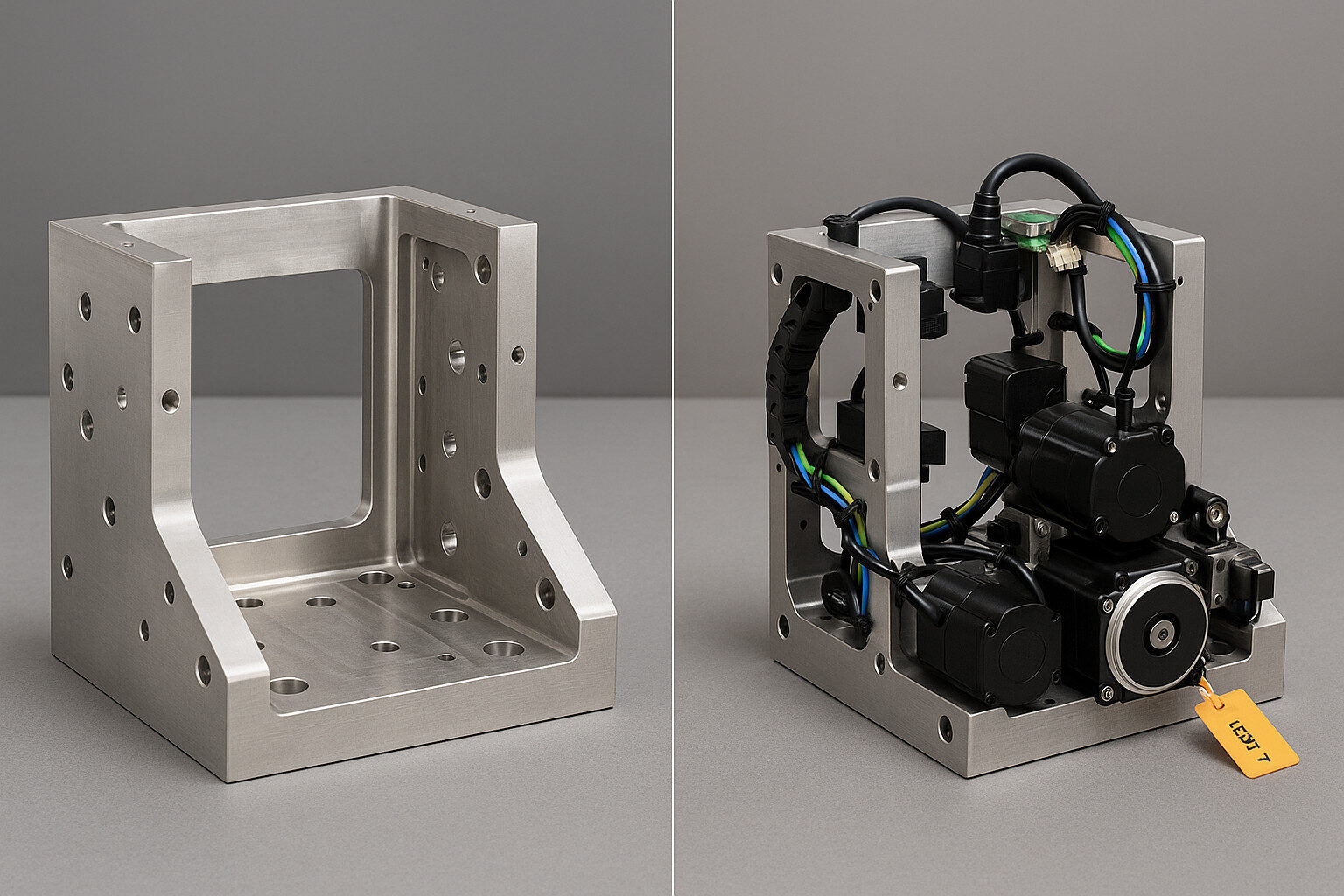
A European customer initially worked with an officina meccaniche for machining complex frame structures. By adding encoders, drives, firmware, safety I/O, and EOL testing, the setup evolved into an integrated mechatronics solution with verified control loops.
During ramp-up, the customer observed a shorter cycle time compared with the initial baseline, without requiring a fundamental redesign between prototype and production.
FAQ
Q1: How do mechatronics engineering services differ from a traditional machine shop?
Mechatronics engineering combines mechanics, electronics, controls, and software, supported by verification and traceability—an important factor for complex or regulated applications.
Q2: How can companies for mechatronics engineering be evaluated?
Typical criteria include system architecture documentation, control design artifacts, HIL/EOL evidence, and MES/QMS traceability, complemented by a focused capability pilot.
Q3: Is collaboration with named peer companies possible?
Yes. Multi-supplier projects often involve shared module development and coordinated verification planning.
Q4: How should “how to mechatronics” be interpreted in practice?
As a structured development mindset: clarify requirements, co-design, simulate, prototype and verify, industrialize, and monitor in operation.
Q5: What supports a smooth transition from prototype to precision components manufacturing?
Early stabilization of interfaces, datums, and bus protocols, combined with control-loop validation before production fixtures are finalized.
TPS Elektronik supports customers with end-to-end mechatronics engineering services—from concept and simulation through precision components manufacturing and series production. When comparing companies for mechatronics engineering, a structured capability pilot can help establish a transparent technical basis for decision-making.