

Introduction: Emerging Concepts in Hydrovoltaic Energy
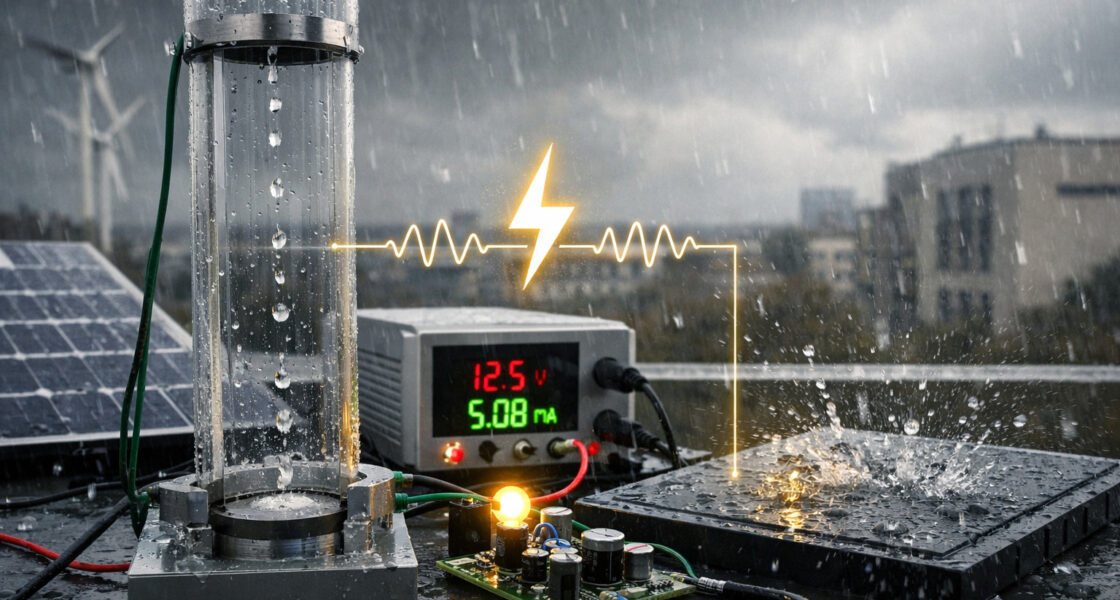
Recent laboratory research has demonstrated that electricity can be generated from falling water droplets without conventional turbines. The concept is based on electrostatic charge separation occurring when water interacts with solid surfaces.
Although still at an early research stage, rain-based electricity generation—often referred to as hydrovoltaic or triboelectric rain energy harvesting—has attracted attention as a potential complementary renewable energy source.
Technical Background: How Electricity Can Be Generated from Rain
1. Physical Principle: Contact Electrification (Triboelectric Effect)
The underlying mechanism is typically the triboelectric effect. This phenomenon occurs when two materials come into contact and then separate, resulting in charge transfer.
In rain-based systems:
- A water droplet falls onto or through a solid surface or channel.
- Charge redistribution occurs at the interface between water and the solid material.
- As the droplet moves away, a net electrical charge can remain.
- Electrodes capture this charge as an electrical current.
The process does not rely on rotating mechanical components. Instead, it uses surface interactions and electrostatic induction.
2. Flow Configuration and Charge Amplification
Some laboratory systems use vertical tubes or channels designed to create a defined “plug flow” regime. In this configuration:
- Droplets move in discrete segments rather than continuous flow.
- Charge separation can occur repeatedly along the flow path.
- Electrical output increases with optimized surface geometry and material selection.
The generated power levels in reported experiments are typically in the milliwatt range. These values depend on droplet size, flow rate, material properties, and electrode configuration.
3. Comparison with Conventional Hydropower
Conventional hydropower converts gravitational potential energy into mechanical rotation and then into electricity via a generator.
Rain-based electrostatic systems differ in several aspects:
- No turbine or rotating mass
- No requirement for large water volumes
- Output strongly dependent on surface interactions
- Typically suited to low-power applications
These characteristics position the technology differently from traditional hydroelectric plants.
Typical and Potential Applications
At the current stage of development, rain-based electricity generation is primarily relevant for small-scale and distributed applications.
1. Low-Power Electronics and Sensors
Possible use cases include:
- Environmental monitoring sensors
- Remote IoT nodes
- Structural health monitoring systems
- Distributed smart infrastructure components
Such systems often require only microwatt to milliwatt power levels and can operate intermittently.
2. Hybrid Renewable Surfaces
Research has explored integration of triboelectric layers into:
- Photovoltaic module surfaces
- Building façades
- Lightweight canopy structures
In this context, rain energy harvesting can support complementary generation during precipitation events, depending on system design.
3. Research and Material Development
From an engineering perspective, the technology is also relevant for:
- Surface functionalization research
- Advanced polymer and coating development
- Micro- and nano-structured electrode design
Industrial suppliers of specialty materials may monitor these developments for future component integration.
4) Design and Engineering Considerations
Engineers evaluating such systems should consider multiple technical factors.
1. Power Density and Scalability
Current prototypes generate relatively low power output. Scaling challenges include:
- Surface area requirements
- Material durability under outdoor exposure
- Electrical losses in collection circuits
- Variability of rainfall intensity
System feasibility depends on application-specific load profiles.
2. Environmental and Mechanical Durability
Rain-facing systems must address:
- UV exposure
- Temperature fluctuations
- Contamination and biofouling
- Mechanical impact from hail or debris
Material selection and protective coatings are therefore critical design parameters.
3. Electrical Integration
Integration into existing electrical systems requires:
- Voltage conditioning
- Rectification and storage (e.g., capacitors or batteries)
- Overvoltage protection
- Safe grounding concepts
Depending on application requirements, hybrid control electronics may be necessary.
4. Reliability and Maintenance
As with any distributed micro-generation concept, maintenance accessibility and long-term performance stability must be assessed. Field data for large-scale deployment are currently limited.
Standards and Regulatory Context
Rain-based triboelectric systems are not yet widely standardized. However, installations integrated into buildings or infrastructure would need to comply with:
- Low Voltage Directive (2014/35/EU), where applicable
- EMC Directive (2014/30/EU) for electronic components
- Construction product regulations if integrated into façades
- National grid connection rules for any grid-tied system
In most foreseeable scenarios, these systems would operate off-grid or in isolated low-voltage circuits.
Procurement teams should ensure that any pilot implementation aligns with applicable safety and electrical standards in the respective EU member state.
Conclusion
Electricity generation from falling rain represents an emerging research field within hydrovoltaic and triboelectric energy systems. The concept leverages surface charge effects rather than mechanical turbines.
At present, the technology appears primarily suited to low-power and distributed applications. Further material optimization, durability validation, and system integration studies are required before broader deployment becomes feasible.
For industrial stakeholders, the topic is relevant as part of the broader diversification of renewable and micro-generation technologies. Monitoring developments in materials science and power electronics can support informed long-term technical assessment.