
Key Takeaways
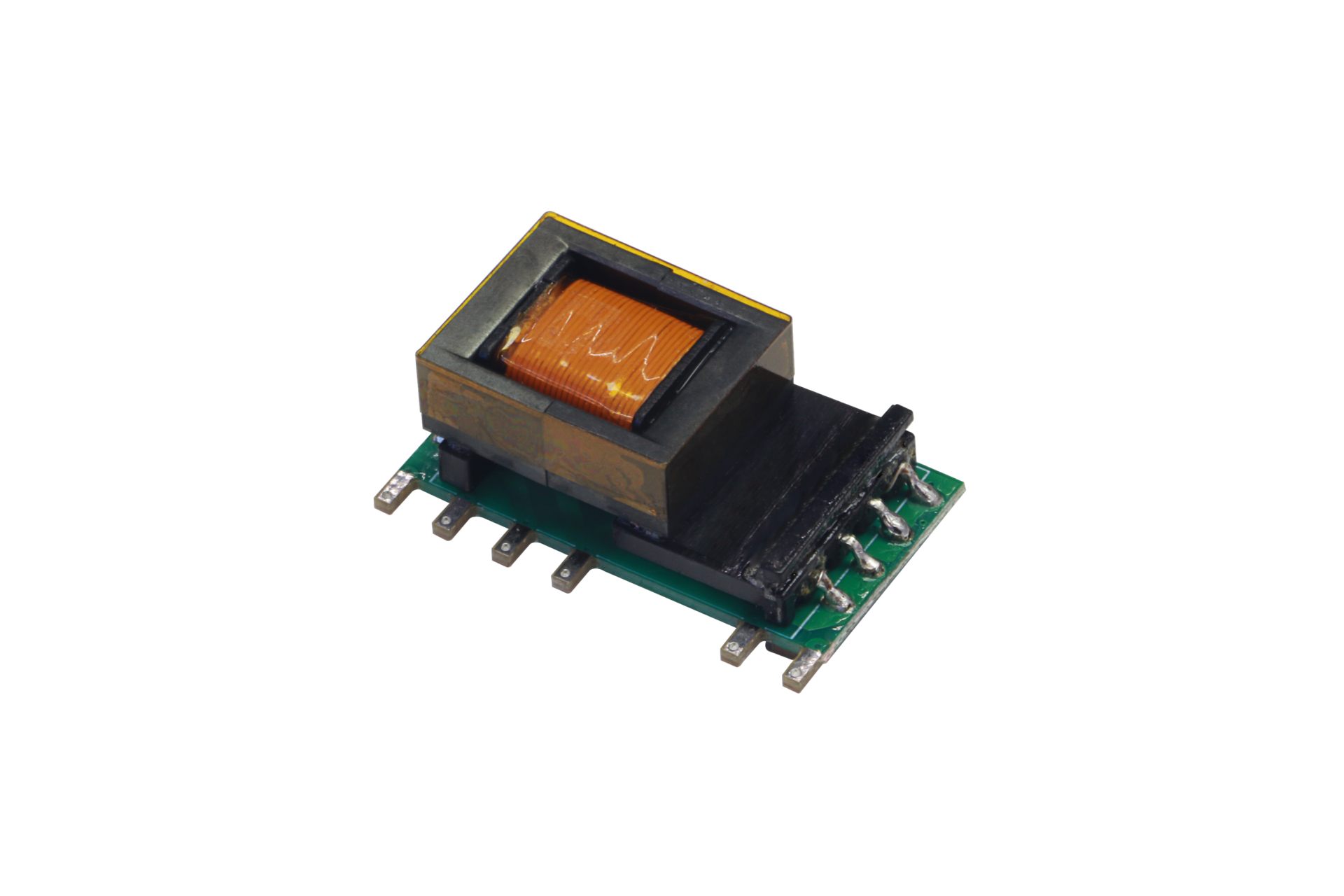
- ACDC Print Modules, exemplified by the TPS-AWS10/1523S Series, serve as high-performance ac dc converters that we specifically designed for direct PCB mounting in space-constrained Industry 4.0 applications such as dynamic labeling systems.
- These modules feature an ultra-wide input voltage range of 85-305 VAC or 100-430 VDC, making them universally compatible with global industrial mains and ensuring stable operation during grid fluctuations.
- With reinforced 4000 VAC isolation, an extended operating temperature range of -40°C to +85°C, and comprehensive short-circuit, overcurrent, and overvoltage protection, they guarantee reliable and safe power for sensitive industrial electronics.
- Their compact size (32.0 x 14.5 x 20.0mm), lightweight design (10.2g), and high efficiency (up to 84%) allow for natural cooling and easy integration into label controllers, RFID readers, and smart sensors.
- Compliant with IEC/UL62368-1 safety standards and capable of meeting EN55032 Class B EMC requirements with a simple external circuit, these ac dc power supply modules simplify the certification process for intelligent industrial equipment.
Imagine an automotive assembly line where every component carrier uses an electronic shelf label (ESL) that updates in real time as the vehicle progresses. Or consider a pharmaceutical packaging line where each batch relies on RFID readers powered reliably from a single AC source. In such Industry 4.0 scenarios, the unsung hero is often a tiny power module – the ACDC Print Module. Far from being a printer accessory, this ac dc module is a sophisticated power supply that converts mains voltage into clean, stable DC for powering intelligent devices on the factory floor.

1. What Are ACDC Print Modules? (And What They Are Not)
Despite the name, ACDC Print Modules have nothing to do with printers or printing mechanisms. The term “Print” refers to their suitability for printed circuit board (PCB) assembly – we designed them to wave-solder or reflow-solder like any other electronic component. As the TPS-AWS10/1523S Series datasheet shows, these modules are complete ac/dc converters in a miniature, encapsulated package, delivering isolated and regulated DC power directly to the circuits that drive various industrial devices on the factory floor.
In the context of Industry 4.0, devices such as electronic shelf labels (ESLs), e-paper displays showing production orders, smart RFID reader arrays, and indicator lights that change based on real-time data all require a reliable dc power supply – typically 3.3 V, 5 V, 12 V, or 24 V – derived from the AC mains available in the plant. ACDC Print Modules fill this role perfectly, combining the robustness of industrial power supplies with the tiny footprint needed for distributed intelligence.
2. The Growing Need for Distributed Power in Industry 4.0
Traditional manufacturing lines often used centralised power cabinets with long cable runs to field devices. However, with the advent of Industry 4.0, hundreds of smart endpoints are scattered along the line, each needing power. Daisy-chaining 24 V from a distant 24v power supply leads to voltage drop, noise pickup, and installation complexity. Consequently, a smarter approach is to place a tiny ac to dc converter right at the point of load – exactly what ACDC Print Modules offer. They accept the local AC mains (or a high-voltage DC bus) and produce the required low voltage with high efficiency and low ripple.
For example, a controller for dynamic labels mounted near a conveyor belt can incorporate an ACDC Print Module that takes 230 VAC and outputs 24 V for the display driver and wireless module, while another variant provides 5 V for sensors. This decentralised architecture reduces copper losses, simplifies cabling, and improves system reliability – a perfect fit for modular Industry 4.0 lines.
3. Technical Deep Dive: Key Features of ACDC Print Modules
To meet the stringent demands of industrial automation, ACDC Print Modules like the TPS-AWS10/1523S Series incorporate a host of features that go beyond standard ac dc power supply units. Let’s explore each of these characteristics in detail, verified against the datasheet.
3.1 Wide Input Voltage Range
Industrial environments are notorious for unstable mains: voltage sags, surges, and frequency variations are common. The TPS-AWS10/1523S Series features a universal input range of 85-305 VAC (47-63 Hz) and also accepts 100-430 VDC. This wide input voltage capability ensures uninterrupted operation even when the plant’s power grid fluctuates, making them ideal for global machinery that may operate in regions with 110 V or 230 V grids.
For instance, a packaging line built in Germany (230 V) might ship to the USA (120 V). With these modules, no hardware change is needed – they automatically adapt. This universality simplifies inventory for machine builders and end users alike.
3.2 High Isolation Voltage
Safety and noise immunity are paramount in industrial settings. The TPS-AWS10/1523S Series provides reinforced isolation of 4000 VAC between input and output. This high isolation protects low-voltage control circuits from dangerous transients and ground loops, and it serves as a prerequisite for meeting safety certifications like IEC/UL62368-1. Moreover, the isolation barrier reduces common-mode electromagnetic interference, helping the system pass EN55032 compliance without extensive filtering.
3.3 Extended Operating Temperature
Factory floors can be hot near ovens or freezing in unheated warehouses. These modules operate across a temperature range of -40°C to +85°C (with derating above 55°C for the 15W series and above 60°C for the 10W series, as per the datasheet). This wide range ensures that industrial electronics function reliably regardless of ambient extremes. For example, an outdoor logistics label exposed to direct sunlight in summer will still receive stable power from a module that tolerates 85°C case temperature.
3.4 Comprehensive Protections
Industrial applications demand resilience against faults. As the datasheet confirms, ACDC Print Modules integrate multiple protection layers:
- Short-Circuit Protection (SCP): You can short the output indefinitely without causing damage; the module features continuous, self-recovery.
- Overcurrent Protection (OCP): If the load exceeds the rated current (≥110% of rated load), the module protects the output to prevent overheating.
- Overvoltage Protection (OVP): While the datasheet table does not explicitly state this as a percentage, it recommends a TVS transistor (D1) in the application circuit to clamp the output to a safe level (1.2 times the output voltage), safeguarding sensitive electronics such as display modules.
These protections make the modules virtually indestructible under real-world fault conditions, a key advantage over discrete power designs.
3.5 Low Ripple and Noise
Industrial devices often incorporate wireless communication (Bluetooth, Wi-Fi, Zigbee) or high-resolution displays that are sensitive to power supply noise. The TPS-AWS10/1523S Series features low ripple noise – typically 80mV, with a maximum of 150mV (20MHz bandwidth, 10%-100% load). As a result, this clean power ensures error-free data transmission and stable operation.
3.6 High Efficiency and Natural Cooling
Efficiency is critical for two reasons: energy saving and thermal management. These modules achieve up to 84% efficiency at full load (e.g., TPS-AWS1523S24), meaning less heat dissipates inside the enclosure. High efficiency allows operation with natural cooling (free air convection) – no fan is needed, which eliminates moving parts and enhances reliability. Additionally, the low standby power (typically 0.10W at 230VAC) helps factories meet energy-saving regulations when equipment is idle.
3.7 Compact Size and Lightweight Construction
One of the most appealing aspects of ACDC Print Modules is their miniature footprint. The TPS-AWS10/1523S Series packages measure just 32.0 x 14.5 x 20.0 mm. This compact size and lightweight (typically 10.2 grams) allow engineers to place them directly on the main control PCB, saving space and eliminating the need for separate metal enclosures. They are true modular power supply units that blend into the background of industrial electronics.
3.8 Safety Certifications and Compliance
For industrial equipment sold worldwide, certifications are non-negotiable. The TPS-AWS10/1523S Series carries safety certifications in line with IEC/UL62368-1, IEC/EN60335-1, and IEC/EN61558-1, making it IEC compliant. Furthermore, with the recommended EMC circuit, it meets EN55032 Class B electromagnetic emissions requirements. This pre-certification path saves engineers months of compliance testing.
4. Industrial Applications for ACDC Print Modules
Based on their technical characteristics, these modules are well-suited for various Industry 4.0 scenarios, including dynamic labeling applications.
4.1 Electronic Shelf Labels (ESLs) for Warehouse Racks
In large distribution centers, ESLs attached to rack fronts display item codes, quantities, and pick-by-light instructions. Traditionally, ESLs run on batteries, requiring periodic battery changes. By using ACDC Print Modules (e.g., the TPS-AWS1523S05 for a 5V output) mounted behind each ESL, you can power the label directly from the AC lighting circuit running along the rack. The module’s 5V output powers the ESL and its wireless transceiver continuously, eliminating battery waste and maintenance.
4.2 RFID Reader Arrays on Conveyors
High-speed sortation systems use arrays of RFID readers to track parcels. Each reader needs a clean 12 V or 24 V supply. Instead of running long DC cables from a central dc power supplies cabinet, designers can integrate ACDC Print Modules like the TPS-AWS1023S24 (24V output) into each reader housing. The module’s overvoltage protection (via external TVS) ensures that a fault in one reader does not affect others, and the wide input range tolerates voltage drops along the AC line.
4.3 Industrial Human-Machine Interface (HMI) Displays
Some production lines use dynamic instruction displays that change based on the product being assembled. These displays are essentially small HMIs. An ACDC Print Module mounted behind the screen converts the local 230 VAC to 5 V for the display logic and backlight. Its low ripple noise guarantees flicker-free graphics, while the high isolation protects operators from electrical shock.
4.4 Smart Indicators with IO-Link
IO-Link devices are becoming ubiquitous in Industry 4.0. Many smart indicators (stack lights, status modules) use IO-Link for communication but still need a 24 V supply. By embedding an ACDC Print Module, you can power the indicator directly from AC mains, and the IO-Link data runs separately. This reduces cabling to just two wires for AC plus two for data.
5. Performance Parameters and Selection Guide
Choosing the right ac dc converter for an industrial application involves several considerations. Below is a detailed guide based on the TPS-AWS10/1523S Series.
5.1 Output Voltage and Current
ACDC Print Modules are available in standard outputs: 3.3 V, 5 V, 9 V, 12 V, 15 V, and 24 V. The TPS-AWS10 Series offers up to 10W, while the TPS-AWS15 Series offers up to 15W. For applications such as ESLs, the TPS-AWS1023S05 (5V @ 2000mA) is sufficient, while RFID readers might require the TPS-AWS1523S12 (12V @ 1250mA). Ensure the module provides stable output even during load transients (e.g., when a wireless module switches on).
5.2 Input Voltage Considerations
Check the nominal mains voltage in your facility: 120 VAC in the Americas, 230 VAC in Europe, or 100 VAC in Japan. With a universal input of 85-305 VAC, the TPS-AWS10/1523S Series is the safest choice for equipment that may relocate. It also accepts DC input, which can be useful if you have a DC bus (e.g., 110 VDC) in the plant.
5.3 Isolation Requirements
If your equipment communicates via exposed metal parts or operators touch it, you need reinforced isolation (4000 VAC) for safety. The high isolation of these modules simplifies compliance with Class II safety standards.
5.4 Operating Environment
Consider ambient temperature, humidity, and pollution degree. The extended operating temperature range of -40°C to +85°C ensures reliability near ovens or freezers. Note the derating curves in the datasheet: the 15W modules deliver full power up to 55°C, then linearly derate to lower power at 85°C.
5.5 Efficiency and Thermal Management
High efficiency (up to 84%) reduces heat buildup inside sealed enclosures. Modules with natural cooling (free air convection) are preferred because fans are unreliable in dusty industrial settings.
5.6 EMC Compliance
For industrial environments, both emissions and immunity are critical. The TPS-AWS10/1523S Series, with the recommended EMC circuit (including components like the 14D561 MOV and specific common-mode chokes), meets EN55032 Class B requirements.
6. Technological Innovations in ACDC Print Modules
The TPS-AWS10/1523S Series leverages advanced topologies to achieve its high efficiency and tiny size. The datasheet highlights the need for specific external components like a Pi-type filter (C2, L1, C4) using solid-state capacitors for high-frequency, low-resistance performance. This level of design guidance allows engineers to tailor the module’s performance to their specific application.
7. Comparison with Conventional Power Solutions
Why choose an ACDC Print Module over a traditional enclosed power supply supplies or an external adapter dc ac brick?
- Space: Enclosed power supplies are bulky; ACDC Print Modules fit on a PCB.
- Cost: For distributed systems, one large central supply plus cabling is often more expensive than multiple small modules.
- Reliability: Eliminating low-voltage distribution improves reliability (no voltage drops, fewer connectors).
- Time-to-market: Modules with a clear path to certification (like IEC/UL62368-1 and EN55032) speed up product development.
8. Installation and Thermal Considerations
Mounting ACDC Print Modules is straightforward: they are through-hole devices that standard wave-soldering processes can handle (260±5℃ for 5-10s). The datasheet provides a recommended PCB layout and pin functions. Because they dissipate some heat, proper PCB layout is important. Ensure adequate copper area around the module’s pins for heat sinking. Natural cooling is sufficient, but pay attention to the derating curves if the ambient temperature near the module exceeds 55°C-60°C.
9. Real-World Case Study: Automotive Parts Labeling
A major automotive supplier implemented dynamic labels on their engine assembly line to display torque values and part numbers in real time. Previously, they used paper labels that required manual updates. The new system uses e-paper displays (5 V, 500 mA each) mounted at each workstation. To avoid running 5 V DC from a central ac to dc converter, they installed ACDC Print Modules (TPS-AWS1023S05, 5V / 10W) behind each display, powered from the existing 230 V lighting circuit. As a result, installation time dropped by 60%, and the system is immune to voltage drops. The modules’ short-circuit protection prevented any damage when a technician accidentally shorted a display cable, and the self-recovery feature got the line back up instantly.
10. Future Trends: ACDC Print Modules and Industry 4.0
As factories become more connected, the demand for modular power supply units with built-in intelligence will grow. We foresee modules like the TPS-AWS series integrating functions like:
- Energy monitoring (telemetry of voltage, current, power) for predictive maintenance.
- Further miniaturization using embedded passives.
- Higher input voltages to interface with DC microgrids (e.g., 380 VDC).
The trend is clear: the power supply is becoming an integral part of the intelligent sensor network, not just a dumb brick.
11. Frequently Asked Questions (FAQ)
Q: Can these modules work with both 50 Hz and 60 Hz mains?
A: Yes, they are designed for 47-63 Hz, covering both.
Q: Do I need an external fuse?
A: Yes, the datasheet specifies a 1A, slow-blow fuse that you must install for safety and protection.
Q: What is the minimum load required?
A: The datasheet specifies a minimum load of 0%. Operation below 5% load may cause the ripple to exceed specifications, but it does not affect reliability.
Q: Are these modules suitable for outdoor use?
A: If you house them in an IP67 enclosure, yes. The module itself is not waterproof, but its wide temperature range allows outdoor operation when protected from moisture.

12. Conclusion
ACDC Print Modules, such as the TPS-AWS10/1523S Series, represent a paradigm shift in how we deliver power to distributed devices on Industry 4.0 lines. By combining the functionality of a robust ac dc power supply with the compactness of a through-hole component, they enable truly distributed, intelligent, and flexible factory automation. With features like wide input voltage, high isolation, comprehensive protections, and a clear path to global safety certifications, they remove the traditional barriers to powering smart industrial endpoints.
As you plan your next generation of industrial equipment, consider integrating ACDC Print Modules. They simplify design, enhance reliability, and future-proof your products for the ever-evolving world of Industry 4.0. Whether you need an ac supplies solution for a simple indicator or a sophisticated electrical converter ac to dc for an RFID array, these modules offer the performance and peace of mind that modern factories demand.
For more information, datasheets, and evaluation boards, visit our product page or contact our engineering team. Together, we can illuminate the path to smarter, more efficient production lines.